
Tinted Window Cleaning: Safe Cleaners, Tools and Steps
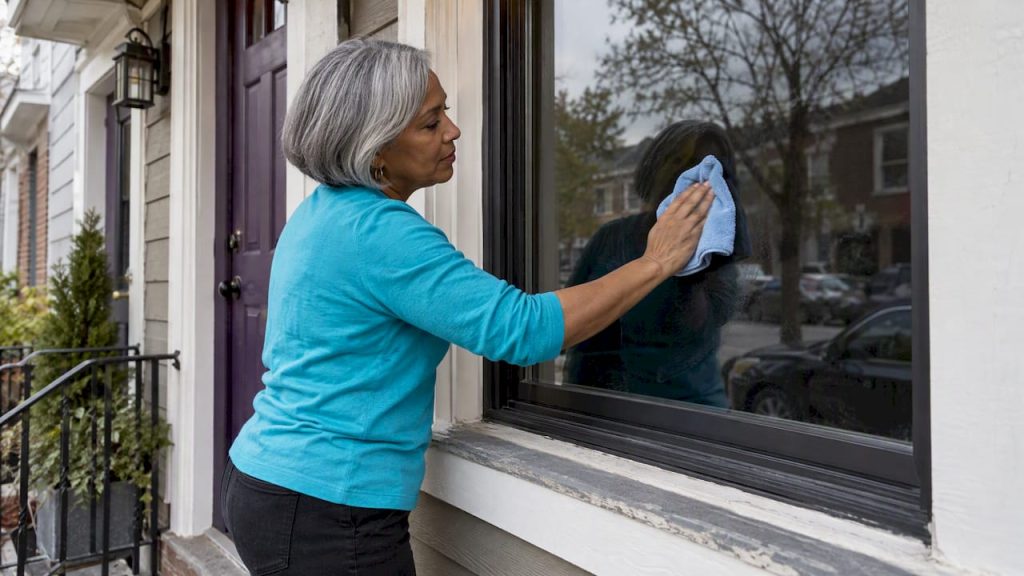
Tinted windows can be cleaned safely and often, as long as you use an ammonia-free cleaner, soft lint-free cloths and no abrasive tools. The tint is usually a thin film applied to the glass, or a coating built into it, and the film is what needs protecting. Wait until new film has cured, keep the pressure light, and finish with a clean microfiber towel or a rubber squeegee.
This guide is written for homeowners, landlords, property managers and business owners with tinted or filmed glass. It covers cure times, cleaners, step-by-step technique, stubborn spots and when it makes sense to hand the job to a professional.
TL;DR
- Wait before the first wash: manufacturers say anywhere from 48 hours to about a week after installation, and full curing can take longer in cool, damp climates.
- Use an ammonia-free cleaner or a few drops of mild dish soap in water, applied with a soft sponge or microfiber cloth.
- Never use bristle brushes, razor blades, scouring pads or harsh solvents on film, and follow the film maker’s own instructions where they differ from general advice.
- Use separate cloths for the inside and the outside, and stop wiping while a thin film of moisture remains so it evaporates evenly.
- Large, high or heavily stained tinted windows are a good fit for a professional who knows what to ask about the film.
Table of Contents
- What “tinted windows” actually means
- How long to wait before cleaning new tint
- Safe cleaners for tinted windows
- What to keep away from tinted glass
- Step-by-step: cleaning tinted windows without streaks
- Removing stubborn spots without damaging the film
- Special cases
- Our perspective
- When to hire a professional
- Get tinted windows cleaned by a local family team
- FAQ
- Sources
What “tinted windows” actually means
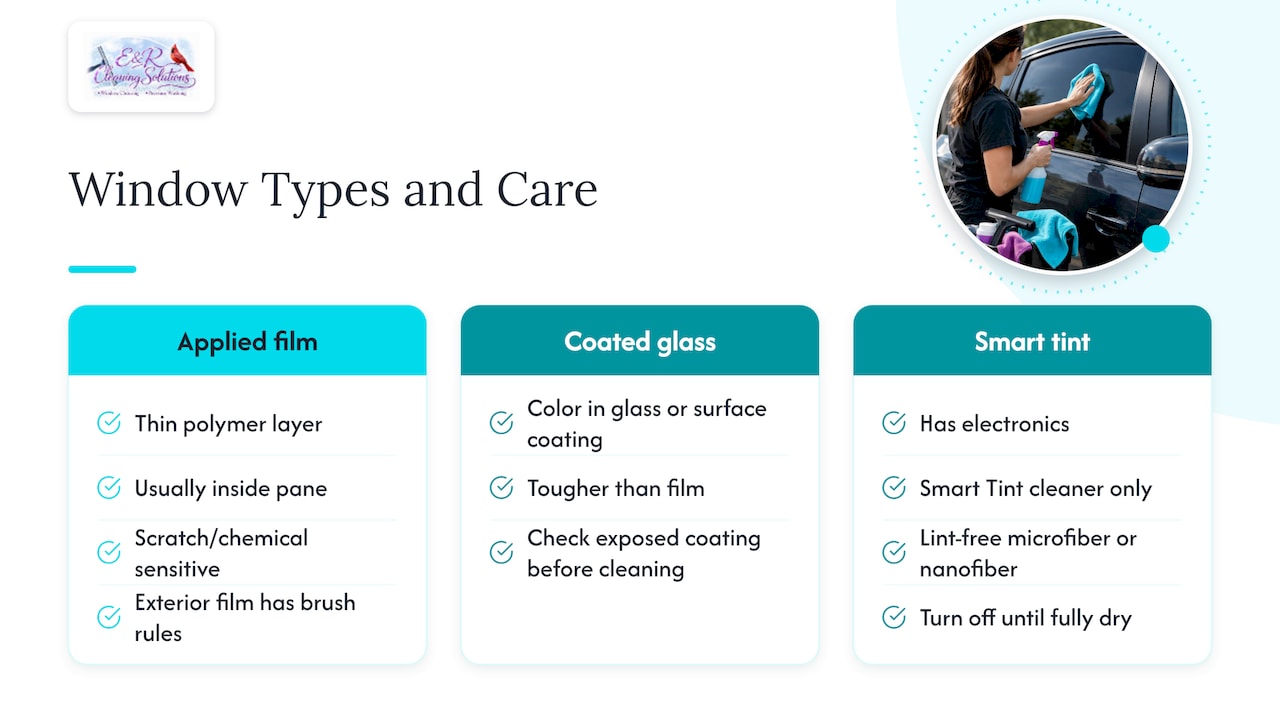
People use the phrase for three different things, and the right cleaning approach depends on which one you have.
Applied window film. A thin polymer layer is bonded to the glass, usually on the inside of the pane in homes and offices. It is the most common type and the most sensitive to scratches and harsh chemicals. Some film is also applied to the exterior, which raises its own rules about brushes and cloths.
Tinted or coated glass. The color is in the glass itself, or a reflective or low-emissivity coating sits on one surface. The glass is tougher than film, but coated surfaces still need care. Pilkington’s guidance is to work out whether coated surfaces are exposed before cleaning, and to take special care on those (PGI glass care guide).
Switchable or smart tint. These have electronics. Smart Tint, for example, tells owners to use only its own cleaner with a lint-free microfiber or nanofiber cloth, and to turn the film off while cleaning and leave it off until the glass is completely dry (Smart Tint care guide). If you have this type, the manufacturer’s sheet outranks anything general you read, including here.
Not sure which you have? Look for the installer’s care card, the original invoice, or a warranty document. Those papers name the film and usually the approved cleaning method. Keep them where the next person who cleans the windows can find them.
How long to wait before cleaning new tint
Fresh film needs time to bond. Cleaning too early can shift edges or trap moisture.
The advice varies by maker, so check yours:
- 3M says not to open or close the windows, or clean them, for at least 48 hours after installation so the tint can adhere properly (3M product care).
- Glass Tint USA advises waiting a week and letting the film fully cure first (Glass Tint USA care instructions).
- Prestige Films notes that drying can take a couple of days or a couple of months, depending on the film and the climate (Prestige Films FAQ).
During that time you may see a hazy, streaky or blotchy look. That is moisture between the film and the glass. Glass Tint USA says it should evaporate and leave excellent clarity (Glass Tint USA). Do not try to wipe it away. Wiping the outside of the pane does nothing for moisture trapped under the film, and pressing on the surface risks lifting an edge.
A practical rule: if the film went on this month and the weather is cold or humid, call the installer before you clean. They know their product’s curing window.
Safe cleaners for tinted windows
The short list is simple. You want something gentle, ammonia-free and free of abrasives.
| Option | Notes |
|---|---|
| Ammonia-free glass cleaner | The baseline advice for film. Glass Tint USA says to use an ammonia-free window cleaner on tinted windows (source). |
| Mild dish soap in water | Pilkington’s technical bulletin lists dishwashing liquids such as Joy, Ivory or Dawn in low concentrations, 10 to 15 drops per 3 to 4 gallons of water (Pilkington bulletin). |
| Clear vinegar solution | The same bulletin lists one part clear vinegar to one to ten parts clean water as a routine cleaner for tinted glass. Check your film maker first. |
| Manufacturer’s own cleaner | Required for smart tint and often the safest choice for specialty film. |
The Pilkington bulletin also names commercial products such as Sparkle Glass Cleaner, Windex Advanced Glass & Multi-Surface, Hi-SHEEN and Windex Multi-Surface Vinegar Cleaner for routine cleaning of tinted glass (Pilkington bulletin). That guidance is about glass. Film makers can be stricter, which brings us to the question everyone asks.
Can you use Windex on tinted windows?
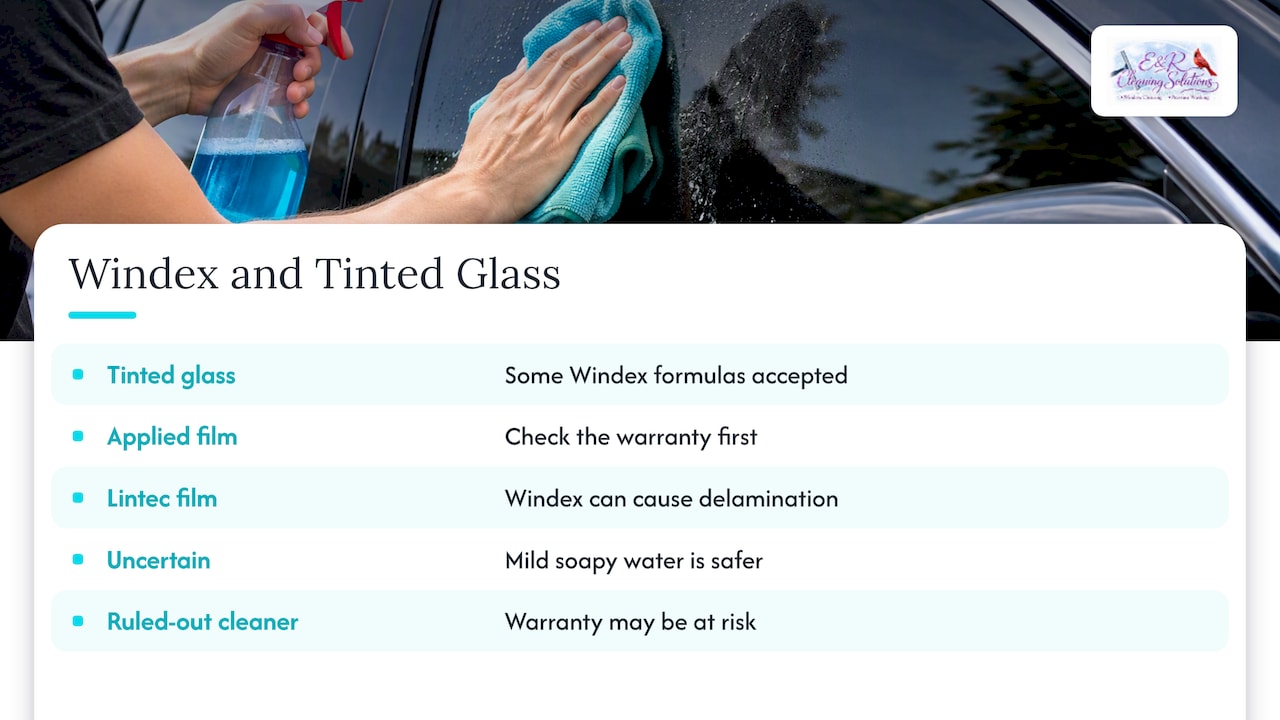
It depends on what is on your glass. For tinted glass itself, the glass maker lists certain Windex formulas as acceptable. For applied film, read the warranty. Lintec, for one, says never to use harsh chemicals or cleaning agents such as Windex on its film, because chemicals in many harsh cleaners can attack the film-edge adhesive and cause delamination (Lintec warranty). Using a cleaner your film maker rules out can also put your warranty at risk. When in doubt, mild soapy water is the safer default.
What to keep away from tinted glass
- Ammonia. It is the most repeated warning on film care sheets, including Glass Tint USA’s.
- Harsh cleaning products. XPEL’s care guide says to avoid them and, for exterior window films, not to use bristle brushes or aggressive cloths (XPEL care and maintenance).
- Razor blades and scrapers. They are common on bare glass and risky on film, because a blade can score the surface or catch an edge. Never run one over film.
- Scouring pads and dry rubbing. Grit dragged across a dry surface is what causes the fine scratches you notice later in raking light.
- Shared dirty cloths. Solar Gard stresses using separate cleaning materials for interior and exterior windows so dirt or abrasives do not cross over (Solar Gard care instructions).
- Pressure washers aimed at the glass. Edges are where film lifts first. Keep high-pressure water away from the window and rinse gently.
Step-by-step: cleaning tinted windows without streaks
This method follows the manufacturers’ guidance cited above.
- Gather clean tools. You need a bucket, a soft sponge or cloth, a rubber squeegee or a soft microfiber drying towel, and your approved cleaner. 3M recommends a soft sponge or cloth for cleaning and a soft microfiber towel for drying (3M). Our guide to window cleaning tools that give streak-free results covers what each tool does.
- Start with the frames and sills. Dirt from the frame ends up on the glass if you clean it last. Our four-step window frame cleaning guide walks through it.
- Remove loose dust first. A light rinse or a soft dry cloth lifts grit before you touch the film with a wet cloth.
- Wet the whole surface. Pilkington’s instruction is to thoroughly wet the surface with cleaning solution, rub with a clean, lint-free towel or cloth, then wipe dry with a clean lint-free towel or squeegee (Pilkington bulletin).
- Use light, even strokes. Do not scrub. Let the solution do the work.
- Stop while it is slightly damp. The same bulletin says to stop wiping when a uniform thin film of moisture remains, and let it evaporate naturally. Chasing every last drop with a cloth is what leaves swirls.
- Use a separate cloth on the other side. Inside and outside get their own towels.
- Check in angled light. Streaks and film residue show up when the sun hits the glass from the side.
Pilkington’s care sheet also says to clean glass when dirt and residue appear, rather than waiting until buildup is heavy (PGI glass care guide). Regular light cleaning is easier on both glass and film than a rare hard scrub. If you are deciding on a rhythm, our window cleaning frequency guide helps you pick one.
Removing stubborn spots without damaging the film
Hard water marks, sap, paint flecks and mildew are where most tinted-window damage happens, because people reach for something stronger.
Start with the gentlest option and work up:
- Soak the spot with soapy water or your approved cleaner and give it a minute. Wipe with a soft cloth.
- For mineral deposits, a diluted vinegar solution within your film maker’s limits can help on glass. Test a small corner first.
- For sap, use a method designed not to scratch. We cover it in removing sap from windows without scratching.
- For mildew on frames and seals, see our guide to cleaning mildew on window frames, so it does not spread onto the glass.
Pilkington describes listed spot cleaners for stubborn dirt on glass, including solvents and a one-time gentle hand application of very fine abrasives (Pilkington bulletin). That applies to glass, not to applied film. On film, solvents and abrasives are exactly what the care sheets warn against. If a spot survives soapy water, stop and get advice instead of escalating.
Hard water is a special case, because mineral spotting builds up over seasons. How it forms and why it clings is explained in how hard water stains form on rental surfaces. Sprinklers aimed at windows are a frequent cause, so it is worth redirecting them. Deionized water leaves nothing behind as it dries, and our piece on deionized water window cleaning explains when it pays off.
Special cases
Exterior film and high windows
Exterior film is more exposed to grit, so the no-bristle, no-aggressive-cloth rule matters most. Second-story and high windows add a safety problem: reaching them with a ladder while holding wet tools is how people get hurt. Our note on second-story window cleaning explains how to approach them from the ground first.
Screens
Screens trap pollen and dust that wash straight onto the glass. Cleaning them first keeps the glass clean longer. See screen cleaning’s role in window care.
Cold weather
Water on cold glass can freeze mid-wipe, and ice on film is a recipe for scratches. Our 32°F rule for winter window cleaning explains where to draw the line between DIY and calling a pro.
Commercial storefronts and office buildings
Storefronts and offices often have film for glare, heat or privacy. Property managers should confirm what film is on each elevation before a bid is accepted, and make sure the cleaning scope notes it. Our guides to commercial window cleaning for property managers and to line items to demand in office window cleaning bids show how to write that into a contract.
Our perspective
We clean a lot of glass, and the pattern is always the same: the damage on tinted windows rarely comes from dirt. It comes from the wrong tool used with good intentions, a blade on a stubborn spot, a paper towel dragged across grit, or a cleaner that was fine on the kitchen window and wrong for the film.
That is why we start every job by looking at what is on the glass and who has to be told about it. We are a family-run, locally owned business with more than five years in window cleaning and pressure washing, and we price honestly. If you tell us your windows are tinted, we plan the job around that, from cloths to cleaner to how we handle frames and screens.
Our advice: do the light, regular cleaning yourself if you enjoy it, using the steps above. Hand us the big, high, stained or commercial glass, where a slip costs more than a visit.
Richard
When to hire a professional
DIY is reasonable for a few low windows in good condition. Consider a pro when:
- you have many panes, or large storefront glass;
- windows are on a second story or higher;
- hard water spotting has built up over several seasons;
- you manage rentals and need a consistent, repeatable result across units;
- the film is under warranty and you want the job done by someone who will follow the care sheet.
When you call anyone, ask three questions: what do you use on film, what do you do on spots that do not come off, and who is responsible if the film is damaged. Our guide to the residential window cleaning process shows what a careful visit looks like from start to finish.
Get tinted windows cleaned by a local family team
We clean windows inside and out, including screens, frames and hard water stain removal, for homes and commercial properties. We also do pressure washing for driveways, walkways, siding and more, so your exterior can be done in one visit. Pricing is custom and quoted per project, with flexible scheduling for one-time or recurring work. Tell us about the tint when you request a quote, and send the care sheet if you have it.

Request a quote for window cleaning or pressure washing
FAQ
Can tinted windows be cleaned?
Yes. Tinted glass and film are cleaned regularly with soft cloths and gentle, ammonia-free products. The caution is about technique: no abrasives, no bristle brushes and no harsh chemicals. Wait until new film has cured before the first wash.
What is the safest cleaner for tinted windows?
An ammonia-free glass cleaner or a few drops of mild dish soap in water is the usual safe choice. Pilkington’s bulletin gives 10 to 15 drops of dish detergent per 3 to 4 gallons of water for glass (Pilkington). If the film has a warranty sheet, follow its list over any general advice.
What should you never use on tinted windows?
Avoid ammonia, harsh chemicals, razor blades, scouring pads and bristle brushes. For exterior film, XPEL specifically warns against bristle brushes and aggressive cloths (XPEL). Paper towels can also leave lint and drag grit, so a microfiber towel is the better choice.
How do I avoid streaks on tinted windows?
Use a clean cloth or squeegee, wet the whole pane, and wipe in light, even strokes. Stop when a thin film of moisture remains and let it evaporate, as Pilkington advises. Keep separate cloths for inside and outside so dirt does not transfer.
Sources
- Window Tint Care Instructions & Advice, Glass Tint USA
- How To Protect Your Vehicle after Tinting, 3M
- FAQ, Prestige Films
- Technical Bulletin: Manual washing of clear and tinted glass, Pilkington
- Glass Care, Precision Glass Industries
- Cleaning and Maintenance, Smart Tint
- Commercial Care & Maintenance, XPEL
- Warranty, Lintec of America
- How to Clean Tinted Windows, Solar Gard