
Deionized Water Window Cleaning: How It Works and When It Pays Off
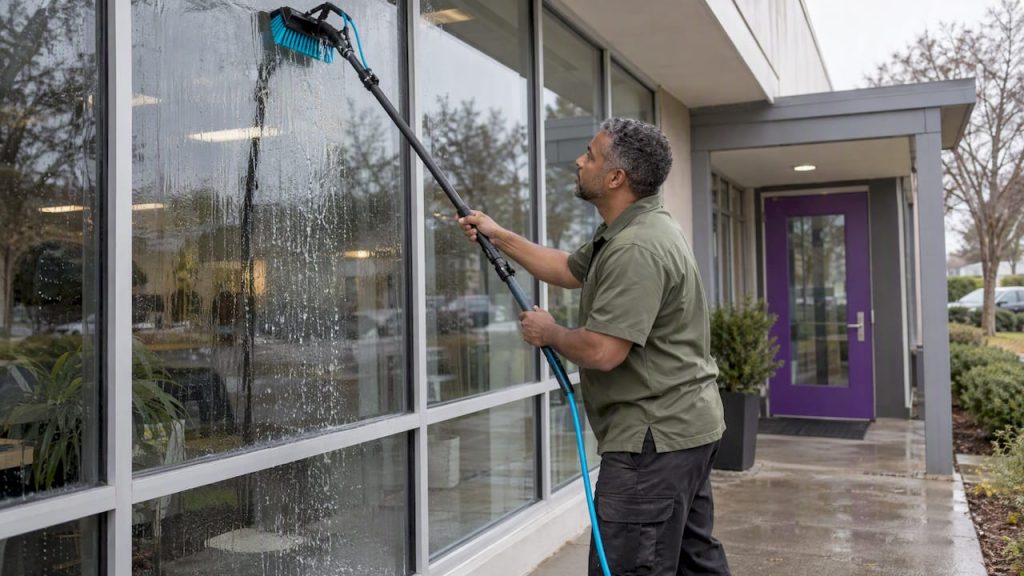
Deionized (DI) water cleans windows without spots because it has had its dissolved minerals removed, so nothing is left on the glass when the water dries. In practice, pros pair it with a water-fed pole and a soft brush, rinse the pane, and let it air-dry. The method is real and it works, but the results depend on water purity, equipment and technique. This guide explains how it works, what “purified,” “pure” and “deionized” mean, and how to decide between doing it yourself and hiring a crew.
TL;DR
- Deionized water is tap water run through ion-exchange resin so its dissolved minerals are removed. It dries without leaving spots or streaks.
- “Pure water,” “purified water” and “DI water” are used loosely in window cleaning. What counts is the TDS reading (total dissolved solids) of the water at the brush.
- The water does the rinsing and drying work. Frames, heavy dirt, detergent residue and old mineral stains still need proper prep or other tools.
- Your incoming tap water decides how fast DI resin is used up, which decides your cost per window.
- If you would rather not buy gear or manage resin, a local pro can handle the job. We do windows and pressure washing for homes and businesses.
Table of Contents
- What pure water window cleaning actually is
- Why DI water leaves glass spot-free
- How to clean windows with deionized water, step by step
- What you need: equipment and water purity
- What pros use besides pure water
- Pure water, squeegee, or both?
- DIY or hire a pro?
- Our perspective
- Let us handle the windows
- Buying DI water or resin: what to check
- FAQ
- Sources
What pure water window cleaning actually is
Pure water window cleaning uses tap water that has been stripped of naturally occurring minerals and impurities, leaving water with a very low TDS. The cleaner applies it with a brush on a pole, rinses, and walks away. No squeegee, no towel, no ladder.
Two purification methods produce that water:
- Reverse osmosis (RO) forces water through a membrane that holds back most impurities.
- Deionization (DI) passes water through ion-exchange resin.
The same Unger source describes both methods and their differences. Many professional rigs combine them: RO first to take out the bulk of the solids, then a DI stage to polish the water down to zero.
Deionized, purified, distilled: are they the same?
Not exactly. “Purified water” is a catch-all for water that has been treated by any method. Distilled water is boiled and condensed. Deionized water is ion-exchanged. For window cleaning, the label matters less than the reading. A handheld TDS meter tells you what you are really putting on the glass.
A point worth knowing: one supplier notes that purified water has no more cleaning power than tap water. Its benefit on glass is that it prevents spotting as it dries. That is exactly why it is useful, and also why it works best on windows that are already reasonably clean or are cleaned with the right technique.
Why DI water leaves glass spot-free
Tap water carries dissolved calcium, magnesium and other minerals. When a droplet dries on glass, the water leaves and the minerals stay behind as a spot. Pure water has none to leave. According to Unger, when pure water evaporates, it leaves no residue because the minerals that cause spots and streaks have been removed.
There is a second effect. Water with no dissolved solids is described as “hungry” water that attracts and absorbs dirt, dust and pollen. Unger describes the same idea: pure water seeks out particles such as dirt and dust, and rinsing carries them away, leaving a spot-free surface.
The condition: the water has to be truly at or near zero. One supplier says windows can air-dry spot-free when the water is at 0 TDS. Unger notes that pure water can be used up to 10 ppm, but it is advisable to change the resin when the reading hits that level.
How to clean windows with deionized water, step by step
Here is the sequence Unger lays out for pure-water cleaning, with some practical detail added.
- Clean the frames first. Dirty frames drip onto clean glass. Doing them first means the final rinse carries that runoff away.
- Remove coarse dirt from the glass. Heavy debris, bird droppings and cobwebs should come off before the brushing starts.
- Scrub with a clean brush, top to bottom. Unger describes working in slight V-movements with a water-fed pole and clean brush.
- Rinse until a continuous film covers the pane. The water should sheet across the glass instead of beading.
- Let it dry naturally. Do not wipe. Wiping with a towel can reintroduce lint or residue.
Why the first cleaning sometimes looks worse
Glass that has been cleaned for years with detergent or glass spray may hold a surfactant film. The same Unger guide says surfaces previously cleaned with detergents may need two to three pure-water cleaning cycles to remove that residue. If your first attempt looks hazy, that is a likely cause, not proof the method failed.
Can you use it indoors and on storefronts?
Yes, with the right setup. Pure-water cleaning suits large window facades and was first used for photovoltaic systems. Outdoors, a pole and hose make short work of it. Indoors, there is no hose run-off to manage, so many cleaners prefer a bucket of pure water, a cloth and a squeegee or towel. Protect floors, sills and electronics from drips, and keep storefront sidewalks safe while you work.
What you need: equipment and water purity
Professional pure-water cleaning uses water-fed poles and brushes with an RO or DI purification system. Here is how the pieces fit together.
| Component | What it does |
|---|---|
| Water-fed pole | Carries purified water to the brush so the cleaner can work from the ground |
| Soft-bristle brush | Loosens dirt while rinse water flows through it |
| Pre-filters (sediment, carbon) | Protect the RO membrane and resin from chlorine and particles |
| RO unit (optional) | Removes most dissolved solids before the DI stage |
| DI resin tank | Polishes water to near 0 TDS |
| TDS meter | Shows when the resin is spent |
The pole matters for more than convenience. A trade publication has noted that water-fed poles changed window cleaning by letting workers stay on the ground while servicing many three-to-five-story buildings more safely.
DI only, or RO plus DI?
This comes down to your tap water. According to Unger, DI-only systems can work for soft-to-medium water (under 100 up to 250 TDS). For higher TDS, RO or Nano systems may be better, because DI resin is used up more quickly.
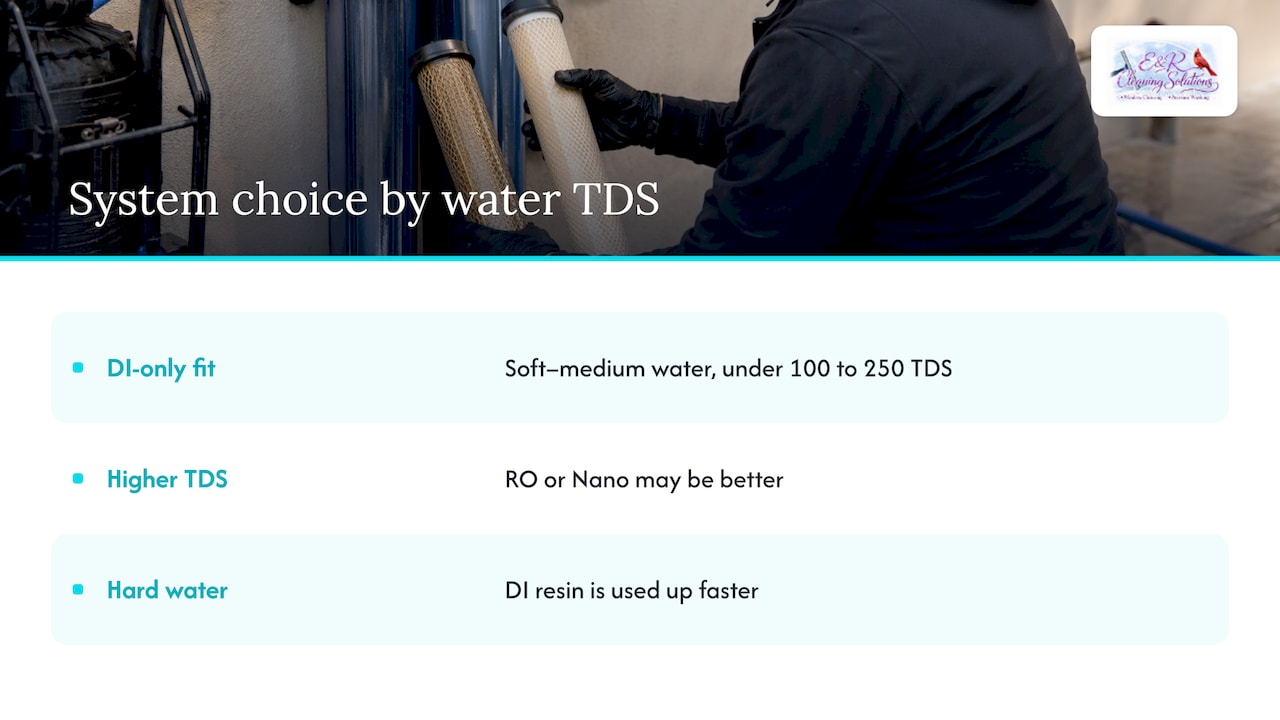
The resin does the work through ion exchange. It swaps ions such as calcium or magnesium for others, and it has to be replaced once it is saturated. That is the main running cost of a DI-only setup. Run it on hard water and you will be changing resin often.
Know your incoming water
Before buying anything, test your tap. A cheap TDS meter gives you a number in seconds. If the reading is high, the comparison between a water filter and a softener is worth understanding, since they treat water differently and neither one produces window-grade water on its own. This water filter versus softener breakdown covers what each does to household water. Pure-water window cleaning needs a dedicated purification stage after any of that.
What pros use besides pure water
Pure water is one tool in a kit. A trade handbook from IPC lists pure-water systems with RO and deionization, water-fed poles and brushes, along with squeegees, microfiber cloths and Techno Pads.
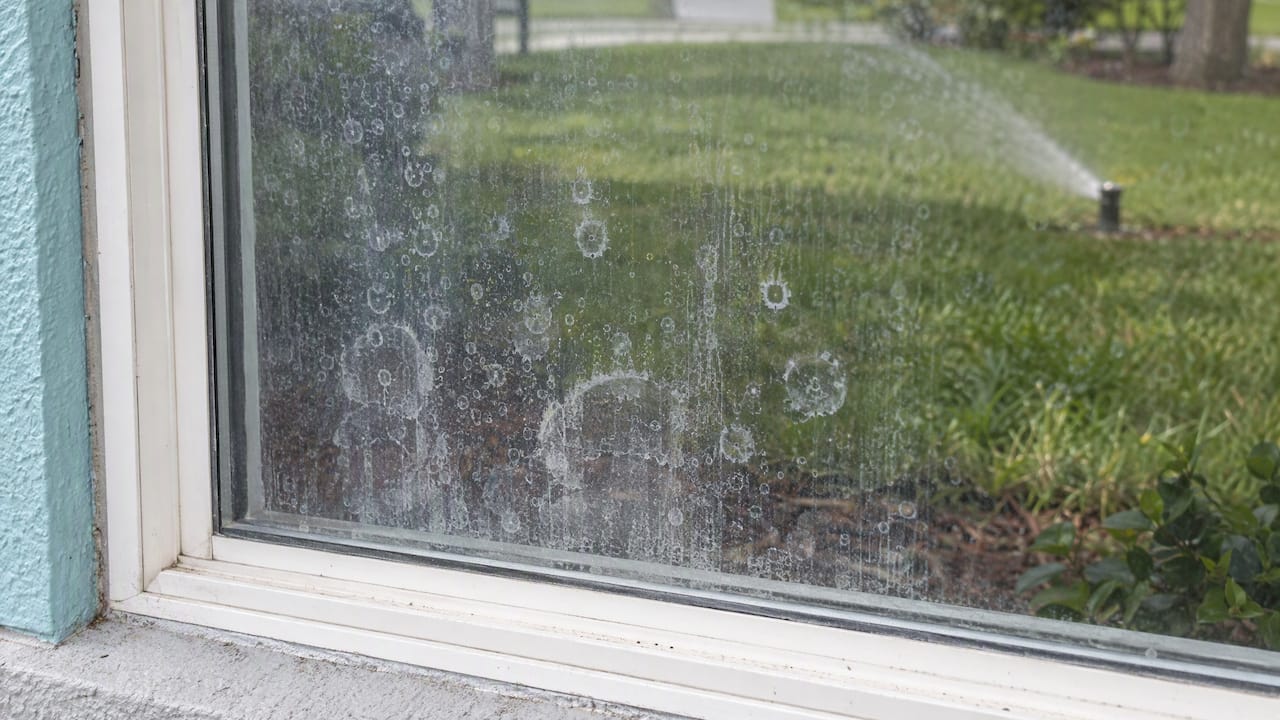
That last item matters for a common problem. Hard water marks that have etched into glass do not rinse off with any water, however pure. The same handbook says a Techno Pad and rubbing compound may be needed to remove mineral stains and deposits. Sprinkler overspray on a ground-floor window is a typical example: the minerals have bonded to the surface, so you need a restoration step first. Once the glass is restored, pure water keeps new spotting from forming.
Pure water, squeegee, or both?
Neither is simply better. Each has a place.
| Situation | Good fit |
|---|---|
| Tall exterior glass, upper floors, hard-to-reach panes | Pure water with a water-fed pole |
| Interior glass, small panes, heavy grime | Squeegee or cloth, often with a cleaning solution |
| Mineral-stained or etched glass | Mineral removal first, then routine cleaning |
| Frames, screens, sills | Brush and rinse by hand |
| Storefront glass cleaned on a regular schedule | Either, depending on access and traffic |
Some working window cleaners argue that DI water does little for traditional squeegee jobs because the water is contaminated after the first dip. That is a fair point, and it shows the method fits best when the water never touches a dirty bucket: fed through a brush, rinsed, and left alone.
DIY or hire a pro?
If you want to try it yourself, a small DI system can be affordable if your tap water is soft. You will need a pole, hose, brush, resin and a TDS meter, plus the patience to learn the brushing and rinsing rhythm. For a few ground-floor windows, a bucket of pure water and a clean cloth can work indoors.
Hiring makes sense when:
- You have second-story or taller glass.
- Your windows have hard water staining that needs restoration.
- You manage several units or a storefront and want a regular schedule without running equipment.
- You want frames, screens and the surrounding concrete or siding cleaned in the same visit.
Cost differs by property size and access, which is why reputable crews quote per job. We quote that way too.
Our perspective
Most people who search for deionized water want one thing: windows that do not spot up two hours after cleaning. The water is part of the answer, but not the whole of it.
In our experience, the visits that go best start with the glass and the surroundings, not the gadget. What is on the windows? Is it dust, or mineral buildup from sprinklers and hard water? Are the frames and sills going to drip back onto the glass? Those questions decide the result more than any single product.
We are a family-run business, and we like to be plain about pricing and what a job involves. We handle window cleaning inside and out, hard water stain removal, screens and frames, and we do pressure washing on driveways, sidewalks, patios, siding and roofs. Doing both means we can look at the whole exterior and recommend what will actually make the property look better, not just sell you one service.
If you manage rentals, a storefront or a commercial building, regular scheduling keeps buildup from getting a foothold. It is usually easier and cheaper to maintain glass than to restore it.
Richard
Let us handle the windows
If you would like clean, spot-free glass without buying equipment or tracking resin, we can take care of it. E&R Cleaning Solutions offers window cleaning and pressure washing for homeowners, landlords, property managers and small business owners. Jobs are quoted individually and scheduling is flexible, for one-time or recurring visits.

Tell us about your property and the problem you want solved, whether that is hard water marks, algae on a patio or a storefront that needs a regular clean. We will give you a straightforward quote.
Buying DI water or resin: what to check
If you go the DIY route, a few checks save money and frustration:
- Test your tap TDS first. Higher incoming TDS means DI resin runs out faster, so the cost per window rises.
- Buy a TDS meter. It is the only reliable way to know when water is no longer spot-free. Change resin when the reading reaches the range your supplier recommends.
- Match the system to your water. Soft to medium water suits DI alone. Harder water points to RO ahead of the DI stage, per the guidance above.
- Do not rely on bottled water. Bottled “purified” water varies, and a gallon will not cover more than a few panes. Check the label and the reading rather than assuming.
- Plan for resin disposal and replacement. Spent resin has to be swapped, so keep spares on hand.
FAQ
Is deionized water good for cleaning windows?
Yes. Because it contains no dissolved solids, it dries without leaving mineral spots, which is the main cause of streaks on exterior glass. It works best on windows that are already reasonably clean, and with a brush and a thorough rinse. Heavy grime or etched mineral stains need extra steps.
What is the difference between purified water and deionized water for window cleaning?
Purified is a broad term for water treated by any method, such as RO, distillation or deionization. Deionized water is a specific type, made with ion-exchange resin. For glass, check the TDS reading: the closer to zero, the better the spot-free result.
What do professional window cleaners use to wash windows?
Many use water-fed poles with brushes and an RO or DI system. Others rely on squeegees, microfiber cloths and abrasive pads for stained glass, as described in an industry handbook. The mix depends on the building, the access and the condition of the glass.
Can I use deionized water on indoor windows?
Yes, for example with a bucket, a clean cloth and care around floors and electronics. Pure water spots less than tap water when it dries. A towel or squeegee finish is often more practical indoors than a hose and pole.
Does deionized water remove hard water stains?
Not on its own. Pure water prevents new spots, but mineral deposits that have bonded to glass usually need a mineral-removal step with a pad and compound, as noted above. After that, pure water helps keep the glass clear.
Sources
- Pure Water Window Cleaning, Unger USA
- Benefits of Pure Water Cleaning, Unger USA
- Deionized Water for Window Cleaning
- Pure Water Cleaning Systems FAQ
- Window cleaning with pure water, Unger
- Water Purification Technology: RO, DI and Nano Filtration, Unger USA
- Pure water cleaning: Which pure water filter to use, Unger
- Purified Water Leaves Windows Streak-free, CleanLink
- Handbook: Tips and Tricks, IPC
- Water Filter vs. Softener: Which Does Your Home Need?