
What Causes Staining on Concrete Surfaces?

Six culprits account for nearly every stain you’ll find on a driveway, sidewalk, or patio: oil and grease, rust from metal contact, algae or mold, tire marks and plasticizer migration, paint residue, and efflorescence from mineral salts. How deep and how old the stain is decides whether a hose and detergent will fix it or whether you need a professional with the right chemistry.
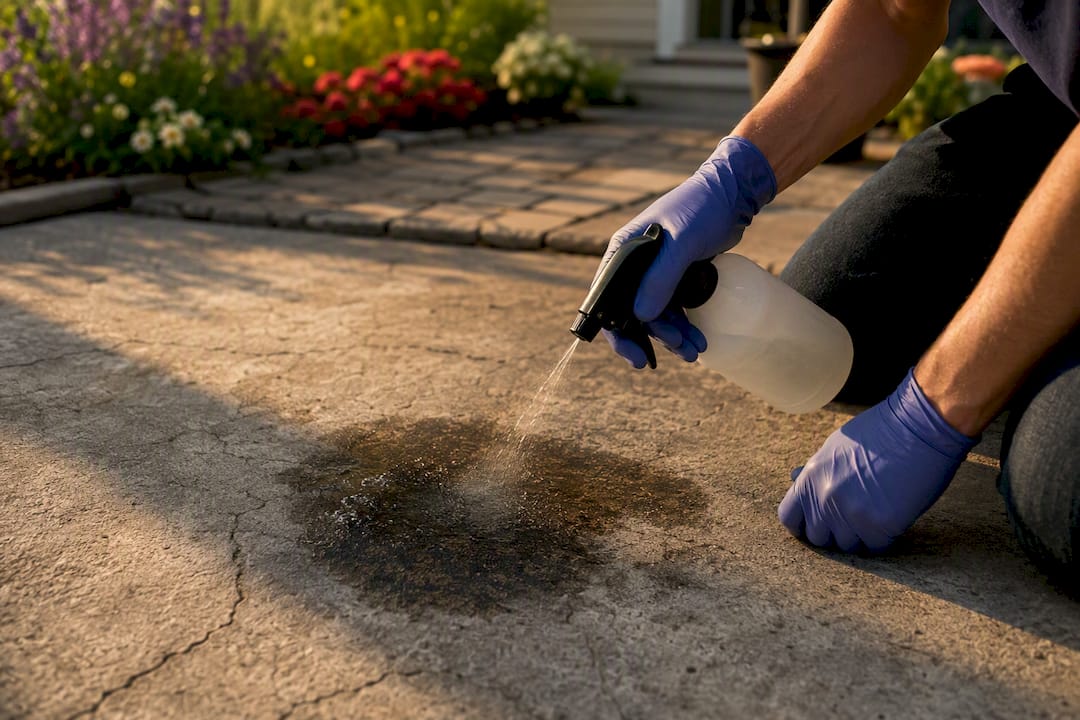
- Fresh spills: blot with an absorbent material and rinse with mild detergent right away
- Old or widespread stains: skip the DIY experiments and call a cleaning professional before the contaminant sets deeper into the pores
- Unknown or large-area staining: get a diagnosis first, since concrete porosity, moisture, temperature, and slab age all affect what removal method will actually work
Key Takeaways
Concrete staining comes from six recurring sources, and matching the removal method to the stain’s depth and age is what actually gets it clean without damaging the slab.
| Point | Details |
|---|---|
| Six main causes | Oil/grease, rust, biological growth, tire marks, paint, and efflorescence each stain concrete through a different mechanism. |
| Depth decides the method | Fresh surface films need detergent, embedded stains need enzymes or poultices, and deep stains need grinding as a last resort. |
| Pressure washing carries risk | High PSI can open pores and strip sealer, so resealing within 24 to 48 hours after cleaning matters. |
| Prevention beats repeat cleanings | Penetrating sealers every 3 to 5 years and quick spill response cut down future staining significantly. |
| Test before you commit | E and R Cleaning Solutions diagnoses stain type and depth with a test patch before recommending a removal method. |
Table of Contents
- What Causes Concrete Staining on Driveways and Patios?
- How Do Pros Decide Which Removal Method to Use?
- Is Pressure Washing Safe for Removing Concrete Stains?
- How Can You Prevent Concrete Stains From Coming Back?
- When Should You Hire a Professional for Concrete Stain Removal?
- What I’ve Learned From Years of Concrete Cleaning Calls
- Get Your Concrete Stains Diagnosed and Cleaned Right
- Frequently Asked Questions
- Sources
What Causes Concrete Staining on Driveways and Patios?
Every stain type has its own mechanism, and knowing which one you’re dealing with changes the entire treatment plan.
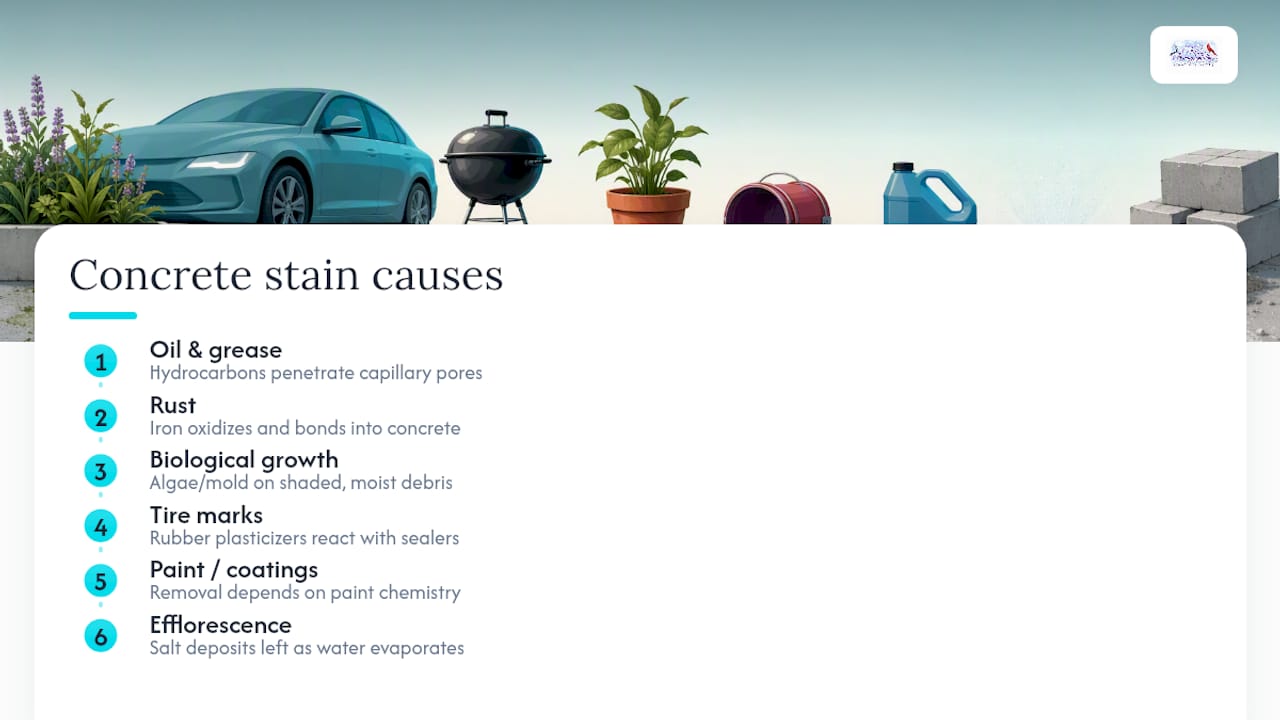
Oil and grease are hydrocarbons, and hydrocarbons are drawn into concrete’s capillary pores almost immediately after contact. The longer the oil sits, the further it migrates, which is why a stain from last week’s oil change behaves nothing like one that’s been there for two years.
Rust happens when iron, whether from a dropped tool, a rusting patio chair leg, or irrigation water high in iron, oxidizes on contact with the surface. That oxidation forms iron oxide compounds that bond chemically with the concrete rather than just sitting on top of it, which is why pressure alone rarely lifts rust.
Biological staining, the greenish or black film you see on shaded patios, needs three things to take hold: shade, consistent moisture, and organic debris like leaves or pollen for algae and mold to feed on. Cut off any one of those conditions and the growth usually stops spreading.
Tire marks are trickier than they look. In many cases, the black streaking isn’t from the tire itself but from plasticizers in the rubber reacting with certain sealers, pulling color out of the coating rather than depositing it.
Paint and coating residue varies by chemistry. Latex paint typically lifts with the right detergent, while oil-based paint or cured epoxy usually needs solvent-based strippers or mechanical abrasion.
Efflorescence is the white, chalky bloom you’ll spot on new or damp concrete. Water inside the slab dissolves mineral salts, carries them to the surface, and leaves them behind as it evaporates.
One detail surprises a lot of property owners: matching the cleaning chemical to the exact stain type, concrete degreasers for oil, biodegradable acid cleaners for rust and efflorescence, and diluted sodium hypochlorite for biological growth, makes a measurable difference in outcome compared to using one all-purpose cleaner on everything.
How Do Pros Decide Which Removal Method to Use?
Professionals don’t guess. They run through a short diagnostic sequence before touching a single chemical, because the wrong method on the wrong stain can make things worse, not better.
- Test patch first. A small, inconspicuous area gets treated to see how the concrete and any existing sealer react before committing to the whole surface.
- Check for coatings. Sealed concrete behaves differently than bare concrete, and a sealer that’s already failing changes which chemicals are safe to use.
- Determine penetration depth. Fresh surface films, embedded stains that have soaked into the pores, and deep-set contamination that’s been there for months or years each call for a different level of intervention.
For a fresh, surface-level film, a detergent wash paired with a hot-water rinse usually does the job without escalating to anything stronger. For embedded oil or light organic staining, enzyme cleaners break down the hydrocarbons biologically rather than just pushing them around, which works well on stains that have soaked in but haven’t gone deep.
When contamination has settled further into the slab, poultice and extraction products come into play. These draw the oil back toward the surface as they cure, and repeated extraction cycles often lighten deep oil halos incrementally rather than erasing them in a single pass.
Mechanical grinding is the last resort, reserved for deep, set-in stains that won’t respond to chemistry. It works, but it changes the surface texture and color, and it should only be used as a final step because it typically requires dust control and often resealing or resurfacing afterward.
Pro Tip: Never let a contractor skip the dry-down period between treatment cycles. A stain can look gone while wet and reappear once the concrete fully dries, which is why patience between passes matters more than raw chemical strength.
Is Pressure Washing Safe for Removing Concrete Stains?
Pressure washing is safe when it’s done chemical-first and at the right settings, but used carelessly, it can do more damage than the stain itself.
The professional workflow starts with detergent, not water pressure. Specialized cleaners break down the stain bonds first, and only then does controlled, hot-water rinsing extract what’s left from the pores. That sequence matters because pre-treating chemically lowers the PSI needed to finish the job, which cuts down the risk of etching the slab.
- Use lower PSI on newer or already-damaged concrete, since higher settings can strip the thin, dense pet safe patio cleaner cream coat that gives the surface its finish
- A surface cleaner attachment is close to mandatory on driveways over roughly 200 square feet, since it distributes pressure evenly and prevents the streaky “tiger striping” that comes from uneven passes
- Overwetting or letting detergent dry on the surface before rinsing causes the same streaking, so timed, overlapping passes matter as much as the pressure setting itself
The real risk with pressure washing isn’t cosmetic. It’s that high pressure can open up the concrete’s pores and strip away any existing sealer, leaving the surface more vulnerable to future staining if it isn’t resealed afterward. That’s why a professional job doesn’t end at the rinse. Give the slab 24 to 48 hours to dry before sealing, and document the test patch results so you know exactly what worked. Our walkway pressure washing guide walks through the same sequencing for residential jobs.
Pro Tip: If a contractor shows up and starts blasting the whole driveway at max pressure without a test patch, that’s your signal to stop the job. A rushed pass can etch bare concrete permanently, and there’s no undoing that.
How Can You Prevent Concrete Stains From Coming Back?
Cleaning solves today’s problem. Sealing and routine care are what keep tomorrow’s stain from happening at all.
Sealer choice matters more than most homeowners realize. Penetrating sealers, like silane or siloxane formulas, soak into the pores and generally require reapplication every few years. Film-forming sealers sit on top and look glossier, but they show wear faster and can peel if applied over a damp or improperly cleaned slab.
- Sweep debris regularly and rinse the surface every few weeks to keep organic matter from building up in shaded corners
- Address vehicle leaks immediately rather than letting a slow drip become a permanent oil halo
- On a fresh spill, absorbents like cat litter or diatomaceous earth pull the oil out before it penetrates, followed by a mild detergent wash
- Always test any cleaning product on a small area before treating the whole surface, since sealers and concrete age react differently from one slab to the next
If you’re dealing with sticky organic residue rather than oil or mineral staining, our guide on what causes gum stains on sidewalks covers a related but distinct removal process worth knowing before you hire anyone.
When Should You Hire a Professional for Concrete Stain Removal?
DIY works fine for a small, fresh spill you caught the same day. Beyond that, the math tips toward hiring a professional fast.
Call a pro when you’re dealing with a large surface area, a stain that’s clearly old or deeply embedded, chemistry you can’t identify (was that paint, sealer, or something else?), or any situation where an aggressive method could damage a slab you can’t afford to replace.
Before signing anyone, ask these questions:
- How will you diagnose the stain and confirm penetration depth before starting?
- Will you run a test patch, and what will you watch for?
- What chemicals and concentrations are you planning to use on this specific stain?
- What PSI and nozzle setup will you use, and will you use a surface cleaner on a large area?
- How will you control dust and prevent chemical runoff into landscaping or storm drains?
- What’s your drying and resealing timeline after the job’s done?
- Can you provide proof of insurance and references from similar jobs?
Red flags are just as telling as good answers. Walk away from anyone who refuses to test a small area first, promises “complete” removal of a deeply embedded stain with total certainty, or has no plan for containing runoff. Landlords managing turnover cleanings should also check our driveway cleaning guide for rental homes for scope questions specific to tenant properties.
What I’ve Learned From Years of Concrete Cleaning Calls
Most homeowners want a guarantee before we even test the surface. I get it, but a real diagnosis always beats a promise. We start with a test patch and matched chemistry every time, and we’ll walk away from grinding if a gentler method still has room to work. Cleaning without a sealing plan afterward is half a job.
Get Your Concrete Stains Diagnosed and Cleaned Right
Most cleaning companies show up with one pressure washer setting and hope for the best. E and R Cleaning Solutions starts differently: we diagnose the stain, run a test patch, and match the chemistry to what’s actually on your concrete, whether that’s an enzyme treatment for a light oil stain, a poultice for something embedded, or controlled chemical-first pressure washing for a driveway that just needs a deep clean.

A first visit includes an inspection, a test patch on an inconspicuous area, and a straightforward recommendation on method and timing, including when it’s safe to seal afterward. We serve homeowners, landlords, and property managers who’d rather get an honest answer than a rushed guarantee. If you’re managing a rental turnover, our pressure washing between tenancies service is built around exactly that timeline. Request a quote today and we’ll tell you what your concrete actually needs, not just what’s easiest to sell.
Frequently Asked Questions
What causes staining on concrete surfaces most often?
Oil and grease from vehicles, rust from metal objects, algae and mold in shaded damp areas, tire plasticizer migration, paint residue, and efflorescence from mineral salts cause the vast majority of concrete stains on driveways, sidewalks, and patios.
How do stains form on concrete if the surface looks solid?
Concrete is porous at a microscopic level, and liquids like oil or moisture carrying dissolved salts move into those pores over time. The longer a contaminant sits, the deeper it travels, which is why fresh stains lift easily and old ones require stronger methods.
What causes concrete discoloration that isn’t a stain from an external substance?
This article focuses on surface contamination like oil, rust, and biological growth rather than discoloration tied to the concrete mix itself. If your slab shows uneven color right after it was poured, that’s a separate issue tied to the original installation, not something a cleaning service resolves.
Can pressure washing alone remove embedded oil stains?
Rarely on its own. Pressure washing works best after a chemical pre-treatment loosens the stain bond, and even then, deeply embedded oil usually needs an enzyme cleaner, poultice, or extraction cycle rather than water pressure alone.
How often should sealed concrete be resealed to prevent staining?
Penetrating sealers like silane or siloxane typically need reapplication every 3 to 5 years, though heavy vehicle traffic or harsh winters can shorten that window. Film-forming sealers wear faster and often need more frequent attention.
When should I stop trying to remove a stain myself and call a professional?
Call a professional once a stain covers a large area, has clearly soaked in over time, or resists a basic detergent and rinse. Attempting stronger chemicals or higher pressure without testing first risks etching the surface or damaging a sealer you didn’t know was there.
Sources
- How To Remove Oil Stains From Concrete and Prevent Future Marks – Prosoco
- Concrete driveway oil stain removal: Enzyme vs. poultice vs. grinding – Crafting With Concrete
- How to pressure wash a driveway without damaging concrete — Linea
- How to clean concrete driveways – ConcreteNetwork