Polymeric Sand Haze Removal: What Works and When to Start
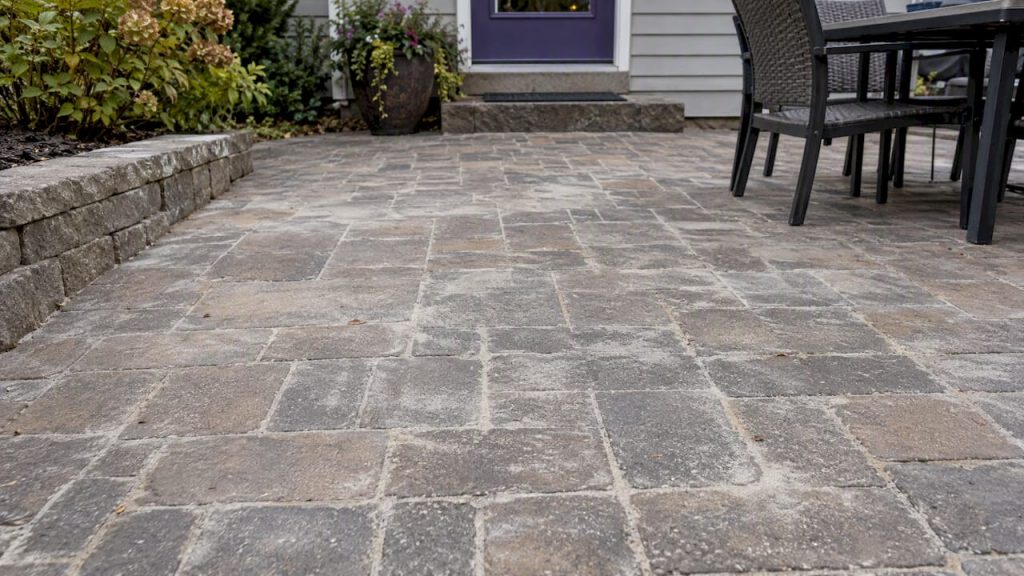
Polymeric sand haze is a white or gray film of binder and fine dust left on the face of pavers after jointing. You remove it by waiting out the cure time, scrubbing with water first, and then, if it stays, applying a diluted paver-safe haze remover to a tested patch. Skip raw muriatic acid, and do not start on a fresh install.
The order matters more than the product. Most damage we hear about comes from rushing: scrubbing a joint that has not cured, or putting strong chemicals on a surface that never needed them. This guide walks through diagnosis, timing, methods, and the point where it makes sense to hand the job to a crew.
TL;DR
- Haze is mostly leftover polymer binder and construction dust that was not flushed off the paver faces during the first watering.
- Wait for the cure window before any cleaner. The sand maker’s data sheet sets the number, and one major paver-cleaner data sheet says at least 30 days.
- Try water and a stiff brush first. For haze that stays, use a purpose-made haze remover, diluted per the label, on a small test area.
- Avoid generic muriatic acid. It can etch, discolor, or pit concrete and clay pavers.
- Check that it is not efflorescence. That is a different problem and it can come back.
Table of Contents
- What polymeric sand haze actually is
- Is it haze or efflorescence?
- Step one: wait for the cure, and maybe wait longer
- Step two: start gentle, with water and a brush
- Step three: use a haze remover made for the job
- Why not muriatic acid?
- What about sealing over haze?
- How to prevent haze next time
- Our perspective
- When to call a professional
- Need a hand with your patio?
- FAQ
- Sources
What polymeric sand haze actually is
Polymeric sand is fine sand mixed with polymer binders. You sweep it into paver joints, wet it, and the binder activates and hardens so the joints resist weeds and washout. The catch is that the same binder is sticky. Any sand left on the paver surface when it gets wet bonds there instead of in the joint.
According to manufacturer guidance, the haze homeowners see is often a mix of polymeric binder and construction dust that was never effectively flushed into the joints. The same guidance describes a disciplined multi-stage watering process, often three rinses, to avoid it.
The usual causes are:
- Sweeping excess sand off poorly before wetting.
- Letting the surface dry between rinses, so residue cures in place.
- Wetting the sand too hard, so it splashes onto the paver faces.
- Installing on damp pavers, or right before rain.
Manufacturers say failing to rinse residue thoroughly, or letting the surface dry before the final rinse, leads directly to a hazy film that is hard to remove later. Newer “haze-free” or intelligent polymer sands are designed to avoid this, but only when installed to the manufacturer’s watering and blowing sequence. Older formulations are more prone to residual film.
Is it haze or efflorescence?
Before you buy anything, confirm what you are looking at. Both look like a white veil, and they are not the same problem.
| Clue | Polymeric sand haze | Efflorescence |
|---|---|---|
| Pattern | Usually uniform, or streaked in the direction of the broom | Often patchy |
| Timing | Appears after jointing and the first wetting | Appears as moisture moves through concrete |
| Cause | Binder and dust left on the surface | Natural minerals migrating to the surface |
| Will it return? | Not once removed and the surface is clean | It can, if the moisture source is not fixed |
This comparison follows Techniseal’s paver restorer data sheet, which notes that a dedicated restorer can address both, but that efflorescence may return if excess moisture is the underlying cause. If your white film is patchy and sits where water pools or drains badly, think moisture. Our guide to removing brick efflorescence without acid or pressure washing covers that side in detail.
A simple check: look at the joints. If the film follows the pattern of where the sand was swept and ends at the joint lines, it is almost certainly haze.
Step one: wait for the cure, and maybe wait longer
The most common mistake is impatience. People see a film the day after the job and go after it with a brush and a chemical.
Two timing points matter:
- Rain-safe time. Current-generation sands need anywhere from 15 minutes to 24 hours to be rain-safe, depending on the application type.
- Full cure before chemicals. One paver restorer data sheet says to wait at least 30 days after installing polymeric sand before applying a chemical cleaner. Cleaning too soon can compromise the joint and lead to erosion or bond failure.
The rule is to read the data sheet for the exact sand in your joints. Different products set different waiting periods, and some haze simply dissipates over time with sun, rain, and foot traffic. If your patio is two weeks old, the right move may be to do nothing.
If you do not know which sand was used, ask the installer. If the installer is gone, assume the longer window.
Step two: start gentle, with water and a brush
Once the cure window has passed, begin with the least aggressive method. Hot or boiling water poured onto the surface and a stiff brush will lift lighter film in many cases. Homeowner forums often suggest this, and it is low risk to the pavers. Keep these habits:
- Wet the surface thoroughly first.
- Scrub in small sections with a stiff nylon-bristle brush, not wire.
- Keep the surface wet and rinse as you go.
- Do not dig into the joints. You are cleaning faces, not the sand.
A mild case, such as a faint cloud that shows only in raking light, often improves with this alone. Vinegar is sometimes recommended for mild haze, but test it first and rinse well, since acids of any strength can affect some stones and the surrounding plants and metal.
A note on pressure washing
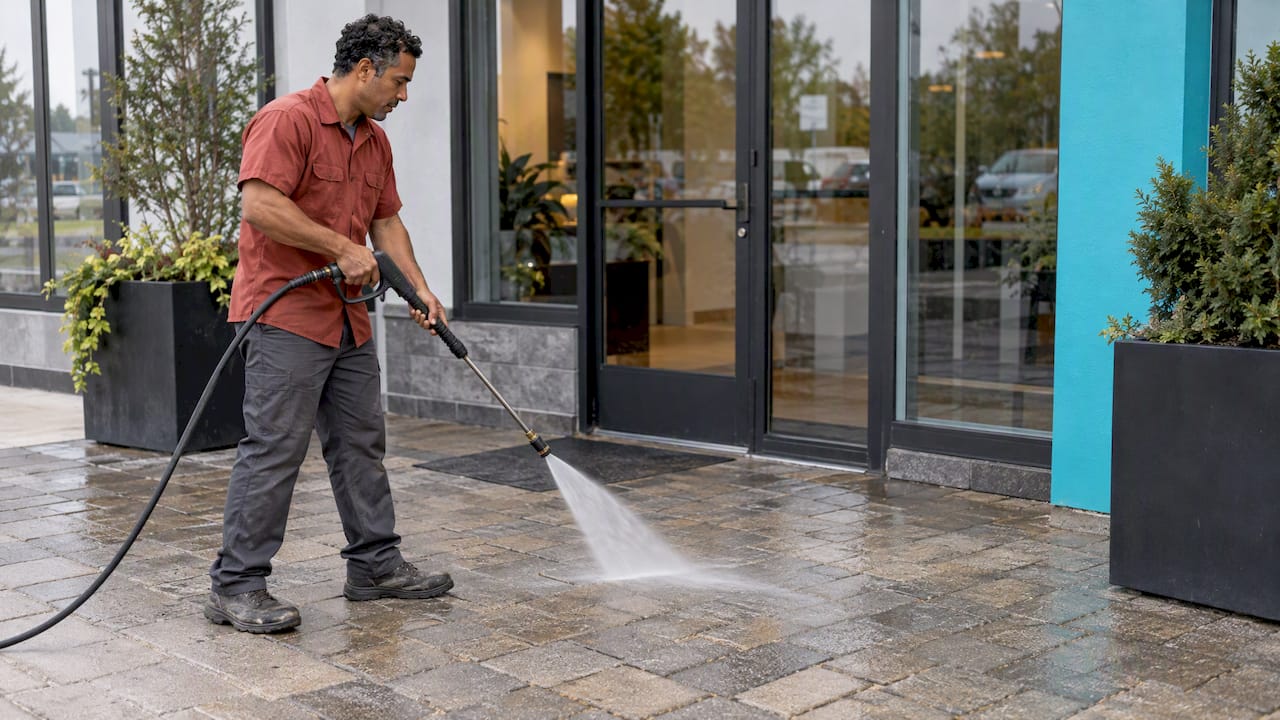
Pressure washing is the tool people reach for, and it is the one that can do the most harm here. High pressure at a cured joint can blast out the sand you just paid for, leaving low, uneven joints. If you use a pressure washer at all, use a wide fan tip, stay well back from the joints, and test somewhere hidden. For hard cases, we often prefer a controlled chemical step over more pressure. Our pool deck guidance on matching PSI explains how pressure and surface type interact.
Step three: use a haze remover made for the job
If water and a brush do not shift it, move to a product made for polymeric haze. These are different from general-purpose acid cleaners.
Two types appear in manufacturer documents:
- Paver restorers and slurry removers. Techniseal advises these over raw acid. They are diluted by severity, often starting around 1:4 to 1:8, and tested first on a small hidden area of about 4 sq. ft.
- Non-fuming haze removers. Some, such as the Artisan product, are ready to use but can be diluted with up to 3 parts water. Dwell time typically runs 10 to 20 minutes, longer for heavier buildup. They are marketed as non-fuming alternatives to mineral or organic acids and contain inhibitors to limit iron staining.
The label always outranks this article, since concentrations and dwell times differ by product.
A safe application sequence
- Confirm the cure period has passed for your specific sand.
- Test a hidden patch, about 4 sq. ft., and let it dry fully before judging color.
- Pre-saturate the area with clean water, as Techniseal’s prep guidance advises, so the cleaner does not soak in unevenly.
- Work in sections of roughly 50 to 200 sq. ft. Never let the product dry on the surface. Drying is the major pitfall that leads to staining.
- Apply, wait the labeled dwell time, and agitate lightly with a brush.
- Rinse thoroughly with plenty of water, and keep runoff away from plants and storm drains where you can.
- Let the pavers dry and judge the result in full daylight before a second pass.
Wear gloves and eye protection, and read the safety data sheet. If the product label says to keep it off certain materials such as metal, glass, or painted surfaces, mask or rinse those as it directs.
Why not muriatic acid?
It is cheap, it is at every hardware store, and it is often the first thing someone suggests. We would steer you away from it. Techniseal’s prep guidance says generic muriatic acid is too aggressive and frequently causes irreversible etching, discoloration, or pitting on concrete and clay. Purpose-made removers use surfactants and inhibitors that target the polymer residue while protecting the paver face.
Etching does not wash off. Once the surface texture is damaged, you are living with a dull, rough patch or replacing pavers. That is a lot of risk to save a few dollars.
What about sealing over haze?
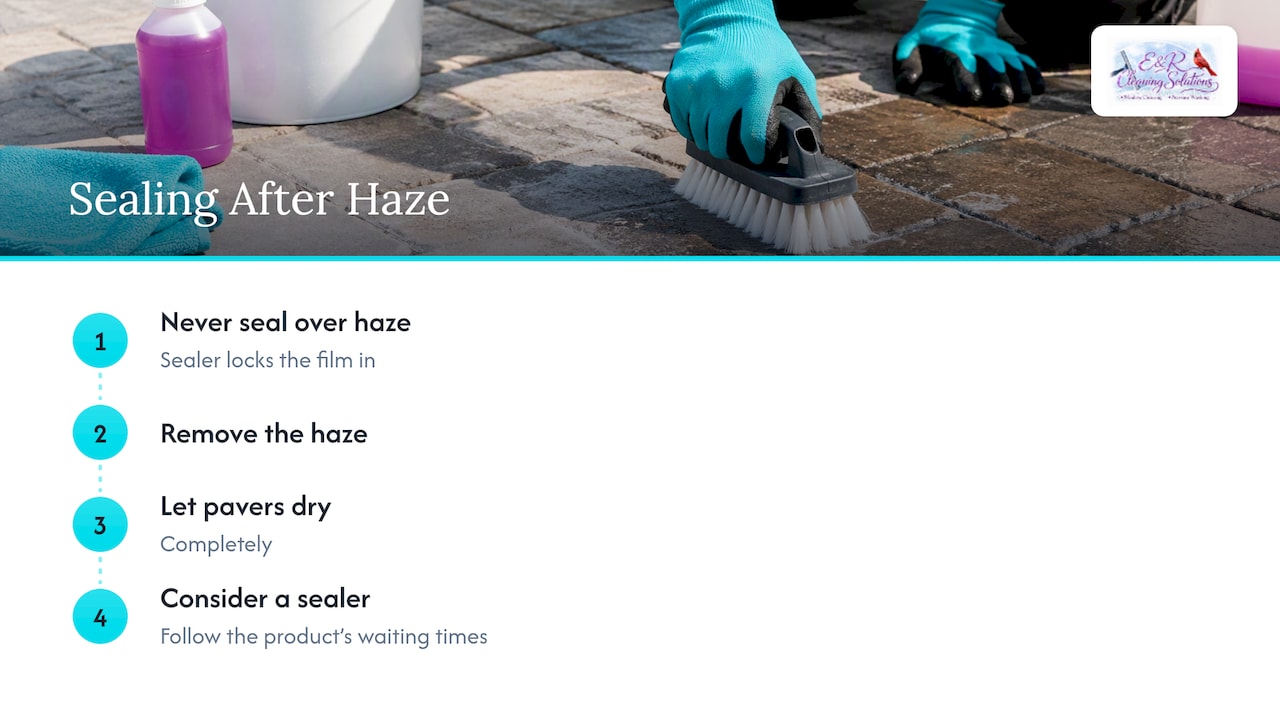
Never seal over it. A sealer locks the film in, and it can turn a faint haze into a cloudy, permanent look. Remove the haze first, let the pavers dry completely, and only then consider a sealer, following that product’s own waiting times.
This also answers a common question from homeowners: why pavers look white and hazy after sealing. Usually the haze was there before the sealer, or moisture was trapped beneath it. Fixing that means stripping or cleaning, not adding another coat.
How to prevent haze next time
If you are installing, or hiring someone to, a few habits cut the risk sharply:
- Install on a fully dry surface, and let clay pavers dry completely.
- Sweep the excess off with a broom, then use a leaf blower at a low angle to clear the faces. Do not overdo the blower, which can pull sand out of the joints.
- Follow the watering sequence on the data sheet, usually a light mist first and then more water in stages.
- Check the forecast. Plan around the rain-safe time of the product you chose.
- Consider a modern haze-free formulation, then follow its directions exactly. The marketing only holds when the install follows the sheet.
Our perspective
We clean patios, driveways, walkways, and building exteriors, and the pattern we see is that haze problems are rarely about the paver and almost always about timing and technique. Homeowners are often told two things at once: scrub it now and it will wear off by itself. Both are partly right, which is exactly why people get stuck.
Our view is simple. Diagnose first, wait the full cure, start with water, and escalate only as far as the surface needs. We are wary of anything that trades a cosmetic film for permanent surface damage. That is also how we approach stains of every kind: test a small area, give it time, and be honest about what a given treatment can and cannot do. If a cleaner is likely to risk the finish, we would rather say so than sell the job.
We are a family-run, locally owned business, and our pricing is honest because we quote each job on what it actually involves. Haze is a good example. A small, lightly hazed walkway and a large, heavily hazed patio are completely different jobs.
— Richard
When to call a professional
DIY is reasonable for a small, mild case on a cured install. Think about calling someone when:
- The haze covers a large patio, a pool deck, or a long driveway, and the sectioned approach would take days.
- The pavers are a light, porous, or specialty material where a test patch already looked off.
- A first pass left blotches or lap marks.
- You cannot tell whether it is haze or efflorescence.
- Joints are already weak, and you are worried more water or pressure will wash them out.
A good contractor will ask what sand was used and how long ago it was installed, test a patch, and explain the plan before touching the main surface. If a crew proposes straight acid or high pressure on day one, that is a reason to keep looking.
If your patio also has black spots, algae, or moss under the film, those need their own treatment. See our notes on patio black spots, slippery algae, and moss on patios. For budget context, our patio pressure washing cost guide lays out what drives price.
Need a hand with your patio?
E&R Cleaning Solutions offers pressure washing for patios, sidewalks, driveways, and building exteriors, along with window cleaning, for homes and commercial properties. Pricing is custom per project, and scheduling is flexible. If your pavers are cured and still look cloudy, or you would rather not risk the joints, you can request a quote through our site and describe what you are seeing.
FAQ
Will polymeric sand haze go away on its own?
Sometimes. Manufacturer guidance says the haze from some modern polymeric sands dissipates over time with regular exposure to weather and traffic. Heavier film from a poor rinse usually will not, and it gets harder to remove the longer it sits.
How long should I wait before using a haze remover?
Check the data sheet for your sand. One paver restorer data sheet says to wait at least 30 days after installing polymeric sand before any chemical cleaner. Using it earlier can damage the joint bond.
Can I use vinegar or boiling water?
Boiling water and a stiff brush are a low-risk first step for light haze. Vinegar is often suggested for mild cases, but test it on a hidden spot and rinse thoroughly. For moderate or heavy haze, a purpose-made remover is the safer, more predictable option.
Is muriatic acid a good haze cleaner for pavers?
We do not recommend it. Manufacturers warn it is aggressive enough to etch, discolor, or pit concrete and clay surfaces. A diluted, purpose-made haze remover, tested first on a small area, is the safer path.
Can I pressure wash polymeric haze off?
You can risk it, but high pressure can erode cured joints. If you try, use a wide tip, keep your distance, and test a hidden area first. Many haze cases clear better with water, a brush, and the right cleaner.
Sources
- Alliance Gator Maxx Bond technical data sheet
- Alliance Gator Maxx Bond G2 technical data sheet
- Techniseal Paver Restorer technical data sheet
- Techniseal Paver Prep HD technical data sheet
- Artisan Poly Haze Remover technical data sheet