
Soft Wash Siding: 1–1.5% On Surface Concentrations Homeowners Need
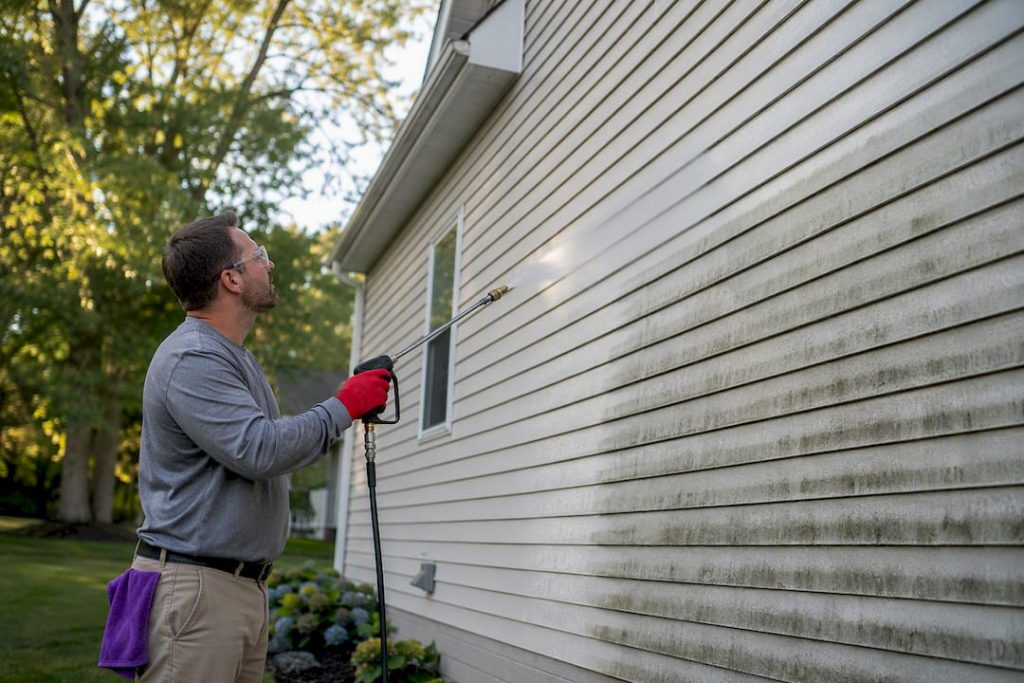
Soft washing is the right call for vinyl, fiber cement, painted wood, and stucco because chemistry does the cleaning, not force. A properly mixed solution kills mildew and algae at the root, applied at pressures as low as 60 to 500 PSI, so there’s no water forced behind laps or paint stripped off trim. Keep on-surface sodium hypochlorite around 1% to 1.5% and never push past 2%. Do it right and you get 12 to 24 months before growth returns, roughly triple what pressure-only cleaning buys you.
TL;DR:
- Proper soft washing uses a sodium hypochlorite solution at 1 to 1.5 percent concentration, avoiding exceeding 2 percent to prevent damage and ensure effectiveness.
- Soft washing results last 12 to 24 months, significantly longer than pressure washing, which often requires re-treatment within 4 to 8 weeks due to root and spore survival.
- The process involves careful pre-wetting, dwell time of 10-15 minutes, and a top-down rinse at 200-500 PSI to avoid streaks and damage.
- Proper equipment includes a downstream injector with a dilution ratio of 8:1 to 10:1 using 12.5 percent stock sodium hypochlorite, and appropriate nozzles held 6 to 12 inches from the surface.
- Mistakes such as skipping dwell time, using narrow spray nozzles, or rinsing bottom-up increase the risk of streaks, damage, and callbacks.
Table of Contents
- What Is Soft Washing, and How Is It Different From Pressure Washing?
- Soft Wash vs. Pressure Wash: Which One Actually Wins?
- How Do You Soft Wash Siding Step by Step?
- What Chemical Mix and Equipment Do You Need?
- What Safety Steps and Mistakes Should You Watch For?
- How Long Do Results Last, and What Does It Cost?
- Why E and R Cleaning Solutions Builds Every Job Around This Protocol
- Ready to Book a Soft Wash for Your Siding?
- Sources
What Is Soft Washing, and How Is It Different From Pressure Washing?
Soft washing pairs a diluted biocide (usually sodium hypochlorite) with a surfactant that helps the mix cling to vertical surfaces long enough to actually kill what’s growing there instead of just blasting it loose. Pressure washing, by contrast, relies on mechanical force alone, often exceeding 3,000 PSI, to physically strip dirt and growth off a surface.
That force is exactly the problem on residential exteriors. High pressure can drive water behind siding laps, blow out weep holes, gouge softwood trim, or crack aging caulk lines. Fiber cement and vinyl siding weren’t built to take a direct hit at those pressures, and painted wood fares even worse.
Here’s how the two methods map to common cladding:
- Vinyl: Soft wash only. Chemistry lifts mildew without stressing panels or seams.
- Fiber cement: Soft wash, with lower concentrations on painted panels.
- Painted wood: Soft wash. Pressure washing on wood almost always chews into the grain or lifts paint.
- Stucco and EIFS: Soft wash at reduced strength. No pressure, ever, on synthetic finish systems.
- Brick: Soft wash for organic staining; mineral deposits sometimes need a different, non-bleach approach.
Soft Wash vs. Pressure Wash: Which One Actually Wins?
Longevity is where soft washing separates itself. Results from a properly dosed soft wash typically hold for 12 to 24 months, while pressure-only cleaning on shaded siding can show regrowth in as little as 4 to 8 weeks. Pressure washing scrubs the visible growth off the surface but leaves the spores and roots intact underneath, so algae and mildew come right back, especially on a north-facing wall that never sees direct sun.
Damage risk tells a similar story. The complaint patterns contractors hear most often involve water intrusion behind siding, cracked caulk joints, and etched or gouged wood trim, almost always tied to pressure applied too close or too high on a delicate surface. Soft washing, done at proper concentrations, sidesteps that risk entirely and tends to run three to four times faster than scrubbing every panel by hand or force.
That doesn’t mean pressure washing has no place. It’s still the right tool for:
- Concrete driveways, walkways, and patios, where mechanical force is the point
- Brick or stone hardscape that can tolerate higher PSI without damage
- Spot cleaning of gum, oil stains, or heavy grime on surfaces built to take it
Most full-property jobs end up as a hybrid: soft wash the siding and roof, then pressure wash the concrete. If you’re bundling both, a walkway pressure washing guide is worth a look before you schedule the hardscape portion.
How Do You Soft Wash Siding Step by Step?
Whether you’re vetting a contractor’s process or supervising a DIY job yourself, the sequence matters as much as the chemistry. Skipping steps is how you end up with streaks, dead shrubs, or a callback.
Before you mix anything:
- Pre-wet all landscaping around the work area and cover anything you can’t move.
- Close and tape off vents, and shut windows tight.
- Test a small, hidden section of siding first. If it’s already flash-oxidized (a chalky white residue that rubs off on your hand), standard dwell time will streak it, and it needs a different approach entirely.
Setting up the equipment:
- Install a downstream injector on the pressure washer’s outlet, with a pickup hose running into the chemical tank. This is the standard entry point for most residential jobs; a dedicated 12V pump system only becomes necessary for higher-volume commercial work or when you need stronger on-surface concentrations than an injector can reliably deliver.
- Mix your tank according to the target on-surface strength (covered in detail in the next section) rather than guessing.
Applying the mix:
- Apply bottom-up, working in manageable sections rather than the whole wall at once.
- Let it dwell for about 10 to 15 minutes, keeping the surface visibly wet the entire time. If it starts drying out before the timer’s up, mist it again. A dry, dwelling chemical is what causes flash-oxidation on vinyl.
- Rinse top-down at 200 to 500 PSI using a wide fan nozzle, held 6 to 12 inches off the surface during the rinse pass.
After the rinse:
- Walk the property looking for streaking or missed spots while the siding is still wet, since it’s much harder to spot once it dries.
- Give windows a second rinse. Overspray settles into corners and tracks, and a pressure window washing pass after the main job catches what the main rinse missed.
- Check nearby plants for browning or wilting in the following 24 to 48 hours. Healthy growth after that window means your dilution and rinse-down were on target.
Pro Tip: If a bid or a DIY plan skips the dwell time entirely and goes straight to rinsing, that’s the single biggest tell of a rushed job. Chemistry needs contact time to actually kill mildew roots, not just wet the surface.
If any of this sounds like more precision than you want to manage on a ladder, that’s the exact judgment call worth handing to a professional crew.
What Chemical Mix and Equipment Do You Need?
Getting the on-surface concentration right is the single biggest variable separating a clean, safe job from one that damages plants or discolors paint. Industry consensus lands squarely on 1% to 1.5% sodium hypochlorite on the surface itself, with 2% as the hard ceiling even for heavy shaded growth.
Most operators buy 12.5% stock sodium hypochlorite and run it through a downstream injector, which typically dilutes the tank mix at 8:1 to 10:1. Here’s the math: if your injector pulls at 10:1, straight 12.5% stock lands around 1.25% on the surface, right in the target range.
| Setup | Best for | On-surface strength achievable | Notes |
|---|---|---|---|
| Downstream injector | Most residential jobs, single-story to two-story homes | 1% to 1.5% (with correct dilution) | Economical entry point; dilution ratio must be checked, not assumed |
| Dedicated 12V pump | High-volume or commercial-scale work | Up to and slightly above 1.5%, with more control | Cleaner metering when consistency across many jobs matters |
| Peroxide-based cleaner | Homeowners avoiding chlorine near sensitive landscaping | Varies by product | Behaves differently as a biocide than sodium hypochlorite (Simple Green Oxy Solve is one example) |
For application, use a 25 to 40 degree fan nozzle held 12 to 18 inches off the surface at 100 to 200 PSI. Tighten the standoff to 6 to 12 inches for the rinse pass, since you’re flushing spent chemical rather than trying to coat the wall evenly.
What Safety Steps and Mistakes Should You Watch For?
The mistakes that cause callbacks are almost always about timing and direction, not the chemical itself.
- Letting the dwell time dry out, which flash-oxidizes vinyl into a chalky, streaked mess that’s hard to fix.
- Using a straight-stream nozzle instead of a wide fan, which concentrates pressure into a point that can etch siding.
- Rinsing bottom-up instead of top-down, which drives water and residue up behind the laps rather than flushing it down and away.
- Spraying on a windy day, letting drift carry bleach solution onto flowerbeds, lawns, or a neighbor’s fence line.
Pre-wet all plants near the work zone and rinse them down again immediately after, since dilution is what protects root systems from chlorine exposure. Wear eye protection and chemical-resistant gloves, and skip the job entirely if wind gusts are pushing spray sideways.
Pro Tip: Ask any contractor what their on-surface concentration target is. A pro rattles off a number without hesitating. A vague answer like “we use commercial-strength cleaner” is a red flag worth walking away from.
How Long Do Results Last, and What Does It Cost?
Expect a properly done soft wash to hold clean for 12 to 24 months, with heavily shaded, humid, north-facing walls sitting at the shorter end of that range and sun-exposed siding stretching toward the longer end.
Price depends mostly on square footage, access difficulty (a steep roofline or blocked side yard adds labor), and how established the growth is. A single light application costs less than a job requiring a second treatment for heavy black streaking, and bundling a soft-wash exterior with a hardscape pressure wash typically costs more than either service alone but less than booking them separately on two different visits.
Why E and R Cleaning Solutions Builds Every Job Around This Protocol
We follow this exact sequence, on-surface concentrations, dwell times, and rinse direction included, because it’s what protects your paint, your landscaping, and your siding’s warranty. Cutting corners on dwell time or nozzle choice is how contractors end up paying for damage they caused. Pricing is custom and provided before work begins, and you can check our approach to larger properties in our commercial soft-washing guide or see how we protect paint finishes over time in a related piece on paint longevity.
— Richard
Ready to Book a Soft Wash for Your Siding?
Choosing a professional cleaning service ensures the on-surface concentration is properly dialed in, the correct nozzle is used, and the rinse plan protects landscaping instead of soaking it in runoff

If you’re gathering quotes, ask every contractor the same four questions: what’s their target on-surface concentration, are they using a downstream injector or a dedicated pump, how are they protecting your plants during the job, and what’s the guarantee period if growth comes back early. If a contractor can’t answer those cleanly, keep calling. For landscaping that needs restoration work after any exterior treatment, Fernandez and Sons handles that side of things well.
See exactly how we approach a full exterior job on our soft washing for commercial buildings guide, or reach out directly for a custom quote on your siding.
Sources
- Pressure Washing Vinyl Siding: Complete Operator Guide · MakeWash
- Cleaning vinyl siding | Simple Green