Cleaning Clauses in Commercial Tenant Agreements

Cleaning provisions in commercial tenant agreements are defined as contractual terms that establish measurable standards, assign responsibilities, and create enforcement mechanisms for property upkeep. These clauses do far more than describe who mops the lobby. 60% of facility management disputes stem from vague cleaning scope and standards. That figure means most landlord-tenant conflicts over cleaning are preventable with better contract language. Property managers who treat cleaning obligations as a strategic asset, not a line-item afterthought, protect both their investment and their tenant relationships.
What is the role of cleaning in commercial tenant agreements?
Cleaning clauses serve as the legal and operational backbone of commercial property maintenance. Without them, both landlords and tenants operate on assumptions, and assumptions generate disputes. The Building Owners and Managers Association (BOMA) recognizes cleaning standards as a core component of building performance benchmarks, placing janitorial quality alongside HVAC and structural maintenance in facility assessments.
A well-drafted cleaning provision defines what “clean” means in measurable terms. That definition matters because “clean” is subjective without a reference point. A tenant running a food service operation has different cleaning demands than a law firm on the same floor. The contract must account for those differences explicitly.

Cleaning clauses also function as a risk management tool. When a tenant causes accelerated wear to flooring or fixtures through inadequate cleaning, a clear contract establishes liability. Without that language, cost recovery becomes a legal argument rather than a straightforward enforcement action.
What essential cleaning clauses should a commercial lease include?
A detailed scope of work forms the foundation of any enforceable cleaning agreement. This document typically runs 3–5 pages and specifies tasks by room type, frequency, and method. A scope that simply says “clean common areas weekly” is unenforceable. A scope that says “vacuum carpeted corridors on Monday, Wednesday, and Friday; mop hard floors with a pH-neutral cleaner on Tuesday and Thursday” is not.
Service level agreements and inspection protocols
A service level agreement (SLA) converts cleaning expectations into measurable outcomes. The SLA defines quality metrics, sets inspection schedules, and establishes correction windows. Routine inspection reports with 24-hour and 4-hour correction windows keep service providers accountable and give landlords documented grounds for enforcement or termination.
Inspection protocols should name who conducts the walk-through, how results are scored, and where records are stored. Documented walk-throughs scored against a quality checklist transform vague contract language into a defensible management tool.
Key clauses every commercial cleaning contract needs
- Scope of work: Room-by-room task list with frequency, method, and responsible party named for each item.
- SLA metrics: Quantified cleanliness standards with defined pass/fail thresholds and inspection cadence.
- Correction windows: Specific timeframes (24 hours for standard issues, 4 hours for urgent ones) for remediation after a failed inspection.
- Supply and equipment responsibility: Clear assignment of who provides chemicals, equipment, and consumables.
- Dispute resolution: A defined escalation path, from written notice to mediation to termination rights, tied specifically to cleaning performance.
- Termination conditions: Grounds for contract termination based on repeated cleaning failures, with notice periods specified.
Pro Tip: Include a clause requiring the cleaning provider to carry liability insurance and name the landlord as an additional insured. This protects the property owner if a cleaning chemical damages a tenant’s equipment or a slip-and-fall occurs during cleaning hours.
How do cleaning clauses divide landlord and tenant responsibilities?
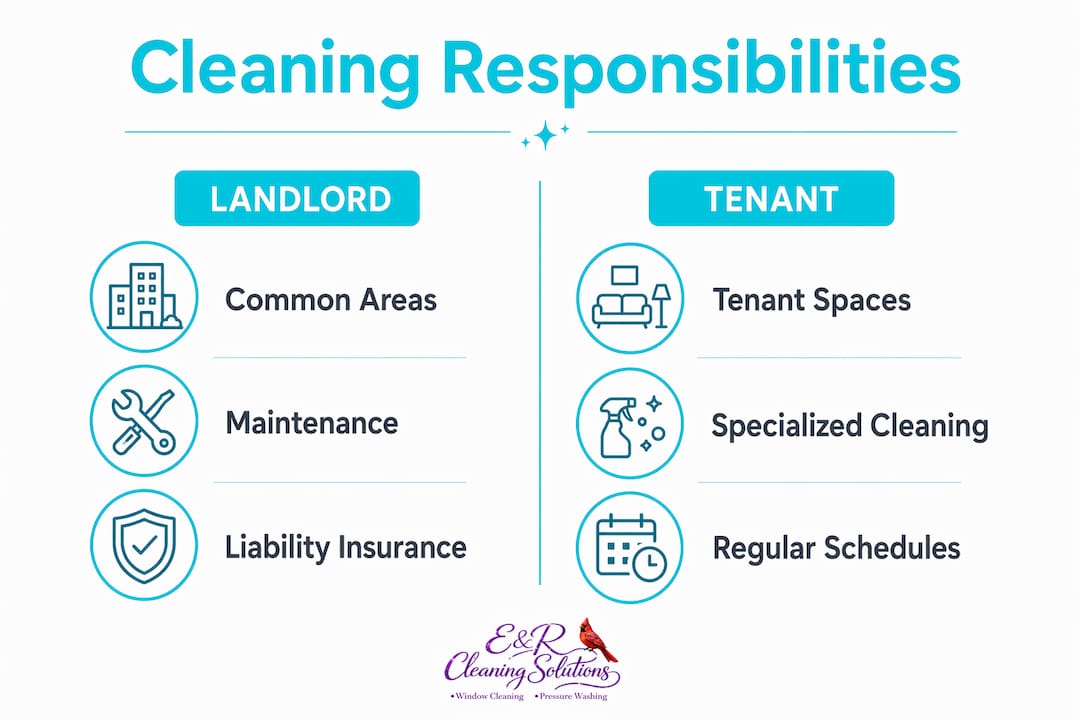
Responsibility allocation in cleaning contracts follows property type more than any other variable. Landlords typically provide janitorial services in multi-tenant office buildings, folding those costs into operating expenses passed through to tenants via a common area maintenance (CAM) charge. Tenants in industrial and retail leases, by contrast, usually bear full cleaning responsibility for their demised space.
Responsibility by property type
| Property type | Landlord responsibility | Tenant responsibility |
|---|---|---|
| Multi-tenant office | Common areas, lobbies, restrooms | Interior suite cleaning |
| Retail strip center | Parking lot, exterior | Interior store, storefront glass |
| Industrial/warehouse | Exterior grounds | Full interior, loading docks |
| Mixed-use building | Common corridors, elevators | Individual unit interiors |
This division has direct cost implications. A retail tenant who fails to maintain storefront cleanliness affects foot traffic for neighboring tenants and degrades the landlord’s asset. An industrial tenant who neglects loading dock cleaning accelerates concrete wear and creates safety liability. Clarity in the lease prevents both outcomes.
Specialized cleaning needs require explicit tenant assignment. A medical tenant using biohazard materials, a restaurant tenant generating grease buildup, or a manufacturing tenant producing chemical residue all create cleaning demands that standard janitorial service cannot cover. The lease must name those specialized tasks and assign them to the tenant with defined frequency and compliance standards.
Operational efficiency improves when responsibility lines are clear. Property managers spend less time mediating disputes and more time managing the asset. Tenants understand their obligations from day one, reducing friction at lease renewal.
How do cleaning schedules protect building value and tenant satisfaction?
Proactive cleaning programs extend building asset longevity by preventing abrasive wear on floors, fixtures, and mechanical systems. Regular dust removal from HVAC intake areas reduces filter load and extends equipment life. Scheduled deep cleaning of grout, tile, and hard surfaces prevents material breakdown that requires costly replacement rather than routine maintenance.
The financial case for cleaning as asset protection is direct. A floor that receives weekly stripping and waxing lasts significantly longer than one cleaned only when visibly dirty. Commercial windows need specialized cleaning to prevent hard water mineral deposits from etching glass permanently, a repair cost that far exceeds the price of a scheduled cleaning program.
Workplace cleanliness directly shapes tenant retention decisions. 86% of employees say workplace cleanliness affects job satisfaction, and 85% connect restroom cleanliness to their perception of the entire building. Tenants whose employees feel this way will not renew leases in buildings that fail to meet basic cleanliness standards.
Cleaning schedules also function as an early warning system for maintenance issues. Coordinating janitorial cleaning with maintenance tasks allows cleaning staff to identify leaks, cracks, and wear before they become expensive repairs. A cleaning crew that notices water staining under a sink during a weekly wipe-down catches a plumbing issue weeks before it causes structural damage.
Pro Tip: Build a quarterly cleaning audit into the lease itself, not just the service contract. When the audit obligation appears in the tenant agreement, both parties treat it as a binding commitment rather than an optional check-in.
Best practices for drafting and enforcing cleaning provisions
Effective cleaning clauses require precision in language and structure in enforcement. Vague terms create the disputes that 60% of facility managers cite as their primary reason for switching cleaning providers. The following practices prevent that outcome.
-
Define “clean” with measurable standards. Reference an industry checklist or ISSA (Worldwide Cleaning Industry Association) cleaning times and tasks as the baseline. Attach the checklist as a lease exhibit so it carries contractual weight.
-
Assign supply and equipment responsibility to the vendor. The vendor-provided supply model centralizes accountability and ensures consistent product quality. When the cleaning provider supplies chemicals and equipment, they own the quality outcome. When the client supplies materials, responsibility becomes shared and disputes follow.
-
Set correction windows in writing. Standard deficiencies require a 24-hour correction window. Urgent issues, such as biohazard spills or restroom failures, require a 4-hour response. Both windows must appear in the contract with consequences for non-compliance.
-
Build an escalation path. Written notice to the cleaning provider is step one. If the deficiency persists, the next step is a formal cure notice with a defined deadline. If the deadline passes without resolution, the landlord retains the right to hire a replacement provider and back-charge the cost.
-
Schedule periodic contract reviews. Tenant operations change. A tenant who adds a second shift creates new cleaning demands that the original contract did not anticipate. Review cleaning provisions annually and amend them when tenant use changes materially.
-
Integrate cleaning into the broader facility management calendar. Align deep cleaning schedules with HVAC filter changes, exterior pressure washing cycles, and window cleaning programs. This coordination reduces disruption to tenants and maximizes the efficiency of each service visit.
Pro Tip: When a tenant takes occupancy, conduct a documented cleaning baseline inspection with photographs. This record protects both parties at lease expiration by establishing the condition of the space at move-in.
Key Takeaways
Clear, measurable cleaning clauses in commercial tenant agreements are the single most effective tool for preventing disputes, protecting asset value, and retaining quality tenants.
| Point | Details |
|---|---|
| Define “clean” in writing | Attach a room-by-room checklist as a lease exhibit to make standards enforceable. |
| Assign vendor-provided supplies | Vendor-supplied chemicals and equipment centralize accountability and reduce management burden. |
| Set correction windows | 24-hour windows for standard issues and 4-hour windows for urgent deficiencies keep service providers accountable. |
| Align responsibility with property type | Landlords cover common areas in office buildings; tenants bear full cleaning costs in retail and industrial leases. |
| Treat cleaning as asset protection | Proactive cleaning programs extend floor, fixture, and HVAC life while catching maintenance issues early. |
What I’ve learned from watching cleaning clauses fail in real leases
Most landlords I’ve worked with treat the cleaning section of a lease as boilerplate. They copy language from a prior agreement, assume the tenant understands the expectations, and move on. That approach works until it doesn’t, and when it fails, it fails expensively.
The most common problem is not a dishonest tenant or a negligent cleaning crew. The problem is that nobody defined what “acceptable” looks like. I’ve seen lease disputes drag on for months over whether a tenant’s weekly vacuuming met the “clean” standard in the agreement. The answer was unknowable because the agreement never defined the standard.
The second problem is enforcement without documentation. A landlord who wants to withhold a security deposit for cleaning failures needs a paper trail. Move-in photos, quarterly audit reports, and written correction notices are not optional extras. They are the evidence that makes enforcement possible.
The third thing I’d push back on is the instinct to keep cleaning clauses short. Brevity feels professional, but in a cleaning contract, brevity creates ambiguity. A 3-page scope of work is not excessive. It is the difference between a clause that holds up and one that generates a legal bill.
Cleaning provisions also need to evolve. A tenant who starts as a standard office user and adds a commercial kitchen two years into the lease has fundamentally changed the cleaning demands on the property. If the lease does not include a mechanism to update cleaning obligations when tenant use changes, the landlord absorbs the cost of that change without recourse.
The landlords who manage this well treat cleaning as a relationship tool, not just a compliance mechanism. Regular audits become a conversation about building quality, not an adversarial inspection. That posture keeps good tenants in place and keeps the asset in condition to attract the next one.
— Richard
How E and R Cleaning Solutions supports commercial property managers
Commercial landlords need cleaning partners who understand lease obligations, not just mops and buckets. E and R Cleaning Solutions brings over five years of experience working with property managers to deliver cleaning programs that align with tenant agreement requirements and protect building value.

From commercial window cleaning that prevents hard water etching on glass facades to pressure washing programs that maintain exterior surfaces and patio areas for rental properties, E and R Cleaning Solutions builds service schedules around your lease terms. The team provides transparent pricing, documented service reports, and the kind of consistent quality that holds up under a lease audit. Contact E and R Cleaning Solutions to build a cleaning program that fits your property and your agreements.
FAQ
What does a cleaning clause in a commercial lease cover?
A cleaning clause defines the scope of work, assigns responsibility between landlord and tenant, sets quality standards, and establishes correction windows for service failures. It functions as the enforceable standard for property upkeep throughout the lease term.
Why do most cleaning-related lease disputes happen?
60% of cleaning disputes stem from vague contract terms that fail to define the scope of work or measurable quality standards. Disputes are preventable with detailed checklists and documented inspection protocols attached to the lease.
Who is responsible for cleaning in a commercial lease?
Responsibility depends on property type. Landlords typically cover common area cleaning in multi-tenant office buildings, while tenants bear full cleaning responsibility in retail and industrial leases. Specialized cleaning needs, such as grease traps or biohazard disposal, are almost always assigned to the tenant.
How do cleaning schedules protect commercial property value?
Regular cleaning programs prevent material breakdown on floors, fixtures, and HVAC systems, extending asset lifecycles and reducing repair costs. Cleaning crews also identify early maintenance issues like leaks before they cause structural damage.
How often should cleaning provisions in a commercial lease be reviewed?
Cleaning provisions should be reviewed annually and amended whenever a tenant’s operations change materially. A tenant who adds a second shift or changes their business use creates new cleaning demands that the original contract may not cover.