Cleaning Service Contract Checklist for Property Managers
A cleaning service contract checklist is a structured framework that turns a vague service agreement into an enforceable document with clear expectations, measurable standards, and legal protections. Property managers and business owners who skip this step routinely face quality drift, surprise charges, and liability gaps. This guide covers every element your commercial cleaning agreement needs, from scope of work and service level agreements to insurance requirements and rollout protocols, so you can hold any vendor accountable from day one.
What essential elements should be in a cleaning service contract checklist?
A cleaning service contract checklist begins with the scope of work, and that scope must be specific. Vague terms like “daily office cleaning” lead to quality drift within 30–60 days. A room-by-room, task-by-task breakdown prevents that drift from the start.
Every contract should include these core elements:
- Scope of work: List every room, surface, and task. Specify whether floors are vacuumed, mopped, or both. Name the restroom fixtures to be disinfected. Leave nothing to interpretation.
- Service schedule matrix: Define frequency per task. Vacuuming may be daily; deep carpet cleaning quarterly. A written matrix removes all ambiguity.
- Pricing and payment terms: State the flat rate or hourly fee, billing cycle, and acceptable payment methods. Include late payment penalties.
- Insurance requirements: Require proof of general liability, workers’ compensation, and commercial auto coverage before the first service date.
- Contract term and termination: Effective contracts use 12-month terms with 60–90 day written notice for non-renewal. Avoid terms longer than 24 months to preserve flexibility.
- Change-order and lockout clauses: Explicit lockout and scope-change clauses with defined fees prevent surprise invoices and unauthorized work.
Pro Tip: Attach the scope-of-work matrix as a numbered exhibit to the contract. This makes it legally binding and easy to update without rewriting the entire agreement.
The most overlooked clause is the change-order provision. Without written approval requirements for any work outside the base scope, vendors can invoice for extras you never authorized. Define the approval process, the fee structure, and the turnaround time in writing.

How do you build measurable quality standards into a contract?
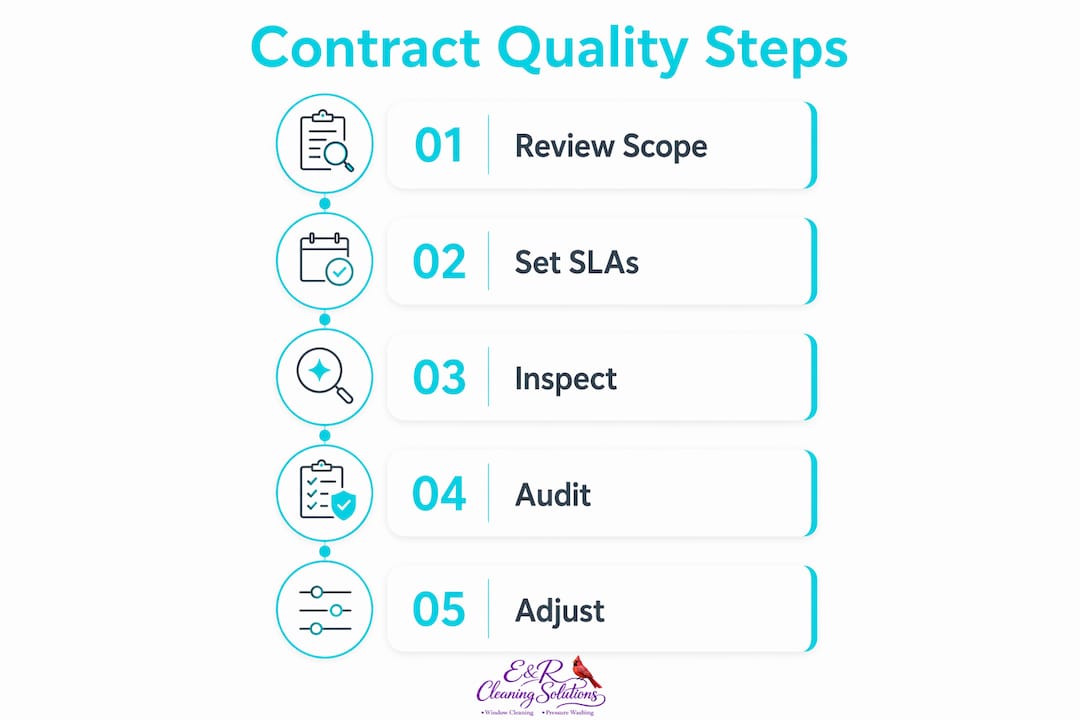
Quality standards belong inside the contract itself, not in a separate email thread. The industry term for this is a Service Level Agreement, or SLA. An SLA defines what “clean” means in objective, auditable terms.
Here is a practical framework for embedding SLAs into your commercial cleaning contract checklist:
- Define pass/fail criteria per zone. Use a 1–5 scoring scale for each area. A score of 3 or below triggers a mandatory re-clean within 24 hours.
- Schedule formal inspections. Monthly walkthroughs with a signed inspection report create a paper trail. Inspection pass rates are more useful than simple pass/fail records because they show trends over time.
- Require documented SOPs. Documented SOPs accessible via mobile devices ensure service quality stays consistent regardless of which crew member shows up. Visual SOPs are especially effective for multi-shift operations.
- Audit disinfectant dwell times. Proper disinfectant dwell time runs 3–10 minutes depending on the product. Many crews spray and wipe immediately, which means surfaces are not actually disinfected. Make dwell time compliance a named KPI in the contract.
- Use a vendor scorecard. Vendor evaluation scorecards rate cleaning partners on a 1–5 scale across multiple criteria. Vendors scoring below 70 out of 100 points are generally rejected for quality reasons.
Pro Tip: Send the vendor a blank copy of your inspection scorecard before the contract starts. Vendors who know exactly how they will be evaluated perform better from the first week.
The scorecard criteria that matter most are supervisor structure, staff tenure, and scope clarity. Aesthetics rank lower because they are subjective. Weight your scoring accordingly.
| Quality KPI | Measurement method | Acceptable threshold |
|---|---|---|
| Inspection score per zone | 1–5 scale per area | Minimum average of 3.5 |
| Re-clean response time | Hours from reported miss | Within 24 hours |
| Disinfectant dwell time | Timed spot audit | Per manufacturer instructions |
| Vendor scorecard total | Points across all criteria | Minimum 70 out of 100 |
What insurance and legal protections should every property manager require?
Insurance is the most frequently skipped section of a cleaning vendor inspection checklist, and it is the section that costs the most when it is missing. Require the following coverage types before any vendor sets foot on your property:
- General liability insurance: Covers property damage and bodily injury caused by the cleaning crew. Minimum coverage limits vary by property size, but $1 million per occurrence is a common baseline.
- Workers’ compensation: Protects you if a cleaner is injured on your property. Without it, you may face liability for their medical costs.
- Commercial auto insurance: Required if the vendor drives to your property in a company vehicle.
- Umbrella liability: Recommended for large commercial properties where a single incident could exceed standard policy limits.
Require a certificate of insurance (COI) naming your facility as an additional insured before the first service date. COI verification is critical because insurance and bonding are frequently overlooked until an incident occurs. Being named as an additional insured means the vendor’s policy covers claims made against you, not just against the vendor.
Bonding and background checks belong in this section too. A surety bond protects you if a crew member steals from your property. Background check assurances confirm the vendor screens employees before placing them on your site.
For healthcare facilities, medical offices, or any property handling sensitive records, add a confidentiality clause and reference HIPAA compliance requirements explicitly. Access control provisions, covering key issuance, key card logs, and alarm code management, round out the legal protections section. For more on how these insurance requirements apply to specialized services, the residential window cleaning process guide from E and R Cleaning Solutions covers COI verification in practical detail.
How do you roll out and manage a cleaning contract over time?
A signed contract is the starting point, not the finish line. The rollout phase determines whether the agreement actually works in practice.
- Conduct a baseline walkthrough. Walk the property with the vendor before the first service. Document existing damage, stains, and problem areas in writing and with photos. This protects both parties from future disputes.
- Calibrate the checklist. Adjust task frequencies based on actual foot traffic and usage patterns observed during the walkthrough. A conference room used daily needs different attention than one used monthly.
- Set up communication channels. Designate a single point of contact on both sides. Define the escalation path: who to call for a missed task, who to contact for a billing dispute, and what the response time expectation is.
- Schedule review cycles. Conduct formal reviews at 30, 60, and 90 days after launch. These early reviews catch scope gaps before they become habits. After 90 days, quarterly reviews are sufficient for most properties.
- Document every change order. Any scope modification, whether adding a new floor or removing a service, requires written approval from both parties. Keep a dated log of all changes. This log becomes critical if a billing dispute arises.
- Maintain digital records. Store signed contracts, inspection reports, COIs, and change orders in a single digital folder. Paper records get lost; digital records are searchable and shareable.
The most common rollout failure is a vague scope statement that neither party questions until quality drops. Detailed task frequency per zone is the single most effective safeguard against this outcome. Treat the contract as a living document. Review and update it at each annual renewal.
Key Takeaways
A complete cleaning service contract checklist combines a detailed scope of work, measurable SLAs, verified insurance, and a structured rollout plan to protect your property and hold vendors accountable from day one.
| Point | Details |
|---|---|
| Scope of work specificity | Use a room-by-room, task-by-task matrix to prevent quality drift within 30–60 days. |
| SLAs and inspection scoring | Embed a 1–5 scoring scale per zone with a mandatory 24-hour re-clean for scores below 3. |
| Insurance verification | Require a COI naming your property as additional insured before the first service date. |
| Change-order controls | Define written approval requirements for all scope changes to prevent unauthorized invoices. |
| Ongoing review cycles | Schedule formal reviews at 30, 60, and 90 days, then quarterly, to catch scope gaps early. |
What I’ve learned from years of watching contracts fail
Most cleaning contracts fail in the first 90 days, and the reason is almost always the same. The scope section reads like a marketing brochure instead of a technical specification. “Clean and maintain common areas” sounds professional. It means nothing when you are standing in a lobby that has not been mopped in a week.
The property managers I respect most treat the scope exhibit like a floor plan. Every zone gets its own row. Every task gets a frequency. Every frequency gets a unit: daily, weekly, per visit. When you write it that way, there is no room for a vendor to claim they did not know what was expected.
The second pattern I see constantly is the insurance section getting skipped during onboarding because everyone is eager to get started. Then a crew member slips on a wet floor, or a window gets scratched, and suddenly no one can find the COI. Require the certificate before the contract is signed. Not before the first visit. Before the signature.
The third thing I would tell any property manager is to use the scorecard before you need it. Run a mock inspection in the first week. Share the results with the vendor. Vendors who see their own scores early adjust their behavior. Vendors who only hear about problems through complaints tend to get defensive. The scorecard makes feedback objective, and objective feedback is much easier for everyone to act on.
Contracts are not about distrust. They are about clarity. The best vendor relationships I have seen are the ones where both sides agreed on exactly what success looks like before the work started.
— Richard
Professional cleaning services backed by clear agreements
Property managers who want contract-backed quality from day one need a vendor who already operates with those standards built in. E and R Cleaning Solutions brings over five years of experience serving commercial properties with transparent pricing and documented service processes.

Whether you manage a single office building or a portfolio of commercial properties, E and R Cleaning Solutions handles the details that matter most. Their commercial window cleaning services are delivered with the same attention to scope and accountability this article describes. For a full picture of their cleaning frequency recommendations and service planning for 2026, the window cleaning frequency guide is a practical next step. Reach out to discuss a service agreement that protects your property and delivers results you can measure.
FAQ
What should a cleaning service contract always include?
A cleaning service contract must include a detailed scope of work, service frequency matrix, pricing terms, insurance requirements, and termination clauses. Vague scope statements are the leading cause of accountability failures.
How do SLAs work in a commercial cleaning agreement?
A Service Level Agreement defines measurable quality standards, such as a minimum inspection score per zone, and specifies remediation timelines like a 24-hour re-clean for any missed task.
What insurance does a cleaning vendor need?
Cleaning vendors should carry general liability, workers’ compensation, and commercial auto insurance at minimum. Require a certificate of insurance naming your property as an additional insured before service begins.
How often should a cleaning contract be reviewed?
Conduct formal reviews at 30, 60, and 90 days after launch, then move to quarterly reviews. Review and update the full contract at each annual renewal to reflect any scope changes.
What is a change-order clause in a cleaning contract?
A change-order clause requires written approval from both parties before any work outside the original scope is performed or invoiced. It prevents surprise charges and unauthorized service additions.