Fleet Window Cleaning for Commercial Property: 2026 Guide

Fleet window cleaning for commercial property is the coordinated use of specialized equipment, trained technicians, and recurring service contracts to keep multiple buildings’ windows clean, safe, and code-compliant. Property managers who treat window cleaning as a maintenance program rather than a one-off task protect their glass investment, satisfy tenants, and stay ahead of OSHA safety requirements. Professional window cleaning also prevents pollutant and mineral buildup that degrades glass over time, making it a structural concern, not just a cosmetic one. E and R Cleaning Solutions has built its commercial program around exactly this principle: scheduled, site-specific service that delivers measurable results on every visit.
What are the essential prerequisites for fleet window cleaning commercial property?
A commercial window cleaning fleet program requires three things before the first crew arrives: proper insurance, the right access equipment, and a site-specific plan. Skipping any one of these creates liability exposure or poor results that cost more to fix later.
Insurance and compliance are non-negotiable. Providers should carry liability coverage of $2M or more, plus workers’ compensation, and supply a Certificate of Insurance before work begins. That documentation protects you as the property manager if an accident occurs on your site.

Access method selection depends directly on building height. Specialized access methods match the job: water-fed poles reach up to 4 stories, rope descent systems handle mid-rise and high-rise facades, and drone-assisted cleaning extends to 30 stories. Choosing the wrong method wastes time and increases risk.
| Access method | Best suited for | Key advantage |
|---|---|---|
| Water-fed poles | Up to 4 stories | No ladders, fast coverage |
| Boom lifts | 4–10 stories | Stable platform, heavy glass |
| Rope descent | 10–30 stories | Low equipment footprint |
| Drone-assisted | Up to 30 stories | Minimal disruption to tenants |
Scheduling and site walkthroughs complete the setup. Off-hours scheduling reduces tenant disruption and avoids foot traffic conflicts. A pre-service walkthrough lets the crew assess glass condition, access points, and any fragile fixtures before pricing is finalized.
Pro Tip: Request a site-specific quote, not a per-pane rate. Pricing that accounts for building architecture, glass type, and access complexity is far more accurate and avoids surprise charges mid-contract.
Recurring maintenance contracts also unlock volume pricing benefits compared to one-time service calls. For property managers overseeing multiple buildings, that cost difference compounds quickly across a full year.
How often should commercial properties schedule fleet cleaning services?
Cleaning frequency is the variable most property managers get wrong. Office towers typically schedule exterior cleaning every 6–8 weeks, while retail storefronts and medical facilities often require monthly service. That gap exists because foot traffic, signage lighting, and patient-facing environments demand a higher visual standard.
Environmental factors push frequency higher in specific locations. Coastal salt air accelerates glass etching and corrosion, meaning a beachfront office park needs more frequent cleaning than an inland corporate campus with identical square footage. Urban pollution from vehicle exhaust and construction dust creates a similar effect in dense city centers.
Preventative maintenance is the real argument for consistent scheduling. Regular cleaning prevents the mineral and pollutant buildup that permanently etches glass surfaces. Once etching occurs, the only fix is glass replacement, which costs far more than a year of scheduled cleaning.
Property type guides the baseline cadence:
- High-traffic retail and medical: monthly service
- Office towers and corporate campuses: every 6–8 weeks
- Industrial facilities: quarterly, adjusted for production dust or chemical exposure
- Coastal or high-pollution locations: add one to two extra cycles per year
Pro Tip: Build your cleaning schedule around your lease renewal cycle. Clean windows before tenant move-ins and annual inspections to protect your property’s perceived value and reduce vacancy time.
For a broader look at how cleaning frequency maps to property type and season, the principles transfer directly from residential to commercial contexts.
What is the step-by-step process for professional commercial window cleaning?
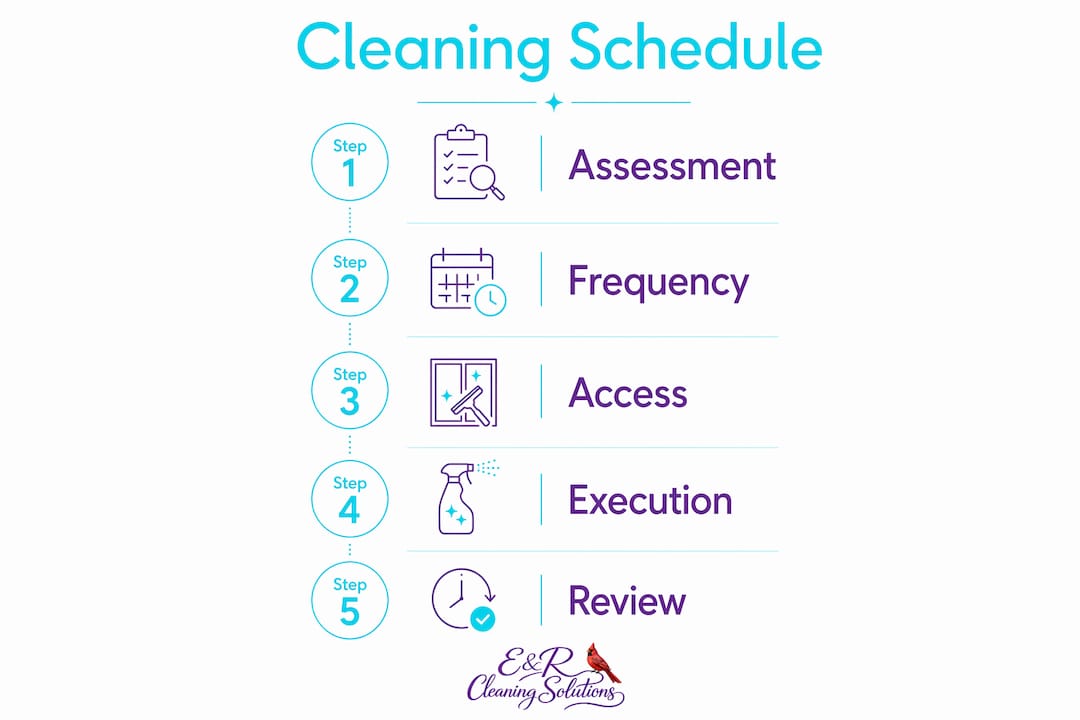
A professional commercial window cleaning operation follows a defined sequence. The standard process moves from inspection through execution to a final quality walkthrough, and each stage has a specific purpose.
- Initial site walkthrough. The crew assesses glass condition, access points, building height, and any hazards. This step produces the data needed for an accurate quote.
- Customized cleaning plan and pricing. Site-specific pricing accounts for glass type, building architecture, and access complexity. Flat-rate pricing ignores these variables and leads to disputes.
- Tenant and building management notification. Property managers should notify tenants at least 48 hours before exterior work begins. This prevents complaints and keeps crews from working around unexpected obstacles.
- Off-hours execution. Crews work before business opens or after it closes to avoid disrupting operations. For multi-building portfolios, staggered scheduling keeps the program moving without bottlenecks.
- Equipment deployment. Technicians select the correct access method for each building section and apply appropriate cleaning solutions for the glass type present.
- Final inspection and client walkthrough. A supervisor reviews every elevation for streaks, missed sections, or damage. The property manager signs off before the crew leaves the site.
Pro Tip: Assign one point of contact on your team to coordinate with the cleaning provider. A single communication channel prevents scheduling conflicts and speeds up issue resolution when something unexpected comes up.
The walkthrough at step 6 is the step most property managers skip when managing multiple sites remotely. Skipping it means defects go undetected until a tenant complains, which costs more to address than a five-minute post-service check.
What are common mistakes in managing commercial window cleaning fleets?
The most expensive mistake property managers make is hiring an uninsured provider. Using insured and certified technicians is the primary way to avoid OSHA liability and financial exposure if a worker is injured on your property. A low bid from an uninsured crew is never worth the risk.
Other common failures include:
- No customized schedule. A fixed calendar that ignores building type and environmental exposure leads to overcleaning some properties and neglecting others.
- Poor tenant communication. Crews arriving unannounced during business hours create complaints and damage tenant relationships.
- Ignoring building complexity. A property manager who treats a 20-story glass tower the same as a two-story retail strip will consistently underprice and underservice the tower.
- Skipping the final inspection. Quality defects caught at the end of a visit cost nothing to fix. Quality defects discovered a week later require a return trip.
- No written contract. Verbal agreements on scope, frequency, and pricing create disputes. A written recurring contract protects both parties.
“Certified insurance and compliance with safety regulations is paramount to managing risk and protecting property owners.” — BAM Pressure Cleaning
The pattern behind most of these mistakes is the same: treating window cleaning as a commodity purchase rather than a managed service. Property managers who build a real vendor relationship, with documented scope and verified credentials, avoid nearly all of these problems.
How do you evaluate and select a commercial window cleaning provider?
Provider selection comes down to six criteria. Work through each one before signing any contract.
Insurance verification. Confirm the provider carries at least $2M in general liability coverage and active workers’ compensation. Request the Certificate of Insurance directly from their insurer, not just a copy from the vendor.
Equipment and access capability. Ask specifically which access methods the provider uses and whether their equipment matches your building heights. A provider with only water-fed poles cannot safely service a 15-story facade.
Contract structure and volume pricing. Recurring maintenance plans at monthly, quarterly, or semi-annual intervals typically offer better rates than one-time calls. For multi-property portfolios, ask about bulk pricing across your full building count.
Certifications and safety training. Height work and traffic safety require specific credentials. Ask for documentation of technician training, not just a general statement about safety practices.
References for multi-site experience. A provider who has managed a single office building is not the same as one who coordinates a 10-property portfolio. Ask for references from property managers with comparable portfolio size.
Pricing transparency. Transparent, site-specific pricing builds trust and prevents scope disputes. Providers who quote without a site visit are guessing, and that guess usually benefits them, not you.
For a detailed breakdown of what drives commercial exterior cleaning costs, reviewing the key pricing variables before your first vendor conversation puts you in a stronger negotiating position.
Pro Tip: Ask every candidate provider for a sample contract before committing. The contract language reveals how they handle scope changes, missed visits, and damage claims, which tells you more than any sales conversation.
Key Takeaways
A well-managed commercial window cleaning fleet program requires verified insurance, matched access equipment, and a scheduled cadence tied to building type and environmental exposure.
| Point | Details |
|---|---|
| Insurance is mandatory | Require $2M liability coverage and a Certificate of Insurance before any work begins. |
| Match equipment to height | Water-fed poles suit low-rise; rope descent and drones handle mid-rise and high-rise facades. |
| Frequency depends on context | Office towers clean every 6–8 weeks; retail and medical facilities need monthly service. |
| Cleaning is preventative maintenance | Regular service stops mineral and pollutant buildup that permanently etches glass. |
| Written contracts protect both parties | Document scope, frequency, pricing, and damage protocols before the first visit. |
What I’ve learned managing window cleaning programs at scale
Property managers consistently underestimate how much building location changes the math on cleaning frequency. I’ve seen coastal properties develop permanent glass etching within 18 months because the cleaning schedule was set for an inland office park. That etching required full panel replacement. The cost of two extra cleaning visits per year would have been a fraction of the repair bill.
The second thing I’d push back on is the instinct to go with the lowest bid. An uninsured provider who charges 30% less is transferring their liability risk directly onto your balance sheet. One on-site injury without proper workers’ compensation coverage can result in a claim against your property. The math on that trade-off is not close.
Recurring contracts are where the real value lives. A provider who knows your buildings, your tenants’ schedules, and your glass types delivers better results than a new crew every quarter who needs to relearn the site. Consistency also makes it easier to spot when something changes, like a new source of pollution or a section of glass that is degrading faster than expected.
Transparent pricing is the last piece. Providers who quote without a site visit are not pricing your building. They are pricing an average building, and yours is probably not average. Insist on a walkthrough before any number is put on paper.
— Richard
E and R Cleaning Solutions’ commercial fleet cleaning programs
Commercial property managers who want consistent results without managing vendor compliance from scratch have a direct option.
E and R Cleaning Solutions brings over five years of hands-on experience to commercial window cleaning programs for property managers and business owners. Every engagement starts with a free site walkthrough and a customized quote that reflects your actual building footprint, not a generic rate sheet. The team carries full liability insurance and workers’ compensation, and recurring maintenance plans are available at monthly, quarterly, or semi-annual intervals with volume pricing for multi-property portfolios. Honest pricing and direct communication are built into every contract. Contact E and R Cleaning Solutions to schedule your walkthrough and get a site-specific plan for your properties.
FAQ
What does fleet window cleaning mean for commercial properties?
Fleet window cleaning for commercial properties refers to a coordinated, recurring service program that covers multiple buildings or large facades using specialized equipment and scheduled visits. It treats window maintenance as an ongoing program rather than a one-time job.
How often should commercial windows be professionally cleaned?
Office towers typically schedule cleaning every 6–8 weeks, while retail and medical facilities often require monthly service. Coastal or high-pollution locations need additional cycles to prevent glass etching.
What insurance should a commercial window cleaning provider carry?
Providers should carry at least $2M in general liability coverage plus active workers’ compensation, and supply a Certificate of Insurance before starting any work on your property.
Why does window cleaning count as preventative maintenance?
Pollutants and mineral deposits etch glass permanently if left untreated, eventually requiring full panel replacement. Regular cleaning removes these deposits before they cause irreversible damage.
What access methods do commercial window cleaning crews use?
Water-fed poles handle buildings up to 4 stories, boom lifts and rope descent systems cover mid-rise structures, and drone-assisted cleaning reaches facades up to 30 stories. The correct method depends on building height and site conditions.