
Homeowners: 2 Conditions That Let Pros Clean Windows in Rain

Yes, but with two conditions: safety and quality. Professional window cleaners will typically continue work through light rain or drizzle, since it rarely affects the finish, but they stop for thunderstorms, lightning, or high winds because those conditions turn ladders and water-fed poles into hazards. Heavy or sustained rain also compromises the clean itself, since fresh water and airborne grime can undo the work before it dries.
TL;DR:
- Using purified water with zero dissolved solids prevents mineral spots that rainwater and runoff can leave on glass surfaces.
- Light drizzle or scattered showers usually do not halt work, but thunderstorms, lightning, or high winds prompt immediate rescheduling for safety reasons.
- Full-assembly cleaning of frames, sills, and screens helps prevent rain from re-soiling the glass after a wash; neglecting these areas can lead to streaks.
- Heavy rain or pollution from nearby construction sites can overwhelm cleaning efforts, making it better to wait for drier conditions rather than attempt to clean in those conditions.
- Rain can cause windows to look worse after cleaning due to mineral deposits or contaminant streaks, especially if seals are failing or mineral etching has occurred.
Table of Contents
- How rain affects window-cleaning results
- When pros clean through rain and when they call it off
- Tools and techniques that keep results consistent in wet weather
- Why windows sometimes look worse right after rain
- Scheduling and setting expectations around wet weather
- How rain interacts with coated and tinted glass
- Cleaning up after a storm passes
- What field experience says about cleaning through wet weather
- How E and R Cleaning Solutions handles wet-weather jobs
- Sources
- FAQ
How rain affects window-cleaning results
Rain is not pure water. As it falls, it picks up dust, pollen, and airborne pollutants, and once it lands on a roof or gutter, it can pick up more. When that water evaporates off a window, whatever it carried stays behind as a spot or film. This is why a window that looks streak-free right after a wash can look spotted an hour later if rain hits it while it is still drying.
Professional cleaners avoid adding to that problem by using purified water with zero total dissolved solids, often shortened to 0 TDS. Ordinary tap water leaves behind calcium, magnesium, and other minerals as it dries, and rainwater and runoff can carry similar dissolved solids and metals, so cleaning with mineral-free water means there is nothing left on the glass for the rain to bond with.
Cleaning only the glass is another common shortfall. Rain that hits a dirty frame, sill, or screen washes that grime straight down onto clean panes.
- Purified water dries clear because it leaves no mineral residue for rain to interact with.
- Full-assembly cleaning, meaning glass, frame, sill, and screen, stops runoff from re-soiling the window after a wash.
When pros clean through rain and when they call it off
Most crews work off a simple rule: if the rain is light and the sky is calm, the job continues. If lightning, thunder, or sustained high winds show up, the job stops. OSHA guidance on outdoor work during storms is direct on this point: developing thunderstorms and lightning are unsafe conditions for anyone working outdoors, and the safest move is to stop and shelter until the risk passes.
- Drizzle or scattered light showers: work usually continues, sometimes with the pole or squeegee technique adjusted.
- Steady moderate rain: crews may shift to interior work first and wait out the exterior pass.
- Thunderstorms, lightning, or high wind: work stops outright, regardless of the schedule.
Crews lean on live forecasts and alerts from sources like NOAA rather than guessing, since local radar can show a storm cell arriving faster than it looks from the ground. Carbon-fiber water-fed poles add a specific risk here too: long conductive poles are a poor idea anywhere near lightning, which is one more reason crews reschedule instead of pushing through.
Pro Tip: If a crew reschedules for weather, that is a sign they are following safety protocol, not a sign of poor service.
Tools and techniques that keep results consistent in wet weather
The gap between a window cleaner who struggles in wet weather and one who does not usually comes down to equipment and sequence, not effort.
- Purified 0 TDS water rinses without leaving mineral spots, since research on rainwater and runoff chemistry shows dissolved solids are a major cause of that hazy residue.
- Water-fed poles reach upper-story glass from the ground, cutting the need for ladders on wet, slippery surfaces and letting crews work faster between showers. A water-fed pole approach also changes how a crew handles borderline weather, since ground-based reach reduces some of the footing risk that stops ladder work.
- Squeegee technique matters more in damp air, where a slower, overlapping pull keeps water from re-depositing on glass that is already clean.
- Full-assembly cleaning of frames, sills, and tracks, detailed in a typical residential window cleaning process, keeps rain from carrying leftover grime onto the glass right after it is wiped down.
Even with the right tools, there is a ceiling. Continuous heavy rain, or a location with heavy pollutant load nearby such as a construction site or busy roadway, can outpace any cleaning method. In those cases, pros will often say the honest thing: wait for a drier window rather than pay for a clean that will not hold.
Why windows sometimes look worse right after rain
A window can come out of a storm looking dirtier than before it rained, and that usually traces back to one of two things: mineral deposits or contaminant buildup.
- Evaporative rings form when mineral-heavy water dries on glass in an irregular pattern, leaving faint circular marks rather than an even film.
- Contaminant streaks come from roof runoff, gutter overflow, or nearby dust and pollen that rain carries down the glass and leaves in vertical lines.
- Urban rainwater can carry dissolved ions from the surrounding air, and research on rainwater composition shows those ions vary by location and season, which is part of why the same rain shower affects two houses differently.
Surface streaks and light mineral film usually come off with a standard clean. Deep mineral etching, where hard water has sat on glass long enough to pit the surface, is a different problem and may need a dedicated hard-water stain treatment rather than a routine wash.
Scheduling and setting expectations around wet weather
Planning around rain is mostly about timing and communication rather than anything technical.
- Book cleans for a stretch of forecasted dry or lightly overcast days rather than the day after a storm, when runoff and dust are still settling.
- Ask a prospective cleaner three things before hiring: do they use purified water, do they clean the full frame and sill assembly, and what is their policy for rescheduling around weather.
- Clear gutters and check that downspouts direct water away from the house, since overflow is one of the most common sources of streaking right after a clean.
- If a storm is approaching from a region prone to seasonal severe weather, treat outdoor cleaning like other exterior prep, in the way hurricane season yard preparation guidance recommends for other outdoor tasks.
Property managers overseeing multiple buildings benefit from a written weather policy in the service agreement, so tenants and staff know rescheduling is standard practice, not an excuse.
How rain interacts with coated and tinted glass
Not all glass behaves the same way in wet weather. Low-E coatings, applied to many modern windows to manage heat transfer, sit on the outer or inner surface of the glass and can be more sensitive to abrasive cleaning than plain glass. Rain itself does not damage a Low-E coating, but grit picked up in runoff can scratch a coated surface if it is scrubbed with the wrong tool, which is one reason professionals favor soft applicators and purified water over abrasive pads.
Tinted film reacts differently. Film is applied to the interior side of glass in most residential and commercial buildings, so exterior rain has little direct effect on it, but water that seeps behind poorly sealed film edges can cause bubbling or lifting over time. That is a maintenance issue tied to installation quality, not to rain exposure during a routine window clean.
Older single-pane glass and newer double-pane units also handle moisture differently. Double-pane windows with a sealed gap resist fogging between panes, while a failing seal on an older double-pane unit can let moisture in in ways no amount of exterior cleaning will fix. If a homeowner notices persistent fog between the panes rather than on the surface, that points to a seal failure rather than a cleaning problem, and it is worth mentioning to a cleaning crew so they can flag it rather than attempt to treat it as dirt.

Cleaning up after a storm passes
Once a storm clears, the priority is removing whatever it left behind before it has time to dry into a harder stain.
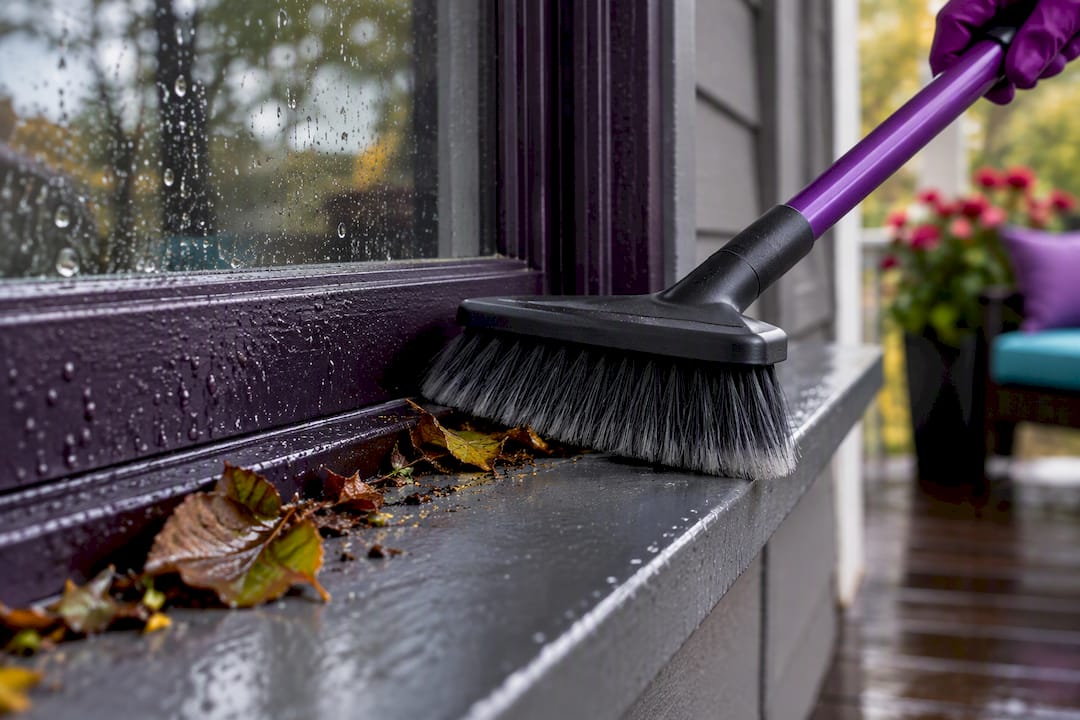
Start with the frames and sills, since debris settled there during the rain will otherwise wash back onto the glass during the next cleaning pass or the next storm. A soft brush attachment clears leaves, grit, and pollen without scratching the frame.
For the glass itself, a squeegee pass with purified water handles surface streaks and light mineral film in one pass. If evaporative rings have already formed and dried, they usually need a second pass with a bit more dwell time rather than more pressure, since scrubbing harder on dried mineral deposits risks micro-scratching the glass.
Homeowners looking for a simple maintenance routine between professional visits can lean on the basics covered in a guide to homeowner window cleaning tools, which walks through which tools handle light residue without leaving lint or streaks behind. For anything beyond light residue, particularly hard-water etching that has been building for months, a professional assessment is the more reliable route, since some mineral damage responds to treatment and some does not.
What field experience says about cleaning through wet weather
The clearest lesson from years of scheduling around weather is that homeowners rarely mind a reschedule once they understand why it happens. A crew that stops for lightning or turns back from a job site when thunder rolls in is protecting people, not dodging work. On the quality side, purified water solves more post-rain complaints than any technique change, since most of what looks like a “bad clean” after rain is actually mineral residue from water that was never fully clean to begin with.
One recurring pattern on rain-affected jobs: switching a scheduled ladder job to a water-fed pole approach when a light shower rolls in mid-job keeps the crew off wet rungs and lets the work finish safely rather than stopping entirely.
— Richard
How E and R Cleaning Solutions handles wet-weather jobs
Some professional window cleaning services build weather judgment into every booking rather than treating rain as an afterthought. Jobs may proceed through light drizzle using purified water and full-assembly cleaning of glass, frames, sills, and screens, with pauses for lightning, high wind, or sustained heavy rain until conditions are safe again.

What a homeowner or property manager can expect when booking:
- Custom estimates for window cleaning or pressure washing based on the property, rather than generic flat rates.
- Transparent weather policies explained up front, so rescheduling is not surprising.
- Flexible scheduling designed to work around storm systems.
For a straightforward, honestly priced quote on window cleaning or pressure washing, visit E and R Cleaning Solutions to check availability and get an estimate.
Sources
- Influence of Atmospheric Deposition and Roof Materials on Harvested Rainwater Quality
- Reducing Lightning Hazards When Working Outdoors — OSHA
- NOAA
FAQ
When should you avoid cleaning windows?
Avoid cleaning windows during thunderstorms, lightning, or high winds, since OSHA guidance treats these as unsafe conditions for any outdoor work. Direct sun on hot days is also a poor time, since cleaning solution can dry before it is wiped, leaving streaks.
What month is best for window cleaning?
There is no single official best month, since it depends on your regional climate and pollen or storm patterns. Many homeowners schedule around spring and fall, aiming for stretches of mild, dry weather between seasonal extremes.
Is vinegar better than Windex for cleaning windows?
Neither is inherently better; both can leave streaks if used with a lint-producing cloth or under direct sun. Professionals typically favor purified, mineral-free water and a squeegee over either product, since it is the water quality, not the cleaner, that most affects spotting.
Do professional window cleaners use Dawn dish soap?
Some cleaners use a small amount of dish soap in their solution, but professional results depend far more on water quality and technique than on the specific soap. Purified 0 TDS water and full-assembly cleaning, covering glass, frames, and sills, matter more to the final result than which brand of soap is in the bucket.
Can window cleaners work in light rain?
Yes, light rain or drizzle rarely stops a professional job, since it has little effect on a properly cleaned surface once purified water is used. Crews reschedule for thunderstorms, lightning, or high winds rather than for rain alone.