Why Paint Peels on Storefronts and How to Stop It
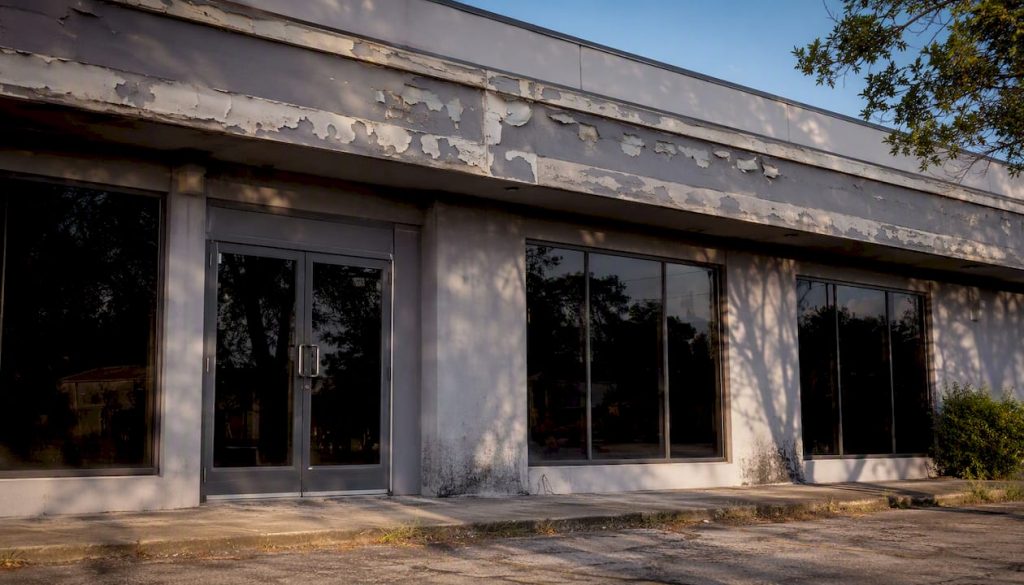
Most storefront paint peeling traces back to one root problem: the coating couldn’t bond to a clean, dry, and stable surface. Research indicates that a majority of exterior paint failures are linked to poor or improper surface preparation, which means the majority of peeling jobs you see on commercial facades were preventable before the first brush stroke. The immediate action is always the same: stop further water exposure, remove loose paint, and identify whether active moisture is still entering the wall.
The causes break into a short list:
- Failed surface prep (the leading cause by a wide margin)
- Moisture intrusion through failed caulk, clogged gutters, or interior vapor migration
- Missing or wrong primer for the substrate
- Wrong paint type for the surface or climate
- Environmental stressors including UV, heat/cold cycling, and wind
- Improper application conditions such as painting in cold or humid weather
- Contaminants like mildew, salt, or oil that block adhesion
Sherwin-Williams guidance on surfactant leaching also flags cool, moist application conditions as a trigger for sticky residue that looks like a finish defect but is actually a chemistry problem. If you need professional help with cleaning and surface prep before repainting, E and R Cleaning Solutions handles exactly that for commercial storefronts.
Pro Tip: Before calling a painter, walk the perimeter and press your thumbnail against any peeling edge. If the paint lifts easily across a large area, the problem is systemic — not just cosmetic — and a spot patch will fail again within months.
Key Takeaways
Poor surface preparation causes most storefront paint failures, and stopping active moisture before any repair work is the single step that prevents repeat failures.
| Point | Details |
|---|---|
| Surface prep is the leading cause | Over 65% of exterior paint failures trace to poor or improper surface preparation. |
| Stop water before repainting | Active moisture behind the film will cause any new coat to fail; fix gutters and caulk first. |
| Primer and product matching matter | Wrong primer or paint type for the substrate leads to early cracking, tannin bleed, or adhesion failure. |
| Schedule regular cleaning | Annual or semiannual soft washing removes mildew and contaminants that degrade paint adhesion over time. |
| E and R Cleaning Solutions | Provides commercial soft washing and surface prep to get storefronts ready for a lasting repaint. |
Table of Contents
- How does paint adhesion actually fail on storefront exteriors?
- What causes paint peeling on storefronts? The eight most common culprits
- How to inspect your storefront and find the real root cause
- When should you DIY storefront paint repairs, and when should you hire a pro?
- A maintenance schedule that prevents storefront paint from peeling
- Why proactive maintenance is the smarter financial decision
- E and R Cleaning Solutions can handle the prep work for you
- Sources
How does paint adhesion actually fail on storefront exteriors?
Adhesion is a mechanical bond. Paint grips a surface through microscopic interlocking with the substrate’s texture, aided by the right primer chemistry. Disrupt any part of that system and the film eventually separates.
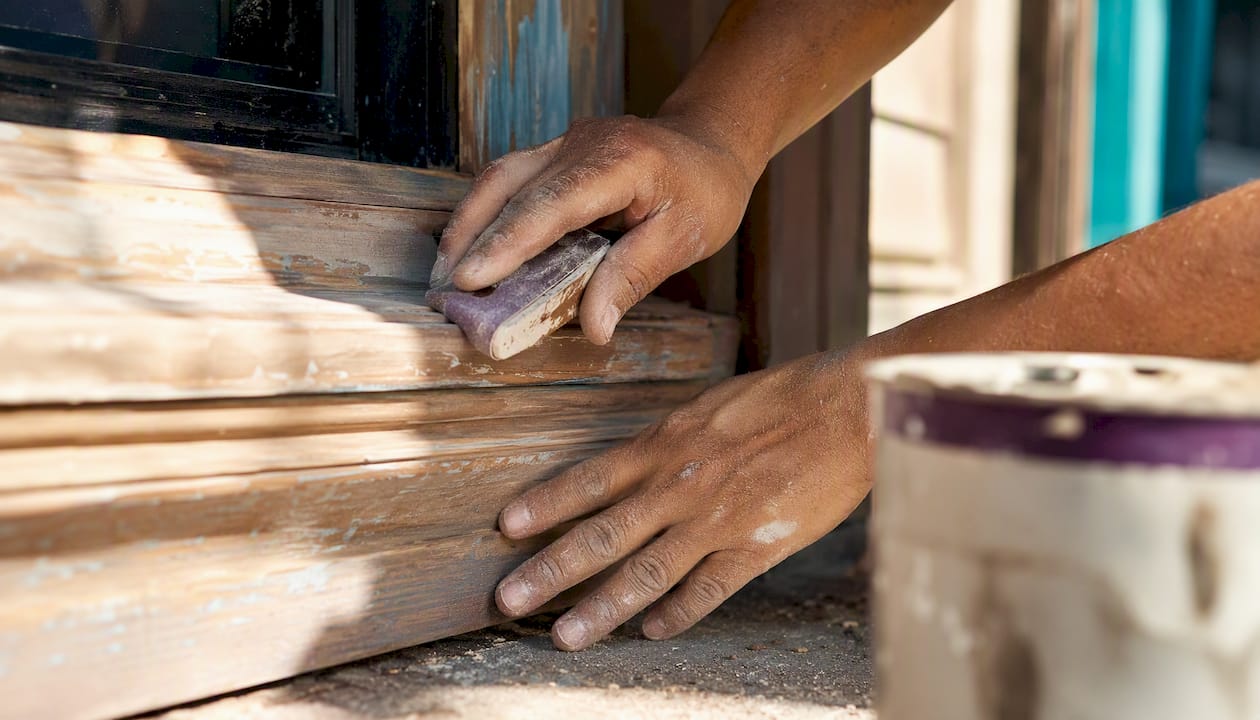
Modern water-based (latex) paints cure through a process called binder coalescence: as water evaporates, polymer particles fuse into a continuous film. Oil-based paints cure through oxidation. Both processes are sensitive to temperature, humidity, and surface condition. Apply either type over a glossy, dirty, or damp surface and the film forms on top of the contaminant layer, not on the substrate itself.
Moisture is the most aggressive disruptor. Water vapor migrating from inside a heated retail space pushes outward through walls in winter. When it reaches the back of a paint film, it condenses, swells the substrate, and breaks the bond from behind. You never see it coming until a blister forms.
Storefronts have two specific vulnerabilities most residential buildings don’t:
- Large display windows create intense UV and heat cycles on adjacent wall sections. UV exposure dries paint resins and makes films brittle, so daily thermal expansion and contraction eventually cracks and peels the coating.
- Metal door frames and storefront systems expand and contract more than wood or masonry. A paint film that can’t flex with that movement will crack at the frame edge within one or two seasons.
Professional cause-to-failure mapping from Fine Homebuilding confirms that missing primer, contaminants, and wrong application conditions are the recurring themes behind most paint failure patterns.
What causes paint peeling on storefronts? The eight most common culprits
-
Poor surface preparation — Visual clue: large sections of new paint lifting, often with the old coat attached. Quick fix: scrape all loose paint, sand edges, clean the surface, and prime before recoating. Most exterior paint failures are often traced back to this single cause.
-
Moisture intrusion — Visual clue: blistering or peeling that starts near window perimeters, caulk joints, or below gutters. Quick fix: identify and stop the water source first, dry the substrate thoroughly, re-caulk, then repair the paint.
-
No primer or wrong primer — Visual clue: rapid absorption, patchy sheen, or brown tannin staining bleeding through. Quick fix: select a primer matched to the substrate — shellac-based for tannin-heavy wood, rust-inhibiting for metal, masonry-specific for block or stucco.
-
Wrong paint type for the surface — Visual clue: cracking or flaking concentrated where the substrate flexes (metal frames, wood trim). Quick fix: match the coating to the substrate and climate; exterior-grade flexible coatings handle movement far better than interior or budget paints.
-
Environmental stressors — Visual clue: chalking, fading, or brittle paint concentrated near large windows or south-facing walls. Quick fix: specify UV-resistant coatings and lighter pigments; freeze-thaw cycles on commercial exteriors accelerate bond failure and demand a full surface-prep workflow before repainting.
-
Improper application conditions — Visual clue: early peeling, surfactant residue, or a cloudy finish. Quick fix: repaint when temperatures are between 50°F and 90°F, humidity is below 85%, and surfaces are dry. Applying paint late in the day risks overnight condensation that prevents proper coalescence of latex coatings.
-
Contaminants and surfactant leaching — Visual clue: sticky or glossy spots that may partially wash off. Quick fix: surfactant leaching from latex paints under cool, moist conditions often responds to washing; persistent staining requires cleaning and repainting under better conditions.
-
Failed caulk and trim interactions — Visual clue: cracking along bead lines at window frames or trim joints. Quick fix: remove failed caulk completely, apply new paintable caulk, and wait for full cure before painting. Painting over partially cured caulk guarantees long-term peeling because the caulk continues to shrink after the film sets.
How to inspect your storefront and find the real root cause
Start with two questions: Is water actively getting in? Does the paint lift easily? Those two answers determine urgency and repair scope.
Inspection checklist:
- Check all caulk joints at window frames, door frames, and trim for cracks, gaps, or separation.
- Inspect gutters and downspouts for blockages or misdirected drainage near the facade
- Look at window perimeters for staining, efflorescence, or soft substrate
- Examine the paint surface for blistering (moisture), chalking (UV degradation), or cracking (movement or age)
- Note substrate type: wood, metal, masonry, and EIFS each have different failure signatures
- Look for mildew, salt deposits, or oily residue that signals a contamination problem
Decision tree:
- Active leak present → stop the water source before any paint work; repairs on a wet substrate will fail again
- Paint fails adhesion test across a large area with an old glossy coat underneath → full surface prep and adhesion promotion required, not a spot patch
- Sticky or glossy residue in patches → surfactant leaching or contamination; commercial paint problems from improper prep and environment need cleaning and drying before repainting
Pro Tip: Press a 6-inch strip of painter’s tape firmly onto a suspect area, then pull it sharply. If paint comes off with the tape, the adhesion has failed and the entire section needs stripping and repriming — not just a topcoat. Always use fall protection equipment or hire a professional for any inspection above 10 feet.
When should you DIY storefront paint repairs, and when should you hire a pro?
Small, isolated peeling on an accessible section is a reasonable DIY repair. Widespread adhesion failure, active moisture, or any work above safe ladder height belongs with a professional.
Step-by-step repair sequence:
- Stop active water entry (repair gutters, re-caulk, fix flashing)
- Remove all loose paint by scraping and sanding to a firm edge
- Clean the surface with a soft wash or pressure wash at a safe PSI to remove mildew, salt, and contaminants
- Repair substrate damage and apply fresh paintable caulk; wait for full cure
- Prime with the correct primer for the substrate
- Apply an exterior-grade topcoat under manufacturer-recommended temperature and humidity conditions
DIY vs. hire:
- DIY is reasonable when: the affected area is small (under 10 sq ft), access is safe from ground level, there is no structural moisture, and the substrate is sound
- Hire a professional when: failure covers a large facade section, high access is required, there is evidence of structural moisture or rot, the building has historic substrates, or you suspect lead paint
On lead paint: any storefront built before 1978 may have lead-based coatings. Before disturbing the paint, test with an EPA-approved lead test kit. If lead is present, follow EPA Renovation, Repair, and Painting (RRP) rules and hire a certified contractor for abatement.
Ballpark costs: a small patch repair (under 20 sq ft) typically runs $150–$400 for materials and labor. A full storefront repaint on a mid-size facade can range from $1,500 to $6,000 or more depending on height, substrate condition, and local labor rates. Getting the surface prep right the first time is far cheaper than repainting a failed job two years later.
A maintenance schedule that prevents storefront paint from peeling
Regular cleaning and prompt moisture control are the two highest-impact prevention steps — and both cost far less than a repaint.
| Task | Frequency | Notes |
|---|---|---|
| Exterior soft or pressure wash | Annually or semiannually | High-traffic or high-pollution locations benefit from twice yearly |
| Inspect caulk joints and gutters | Annually (spring) | Re-caulk any gaps before the rainy season |
| Touch up exposed trim and bare wood | Every 1–2 years | Bare substrate degrades fast; small touch-ups prevent large repairs |
| Full exterior repaint | Every 7 years | Varies by substrate, climate, and coating quality |
| Window and perimeter cleaning | Quarterly | Removes contaminants that migrate to adjacent paint surfaces |
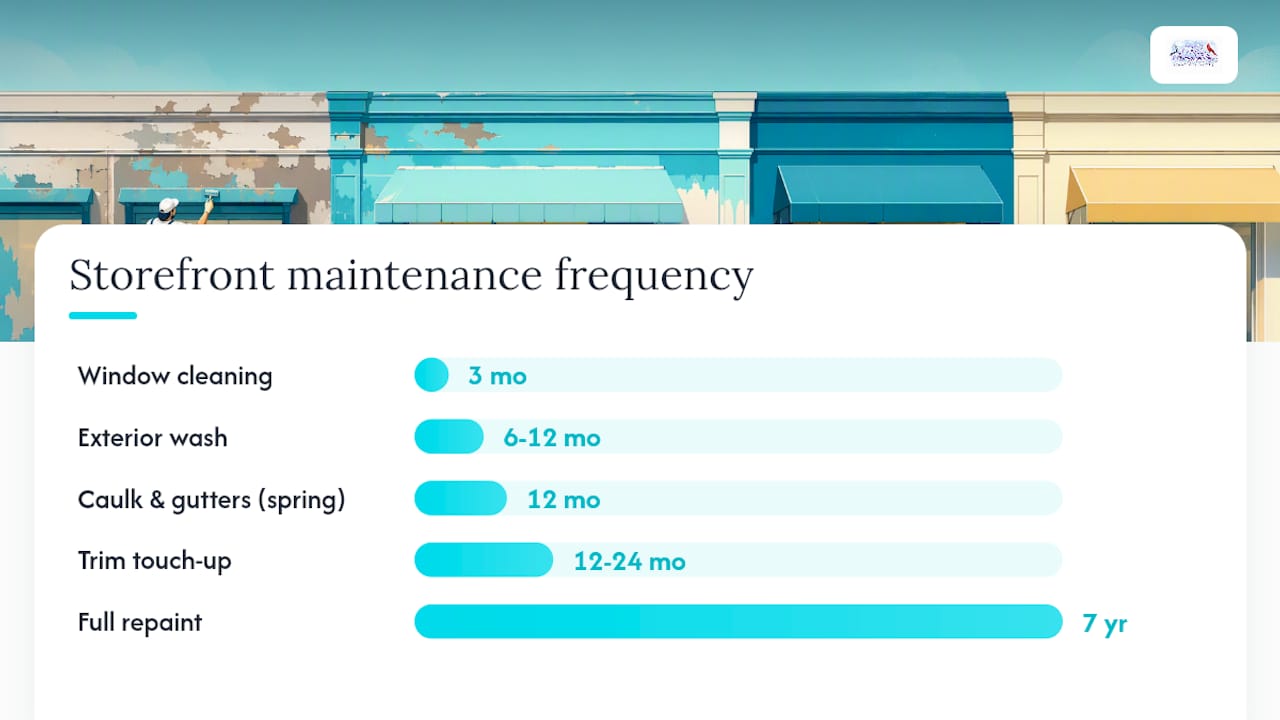
Consistent exterior cleaning frequency for your business matters more than most property managers realize. Mildew, salt deposits, and airborne grease from nearby traffic all degrade paint adhesion over time. Removing them before they penetrate the film is the definition of low-cost prevention.
Pro Tip: Schedule a soft wash 1–2 weeks before any planned repaint. That window gives the surface time to dry fully while still arriving at the paint date clean and contaminant-free. Washing the day before risks trapping moisture under the new coat.
Why proactive maintenance is the smarter financial decision
Storefront exteriors are your first impression. When paint peels, it signals neglect to customers and prospective tenants before they ever walk through the door. The cost of that perception is harder to quantify than a repaint invoice, but it’s real.
From E and R Cleaning Solutions’ experience working with property managers and small business owners, the pattern is consistent: the storefronts that avoid expensive substrate repairs are the ones on a regular cleaning schedule. A soft wash once or twice a year removes the mildew, salt, and grime that quietly destroy paint adhesion. Catching a failed caulk joint in an annual inspection costs a tube of caulk and an hour of labor. Missing it for three years can mean rotted framing and a four-figure repair bill.
The math is straightforward. Routine cleaning and inspection is prevention. Everything else is recovery.
E and R Cleaning Solutions can handle the prep work for you
If paint peeling on your storefront is widespread, or you need safe high-access cleaning before a repaint, professional surface prep is the right call.

E and R Cleaning Solutions provides commercial property cleaning and pressure washing between tenancies that removes the contaminants, mildew, and residue that cause paint adhesion to fail. The team handles soft washing at safe pressures for delicate facades, high-access exterior cleaning, window and frame cleaning, and pre-paint surface preparation for commercial storefronts. With over five years of experience serving property managers and small business owners, E and R Cleaning Solutions offers honest pricing and custom quotes for every job. Contact them for a free estimate and get your storefront surface-ready before the next coat goes on.
Sources
- Paint Job Mistakes to Avoid — InspectAPedia
- How It Works: Paint failure and troubleshooting — Fine Homebuilding
- Surfactant leaching — Sherwin-Williams
- Reasons your paint is peeling and how to fix it — Martha Stewart
- How to fix exterior paint peeling — Sherwin-Williams
- Why is exterior paint peeling on commercial buildings? — H&H Painting Co.