How to Maintain a Clean Retail Storefront Daily
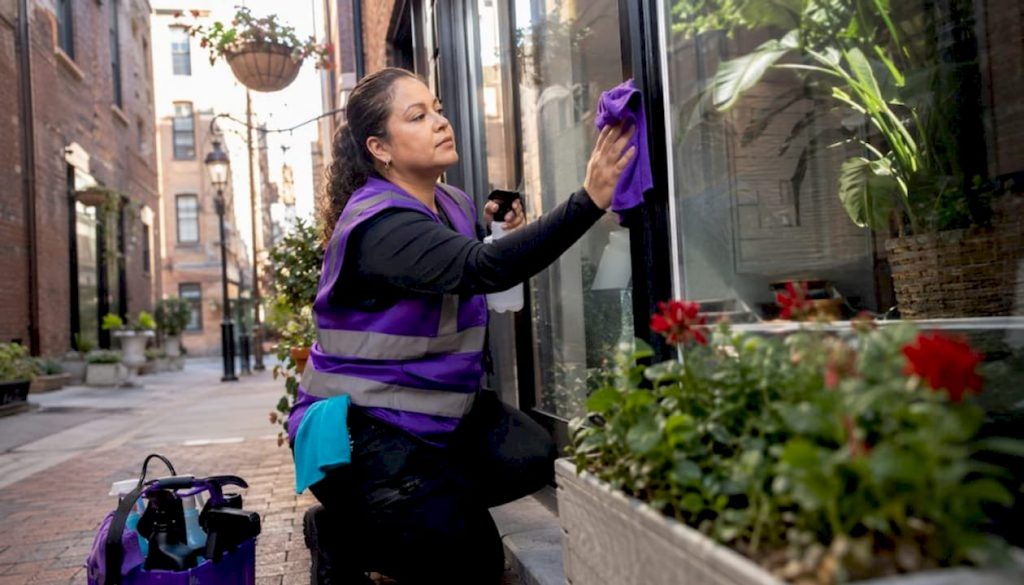
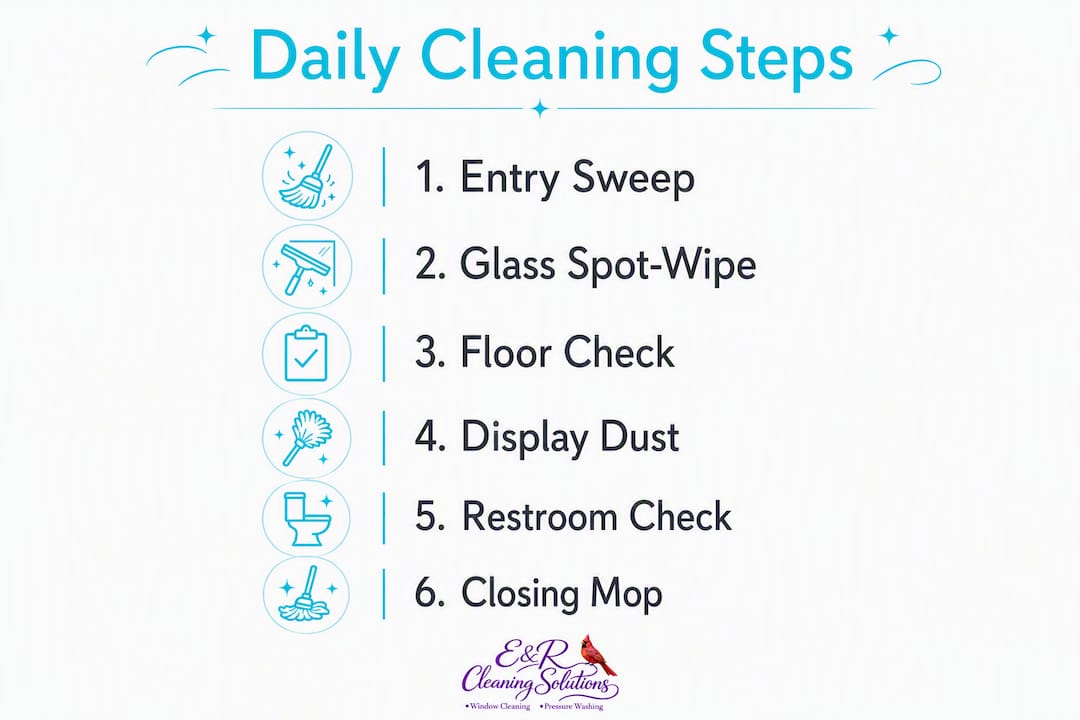
A simple daily routine of six focused actions keeps most retail storefronts visibly clean and guest-ready every operating day. No elaborate system required. Sweep the entry, spot-clean the door glass, run a floor sweep through high-traffic aisles, wipe down your POS terminals and door handles, check and restock the restroom, and empty the trash. That is the core of every effective daily store cleaning checklist, and it takes under 10 minutes to verify at opening.
Here is the quick-check version your team can print, post, and sign each shift:
Daily Quick-Check Checklist (sign-off required)
- [ ] Entry sweep and mat shake (a couple of minutes)
- [ ] Spot-clean entry glass, floor to 6 ft (a couple of minutes)
- [ ] Floor spot-sweep/spot-mop high-traffic aisles (several minutes)
- [ ] Wipe and disinfect POS terminals, door handles, counters (a couple of minutes)
- [ ] Restroom check: surfaces, supplies, floor (several minutes)
- [ ] Trash run and floor-edge spot clean (a couple of minutes)
Staff sign-off: ____________ Date/Shift: ____________
Customers form an impression of your store in seconds. Visible cleanliness — streak-free glass, a clean entry, tidy floors — drives conversion before a single product is touched. The six actions above address every zone a customer sees first.
Pro Tip: OSHA 29 CFR 1910.1200 governs hazard communication for cleaning chemicals. Keep Safety Data Sheets (SDS) accessible for every product your staff uses, and confirm PPE (gloves, eye protection) is available at the supply station before the first shift starts.
Table of Contents
- What does a complete daily cleaning schedule look like for retail stores?
- How do you assign cleaning tasks and keep staff accountable?
- Which areas need daily attention, and what exactly should staff do?
- What tools and supplies does every retail store need for daily cleaning?
- When should you handle cleaning in-house vs. hire professionals?
- How do you make cleanliness visible to customers and run quick audits?
- What safety and compliance rules apply to retail cleaning?
- How long does daily cleaning take, and what does it cost?
- Key Takeaways
- The part most store owners underestimate
- How E and R Cleaning Solutions keeps storefronts spotless year-round
- Useful sources and further reading
What does a complete daily cleaning schedule look like for retail stores?
The six quick-check tasks above are your floor, not your ceiling. A full daily routine runs in three phases: an opening prep block, hourly spot checks throughout the day, and a closing detail that sets up the next morning.
Opening prep (a brief period of time before opening)
Opening staff arrive before the doors unlock. This block covers everything customers will see the moment they walk in.
- Sweep the sidewalk and shake or vacuum entry mats
- Wipe entry doors and windows from floor to 6 ft, inside and out
- Spot-mop any overnight spills or tracked-in debris
- Wipe POS terminals, counters, and high-touch fixtures with disinfectant
- Restock restroom supplies and run a quick surface wipe
- Empty any overnight trash and replace liners
Hourly spot checks (a few minutes each hour)
Assign a floor staff member or cashier to a rotating check every hour. The goal is catching issues before customers notice them.
- Scan entry glass for new smudges at hand level
- Check floor for debris, spills, or wet spots in main aisles
- Glance at fitting rooms and displays for dropped merchandise or packaging
- Confirm restroom supplies are stocked and surfaces are dry
Closing detail (around an hour or slightly longer)
Closing detail for a typical small to medium-sized retail space runs around an hour or slightly longer and is the single biggest factor separating stores that look consistently fresh from those that gradually decline.
- Full floor sweep and mop or vacuum (all zones, not just aisles)
- Wipe all glass surfaces, mirrors, and display cases
- Sanitize POS terminals, door handles, and checkout counters
- Deep restroom clean: toilet, sink, mirror, floor, restock
- Dust eye-level displays and front-face all merchandise
- Empty all trash, replace liners, wipe trash can exteriors
- Spot-check fitting rooms: mirrors, floors, hooks
- Secure cleaning supplies and complete the sign-off sheet
Pro Tip: Stage closing tasks in reverse order of the next morning’s opening sequence. Finish with the entry last so it is the freshest zone when you lock up. That cuts several minutes off your opening prep the next day.
Sample daily checklist template
| Area | Task | Frequency | Est. Time | Owner |
|---|---|---|---|---|
| Entry / sidewalk | Sweep, mat shake | Opening + closing | 5 min | Opening staff |
| Entry glass | Spot-wipe, floor to 6 ft | Opening + hourly | 2 min | Floor staff |
| Sales floor | Spot-sweep/mop aisles | Hourly | 3 min | Floater |
| POS / counters | Disinfect wipe | Opening + hourly | 2 min | Cashier |
| Restroom | Check, restock, wipe | Every 2–3 hrs | 5 min | Floater |
| Trash | Empty, reline | Opening + closing | 3 min | Closer |
| Full floor | Sweep/mop all zones | Closing | 20–30 min | Closer |
| Displays | Dust, front-face | Closing | 10 min | Closer |
| Fitting rooms | Mirror, floor, hooks | Closing + mid-day | 5 min | Floor staff |
How do you assign cleaning tasks and keep staff accountable?
A checklist without ownership is just a wish list. The fix is a short SOP for each task, a clear role assignment, and a sign-off that takes less than 30 seconds.
SOP template (one per task)
| Field | Example |
|---|---|
| Task name | Entry glass spot-clean |
| Steps | Spray microfiber with glass cleaner; wipe floor-to-6-ft zone; buff dry |
| Product | Neutral glass cleaner (SDS on file) |
| PPE | Nitrile gloves |
| Frequency | Opening + every 2 hrs |
| Time | 2 minutes |
| Acceptance criteria | No visible smudges at customer eye level |
| Sign-off | Staff initials + time |
Keep each SOP to one page. Laminate it and post it at the supply station.
Role splits by store size
Under 1,500 sq ft: Two roles cover everything. The opener handles entry, glass, POS, and restroom. The closer handles full floor, displays, fitting rooms, and trash. A manager spot-checks at mid-day.
1,500–3,500 sq ft: Add a floater role for hourly aisle checks and restroom runs. The opener and closer handle their respective blocks. The manager runs a 5-minute walk-through at opening and again 30 minutes before close.
Verification without micromanaging
Three checkpoints keep accountability light but real:
- Hourly visual check by the floater or floor lead (no paperwork, just eyes on the space)
- End-of-day sign-off sheet posted at the supply station (staff initials each completed task)
- Weekly supervisor audit using a scored checklist (10-point scale per zone, filed for 30 days)
Shift handoff dos and don’ts
- Do note any unresolved issues (spill that needs a full mop, low restroom supply) on the handoff log
- Do confirm the sign-off sheet is complete before the outgoing shift leaves
- Don’t assume the incoming shift knows about a problem unless it is written down
- Don’t skip the sign-off because it “looks clean enough” — the log is your liability record
Checklists aligned with OSHA 29 CFR 1910.1200, 1910.132, and 1910.141 improve compliance and audit readiness. Build those references into your SOP header so staff know the standard they are working to.
Which areas need daily attention, and what exactly should staff do?
Break the store into zones and assign a specific action to each. Vague instructions produce inconsistent results.
Entry and sidewalk
Sweep the sidewalk and shake or beat entry mats at opening and closing. Empty the exterior trash can. During winter, remove salt residue from mats and the threshold daily — salt crystals scratch hard floors fast. In spring, a quick pollen wipe-down on the exterior door frame takes 60 seconds and makes a visible difference.
Windows and doors
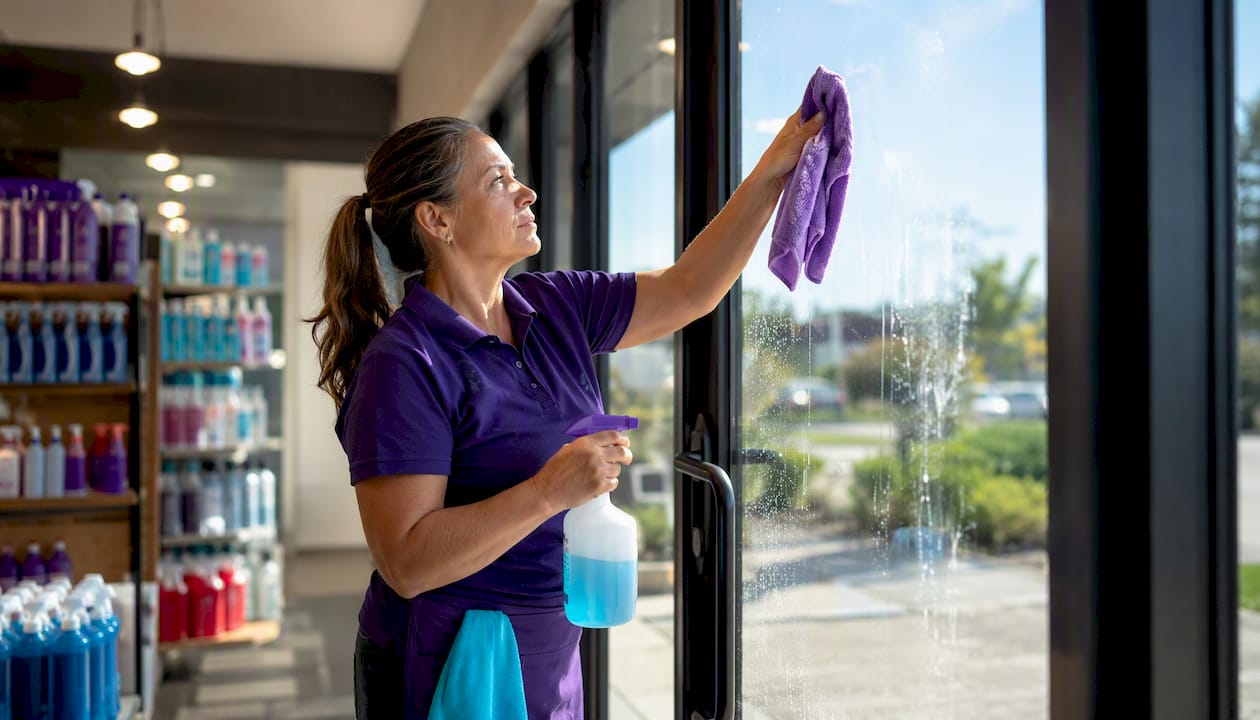
Focus daily cleaning on the floor-to-6-foot zone of entry doors and windows. That is where customer handprints, nose smudges, and push marks concentrate. A damp microfiber cloth followed by a dry buff handles most of it. The glass above 6 feet stays cleaner longer and is better addressed on a weekly or professional schedule.
Floors
Spot-sweep and spot-mop high-traffic aisles throughout the day. Full sweep and mop happens at closing. The approach varies by surface: tile and vinyl get a neutral floor cleaner and a damp mop; hardwood gets a barely-damp mop with a hardwood-safe cleaner; commercial carpet gets a daily vacuum pass with spot treatment for stains. Never use a soaking-wet mop on hardwood or laminate.
Displays and merchandise
Dust eye-level shelves and displays daily. Front-face products (pull items to the shelf edge, labels forward) during closing. Pick up dropped packaging and stray price tags throughout the day. For high-value displays or sample stations, wipe surfaces with a disinfectant-safe cloth after each customer interaction.
Fitting rooms
Check fitting rooms after each use during busy periods. At minimum, run a sweep and mirror wipe twice during the day and a full clean at closing. Floors accumulate tags, pins, and debris faster than any other zone in a clothing store.
Restrooms and high-touch surfaces
Restroom checks every 2–3 hours are the operational standard for retail. During peak hours, that cadence should tighten to hourly. Each check covers: toilet and seat wipe, sink and counter wipe, mirror spot-clean, floor sweep, soap and paper restock, and a trash check. POS terminals and door handles get a disinfectant wipe hourly during busy periods.
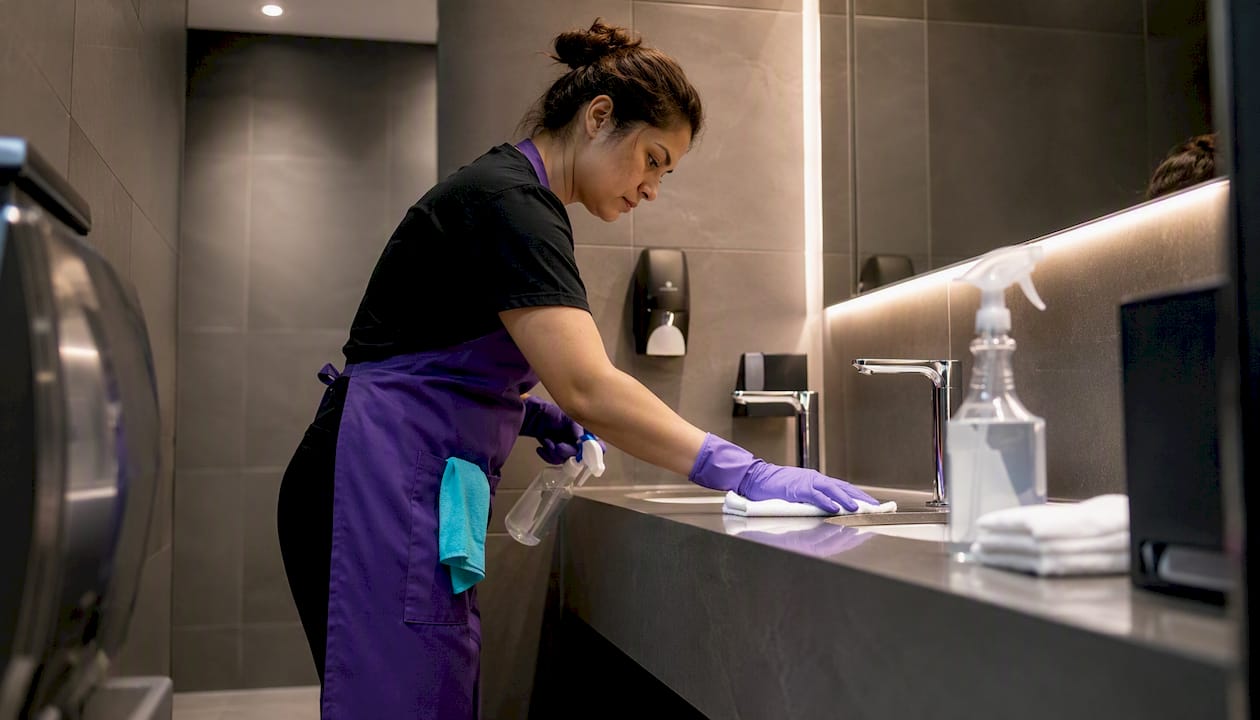
Don’t overlook light fixtures. Dust on fixtures makes stores look dim and tired even when floors are spotless. Add a weekly fixture dusting to your schedule — it takes five minutes and noticeably brightens the space.
Area frequency table
| Area | Daily | Weekly | Monthly |
|---|---|---|---|
| Entry glass (floor to 6 ft) | Spot-wipe | Full clean | Pro exterior wash |
| Entry mats | Shake/vacuum | Deep clean or replace | Inspect condition |
| Sales floor | Spot-sweep/mop | Full machine clean | Grout/edge scrub |
| Displays | Dust, front-face | Wipe all surfaces | Deep dust high shelves |
| Fitting rooms | Sweep, mirror wipe | Full scrub | Inspect hardware |
| Restrooms | Every 2–3 hrs | Deep scrub | Grout, fixture descale |
| High-touch surfaces | Hourly disinfect | Full wipe-down | Inspect for wear |
| Light fixtures | — | Dust | Deep clean |
What tools and supplies does every retail store need for daily cleaning?
The right kit cuts cleaning time and avoids the customer disruption that comes from wrestling with the wrong equipment mid-shift.
Must-have daily tools:
- Microfiber cloths (minimum 12 per store, color-coded by zone)
- Squeegee (12-inch for interior glass, 18-inch for larger panes)
- Spray bottles labeled by product (never mix or relabel)
- Neutral floor cleaner (pH-neutral, safe for multiple floor types)
- Flat mop with microfiber head and wringer bucket
- Push broom and dustpan
- Small commercial vacuum (cordless preferred for mid-day aisle checks)
- Commercial-grade disinfectant wipes for POS and high-touch surfaces
- Wet-floor signs (minimum 2 per store)
- Nitrile gloves and safety glasses at the supply station
Budget vs. pro-level picks: A basic microfiber cloth set runs $15–$30 for a pack of 24; commercial-grade packs designed for daily institutional use run $40–$60 and last significantly longer under daily laundering. A standard household squeegee costs under $10 but flexes unevenly on large panes. A Unger or Ettore professional squeegee ($20–$35) holds its edge and leaves fewer streaks. For floor cleaning, microfiber, squeegees, and neutral floor cleaners reduce cleaning time and minimize disruption during business hours.
Store all chemicals in a labeled, locked cabinet. Every product needs its SDS posted or filed within reach, per OSHA 29 CFR 1910.1200 hazard communication requirements. Never store cleaning chemicals near food, beverages, or merchandise.
Pro Tip: Color-code your microfiber cloths by zone: red for restrooms, blue for glass and mirrors, yellow for POS and counters, green for floors and general surfaces. It takes 30 seconds to train and permanently eliminates cross-contamination risk.
When should you handle cleaning in-house vs. hire professionals?
A tiered approach is the only one that works long-term: daily staff keep visible areas tidy, weekly work removes buildup, and monthly or quarterly professional services address what daily cleaning physically cannot reach or fix.
What daily and weekly in-house work covers
Daily staff handle everything in the customer zone: entry, floor-to-6-ft glass, floors, displays, restrooms, and high-touch surfaces. Weekly work adds full window cleaning of reachable glass, floor machine buffing or scrubbing, high-dusting of shelves and fixtures, and a thorough restroom deep clean.
What professionals handle
Daily manual cleaning cannot remove embedded grime, algae, or hard-water deposits from exterior glass and sidewalks. Those require professional equipment and technique. Schedule:
- Quarterly: Exterior window washing for all glass above 6 ft and full-facade cleaning
- Seasonally (or as needed): Pressure washing of sidewalks, entry aprons, and building base to remove salt, algae, and staining
- Annually: Machine floor buffing or deep scrubbing for high-traffic tile or vinyl; HVAC grille cleaning
Seasonal factors shift that timing. After a heavy winter, salt and grit embed into sidewalk pores faster than a standard spring schedule accounts for. A pollen-heavy spring may push exterior glass cleaning to every 6–8 weeks instead of quarterly.
Tiered schedule overview
| Frequency | Who | Tasks |
|---|---|---|
| Daily | In-house staff | Entry, floor-to-6-ft glass, floors, POS, restrooms, trash |
| Weekly | In-house or part-time cleaner | Full window clean (reachable), floor machine, high-dust, deep restroom |
| Monthly | In-house or contracted | Grout scrub, fixture deep clean, HVAC grilles, high shelving |
| Quarterly | Professional exterior service | Upper-window wash, pressure washing sidewalks, facade cleaning |
For exterior services, a recurring contract with a professional provider is more cost-effective than one-off calls. It also keeps your curb appeal consistent rather than letting it cycle between clean and neglected. See E and R Cleaning Solutions’s guidance on exterior cleaning frequency for businesses for scheduling benchmarks.
How do you make cleanliness visible to customers and run quick audits?
Customers read a store’s cleanliness in the first 5–10 seconds. Visible cleanliness signals — streak-free entry glass, a flat and clean mat, an organized checkout counter, no debris on the floor — influence whether a browser becomes a buyer.
The signals that matter most, in order of customer visibility:
- Entry glass: streak-free at eye and hand level
- Entry mat: flat, clean, no curled edges or debris
- Main aisle floors: no visible debris, no wet spots, no spill cones left unattended
- Checkout counter: clear of clutter, wipes visible but not scattered
- Restroom (if customer-accessible): clean sink and mirror visible from the doorway
2–5 minute manager audit checklist:
- [ ] Entry glass: no smudges at hand level
- [ ] Mat: flat, clean, no trip hazard
- [ ] Main aisle: clear of debris and spill hazards
- [ ] Checkout: organized, disinfectant wipes stocked
- [ ] Restroom: supplies stocked, surfaces dry, no odor
- [ ] Displays: front-faced, no dropped packaging on floor
Run this audit at opening, mid-day, and 30 minutes before close. Score each zone 1–5 on a weekly scorecard and track trends. A zone that consistently scores below 3 needs a revised SOP or a staffing adjustment, not just a reminder.
Pro Tip: Schedule manager walk-throughs at the same time a customer would arrive: right at opening and during peak traffic hours. You will catch slip hazards, presentation gaps, and odor issues that a back-office check never surfaces.
What safety and compliance rules apply to retail cleaning?
Cleaning during business hours introduces real hazards: wet floors, chemical fumes, cords across aisles. Managing them protects both staff and customers and keeps you on the right side of OSHA requirements.
PPE and chemical handling basics:
- Nitrile gloves for all chemical contact; safety glasses when mixing or pouring
- SDS for every cleaning product, posted or filed within reach of the supply station
- All spray bottles labeled with product name, concentration, and hazard per OSHA 29 CFR 1910.1200
- Never mix bleach-based and ammonia-based cleaners — the reaction produces toxic chloramine gas
- Store chemicals in a locked, ventilated cabinet away from merchandise and food
Cleaning during business hours:
- Use low-odor or fragrance-free products in customer areas; strong chemical smells drive customers out
- Pause mopping or chemical application when a customer approaches; resume after they pass
- Place wet-floor signs before you start mopping, not after a slip occurs
- Manage cords from vacuums and equipment against walls and out of walking paths
Restroom and ADA considerations:
- Keep restroom pathways clear of mop buckets and supply carts while customers are present
- Wet-floor signage is required inside restrooms during and after cleaning
- Accessible fixtures (grab bars, accessible sink height) must remain unobstructed at all times
- If your store serves food or operates a café counter, the FDA Food Code sets additional surface sanitation requirements for food-contact zones
For cleaning product selection, the EPA Safer Choice program certifies products that meet safety and environmental standards without sacrificing effectiveness. Choosing Safer Choice-certified products simplifies compliance documentation and reduces chemical exposure risk for staff.
How long does daily cleaning take, and what does it cost?
Time and budget are the two questions every manager asks before committing to a cleaning program. Here are realistic estimates based on a standard retail footprint.
Time estimates by task (1,500–2,500 sq ft store):
| Task | Est. Time |
|---|---|
| Entry sweep + mat shake | 3–5 min |
| Entry glass spot-wipe | 2–3 min |
| Hourly aisle spot-sweep | 2–3 min |
| POS and counter disinfect | 2 min |
| Restroom check and restock | 3–5 min |
| Trash run | 2–3 min |
| Full closing floor sweep/mop | 20–30 min |
| Display dust and front-face | 10–15 min |
| Fitting room sweep and wipe | 5–8 min |
| Full closing detail (all tasks) | 60–90 min |
Ballpark cost ranges:
Daily in-house cleaning costs are primarily labor. For a small store with one or two staff handling cleaning as part of their shift, the incremental cost is low. A part-time cleaner for closing detail runs roughly $15–$22 per hour depending on your market, putting a 60–90 minute closing detail at $15–$33 per night.
Supplies for a 1,500–2,500 sq ft store typically run monthly consumable supplies cost a moderate amount (microfiber cloths, disinfectant wipes, floor cleaner, trash liners, restroom supplies). A full starter kit of tools (mop, broom, squeegee, vacuum, spray bottles, wet-floor signs) runs starter kit costs vary depending on quality.
Professional exterior services vary by scope and region. Quarterly exterior window cleaning for a standard single-story storefront typically runs quarterly exterior window cleaning costs vary by service scope and region. Pressure washing a sidewalk and entry apron runs pressure washing of sidewalks and entry aprons costs vary by size and staining level. Recurring contracts often bring per-visit costs down by a noticeable percentage discount compared to one-off bookings.
Key Takeaways
A consistent daily cleaning routine built around six core tasks, clear SOPs, and a tiered professional schedule is the most reliable way to maintain a clean retail storefront daily and protect long-term curb appeal.
| Point | Details |
|---|---|
| Six daily must-dos | Entry sweep, glass spot-wipe, floor check, POS disinfect, restroom check, and trash run cover every high-impact zone. |
| Time budget per shift | Opening prep takes 15–30 min; hourly checks run 2–3 min each; closing detail runs 60–90 min for a 1,500–2,500 sq ft store. |
| SOP sign-off and audits | Use a printed sign-off sheet daily and a scored weekly supervisor audit to maintain accountability without micromanaging. |
| When to hire professionals | Quarterly exterior window washing and seasonal pressure washing remove embedded grime that daily cleaning cannot fix. |
| E and R Cleaning Solutions | Provides commercial window cleaning and pressure washing on recurring schedules, handling the exterior work daily staff cannot safely or effectively reach. |
The part most store owners underestimate
Most retail cleaning guides treat daily maintenance and professional exterior work as two separate topics. They are not. They are the same system, and the daily work only holds up if the professional layer runs on schedule.
Here is what I see repeatedly: a store owner builds a solid daily routine, trains the staff, gets the sign-off sheets going. The entry glass looks great every morning. Then six months pass without a professional exterior wash, and the upper windows start looking hazy, the sidewalk develops a gray film, and the overall impression of the building starts to undercut everything the daily routine is doing inside. Customers notice the outside before they notice the inside.
The daily floor-to-6-ft glass wipe is not a substitute for a quarterly exterior wash. It is a maintenance layer between professional visits. Embedded hard water deposits, algae on the building base, and ground-in sidewalk grime require pressure and professional-grade equipment to remove. No amount of daily microfiber work gets there.
The concrete example: a storefront that runs quarterly exterior window cleaning and seasonal pressure washing for sidewalks and entry aprons will not develop the embedded staining that forces a costly remediation job 18 months later. The quarterly visit costs a fraction of what a stain-removal or resurfacing job runs. It also means the daily routine your staff does every morning actually shows, because the building behind it looks as clean as the glass in front.
How E and R Cleaning Solutions keeps storefronts spotless year-round
Your daily in-house routine handles the interior and the customer-zone glass. E and R Cleaning Solutions handles everything your staff cannot safely or effectively reach: upper-story and full-facade window cleaning, pressure washing of sidewalks and entry aprons, and soft washing for delicate exterior surfaces.
The difference between a storefront that looks consistently sharp and one that gradually loses its edge is almost always the exterior professional layer. E and R Cleaning Solutions offers one-time, quarterly, and fully recurring commercial cleaning plans with custom pricing, no long-term lock-in, and scheduling built around your store’s hours. Whether you need a quarterly exterior window wash, a seasonal sidewalk pressure wash, or a recurring program that keeps your curb appeal consistent all year, the team at E and R Cleaning Solutions quotes each job honestly and shows up on time.
For storefronts that need specialized commercial window cleaning or a full exterior maintenance plan, reach out to E and R Cleaning Solutions for a custom quote. You can also review the commercial property cleaning best practices guide to see what a full-service exterior program covers before you book.
Useful sources and further reading
These resources support the checklists, SOP frameworks, and compliance guidance in this article.
- OSHA Hazard Communication Standard (29 CFR 1910.1200) — the governing standard for SDS, chemical labeling, and PPE requirements in retail cleaning operations.
- EPA Safer Choice Program — certifies cleaning products that meet safety and environmental standards; useful for selecting staff-safe, compliant products.
- FDA Food Code — Retail Food Protection — applies to any retail store with a food service or café component; sets surface sanitation requirements for food-contact zones.
- Why Commercial Windows Need Specialized Cleaning — explains when and why professional window cleaning is necessary for commercial storefronts.
- Commercial Property Cleaning Best Practices: 2026 Guide — covers weekly and monthly maintenance programs and how to structure a recurring exterior cleaning contract.
- Exterior Cleaning Frequency for Businesses: 2026 Guide — scheduling benchmarks for exterior services by business type and region.
- Large Building Window Cleaning Checklist: 2026 Guide — useful for larger storefronts or multi-story retail properties planning elevated window work.
- The Role of Pressure Washing Between Tenancies — explains commercial pressure washing benefits for sidewalks and building exteriors.