Property Managers: Demand Line Items in Office Window Cleaning Bids

If your office building’s glass looks streaked, spotted, or cloudy with mineral buildup, hire a licensed commercial window cleaning contractor rather than leaning on janitorial staff. Look for one offering full interior and exterior service, frame and sill detailing, and hard-water stain remediation. The next move is simple: request a site inspection and a written, line-item quote before signing anything.
TL;DR:
- Most commercial window cleaning includes interior and exterior glass, frames, sills, screens, and skylights, with scope variations based on building height and access.
- Hard-water stains can permanently etch glass if untreated, making early cleaning and maintenance more cost-effective than restoration or replacement later.
- Choosing a licensed contractor with proper insurance, safety practices, and detailed, written bids helps prevent liability issues and unexpected costs.
- A site inspection should clarify access challenges, scope of work, and exclusions like paint overspray or glass repair, avoiding surprise charges.
- Proper preparation, including access clearance and tenant notification, ensures a smooth cleaning process and a reliable post-job inspection.
Table of Contents
- What Does Professional Office Window Cleaning Include?
- Why Hire a Window Cleaning Specialist Instead of Janitorial Staff?
- How Often Should You Schedule Office Window Cleaning, and What Drives the Price?
- Specialty Services: Hard Water, High-Rise Access, and Pressure Washing Combos
- How to Choose a Window Cleaning Vendor for Your Office
- Getting Your Building Ready for the Cleaning Crew
- What Happens After the Cleaning: Inspection and Guarantees
- Cleaning Tinted, Frosted, and Laminated Glass Safely
- What Fifteen Years in Local Commercial Cleaning Actually Teaches You
- Ready for a Written Quote on Your Building?
- Sources
What Does Professional Office Window Cleaning Include?
A real commercial window cleaning job covers more than the glass you can see from the parking lot. Professional crews typically clean interior glass, exterior glass, frames, sills, tracks, screens, glass partitions, and skylights in a single visit, and they document each of those as separate line items on a proper bid. Office Pride’s service breakdown confirms this is the standard scope for commercial window cleaning, including glass restoration work for buildings dealing with hard-water buildup.
The methods vary by surface and access. Ground-level and low-rise glass usually gets the traditional treatment: a squeegee, a scrubber, and purified or deionized water that dries without leaving mineral spots. Taller buildings often call for water-fed poles, which push filtered water through a pole-mounted brush and let it air-dry streak-free, sometimes from 40 feet up without a ladder. Stubborn deposits, bird droppings, or years of sprinkler overspray usually need a spot chemical treatment applied before the final rinse.
Here’s what a thorough scope-of-work should list:
- Interior glass cleaning for all accessible windows and glass doors
- Exterior glass cleaning using squeegee-and-water or water-fed pole systems, depending on height
- Frame and track detailing, since grime collects in aluminum channels and rubber gaskets
- Sill cleaning, particularly where pollen, dust, and rain residue accumulate
- Screen removal, washing, and reinstallation
- Interior glass partitions and conference room walls, common in modern office layouts
- Skylight cleaning, when access allows it safely
Pro Tip: Ask any bidding contractor to walk the building with you before quoting. A five-minute walk-through often reveals access issues, like a locked mechanical room or a courtyard with no gate key, that turn into change orders after the crew shows up.
Most reputable vendors exclude a few things from a standard cleaning quote, and you should expect those exclusions to appear as separate line items rather than surprise invoices. Glass repair or replacement isn’t part of a cleaning contract. Paint overspray removal from window frames, especially after an exterior repaint, usually costs extra because it requires razor scraping or solvent work. And when hard water has actually etched into the glass surface rather than just coated it, full restoration through grinding or polishing gets quoted separately from routine washing, since it’s a slower, more specialized process according to JAN-PRO’s service documentation.
Building height and access change everything about how a job gets priced and scheduled. A single-story office with a walk-around perimeter is a same-day job for a two-person crew. A six-story building with sealed windows and no roof anchor points means water-fed poles at minimum, and possibly rope access or a lift, which adds equipment cost, insurance considerations, and lead time. If you’re managing a property with mixed access, from ground-floor storefront glass to third-floor windows facing a courtyard, expect your quote to reflect that complexity rather than a flat per-window rate. Our large building window cleaning checklist breaks down exactly what to walk through with a contractor before signing.
Why Hire a Window Cleaning Specialist Instead of Janitorial Staff?
Mineral deposits don’t just look bad. Left untreated, hard water spots can etch permanently into glass, turning what would have been a $200 cleaning into a $2,000 restoration project or, in bad cases, a full glass replacement. Catching that buildup early through a maintenance program is far cheaper than fixing etched glass later, which is exactly why scheduled cleaning programs exist as a category of service rather than a one-off fix, per Office Pride’s maintenance model.
There’s also a liability dimension property managers can’t ignore. Sending a janitorial employee up a ladder to clean second-story exterior glass, without fall protection training or the right equipment, is a workers’ compensation claim waiting to happen. Licensed window cleaning contractors carry insurance specifically for elevated work and train crews on fall protection systems that align with OSHA and ANSI standards, according to JAN-PRO’s safety guidance for commercial accounts.
Beyond safety, hiring a specialist buys you three operational advantages:
- Predictable budgeting through a fixed maintenance contract instead of reactive, one-off calls
- Scheduling that works around tenant hours, so cleaning happens before or after business, not during a client meeting
- Consistent quality from a crew trained specifically on glass, rather than staff whose primary job is trash and floors
Janitorial staff are perfectly capable of wiping down interior lobby glass or a break room window as part of daily upkeep. What they generally shouldn’t be doing is exterior work above ground level, hard-water remediation, or anything involving specialized equipment like water-fed poles or lifts. That’s the line between routine tidiness and a job that needs a licensed specialist.
How Often Should You Schedule Office Window Cleaning, and What Drives the Price?
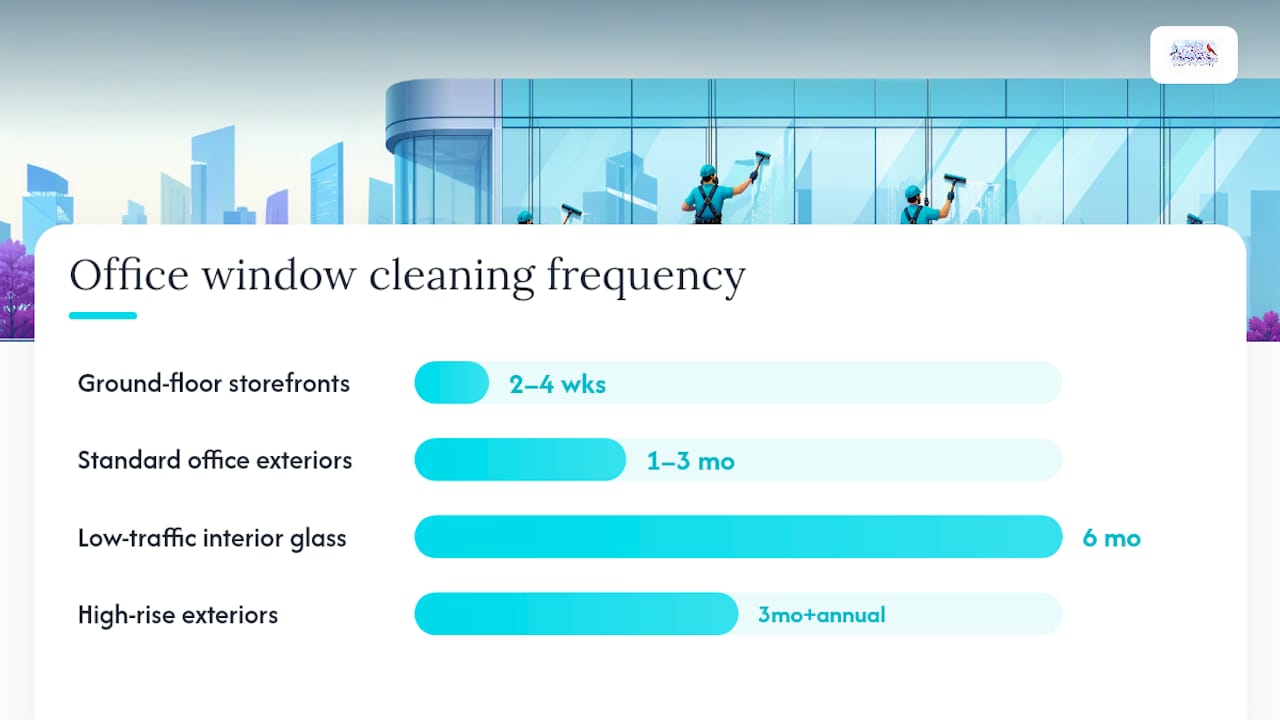
Cleaning frequency depends heavily on property type and street exposure, and getting this wrong in either direction wastes money or lets buildup take hold. Here’s a reasonable starting framework:
- Ground-floor storefronts and high-visibility retail glass: every 2 to 4 weeks, since street-level dust, fingerprints, and exhaust residue accumulate fast
- Standard office exteriors: monthly to quarterly, depending on traffic, tree cover, and sprinkler exposure
- Low-traffic interior office glass (conference rooms, partitions away from entrances): twice a year is often enough
- High-rise exteriors facing weather exposure: quarterly at minimum, with an annual deep clean that includes frame and track detailing
Several variables push the price of any given quote up or down, and understanding them helps you read a bid intelligently rather than just comparing bottom-line numbers. Building height and access method matter most: a squeegee job costs less than a water-fed pole job, which costs less than rope access or a boom lift rental. Total glass area obviously scales cost, but so does condition. A building that hasn’t had exterior glass touched in two years, with visible hard-water rings and bird droppings baked on by the Florida sun, takes longer to clean than one on a quarterly program, and that extra labor shows up in the price.
Contract length and frequency also swing pricing. A one-time deep clean typically costs more per visit than the same scope under a recurring maintenance agreement, because contractors price in the value of predictable, repeat business. Travel time and equipment needs round out the picture. A crew hauling a boom lift to your site costs more than one arriving with poles and buckets.
Industry pricing models generally fall into three structures: per-square-foot, per-window, and per-visit flat rate. Per-square-foot pricing tends to work better for large commercial jobs with uniform glass, while per-window pricing suits buildings with mixed window sizes and irregular layouts. Pricing guidance from Jobber’s window cleaning pricing breakdown shows per-square-foot rates vary widely based on access difficulty and glass condition, which is exactly why two contractors can quote wildly different numbers for the same building.
Statistic Callout: Per-square-foot pricing ranges vary so widely across Jobber’s industry data that a bare rate quoted over the phone, without a site visit, tells you almost nothing about your actual cost.
When you’re comparing bids, demand three things from every estimate: line-item pricing that separates routine cleaning from restoration work, a written access plan showing how the crew reaches upper floors, and a firm timeline for any specialty work like hard-water removal. A vendor who won’t break down these details on paper is one you should be wary of signing with.
Specialty Services: Hard Water, High-Rise Access, and Pressure Washing Combos
Hard-water stains form when mineral-rich water, usually from sprinklers or roof runoff, dries on glass and leaves calcium and lime deposits behind. Removing fresh deposits is usually straightforward: a chemical softening solution breaks down the minerals, followed by mechanical polishing with a non-abrasive pad to lift what’s left. The catch is timing. Once minerals sit long enough to actually etch the glass surface, rather than just coat it, full restoration requires grinding and polishing that can take hours per window, and even then, some etching is permanent. That’s the point where a contractor should tell you honestly that full restoration isn’t possible and the better long-term fix is a protective sealant to slow future buildup.
High-rise access is where safety planning and pricing intersect most directly. A few common methods, each with tradeoffs:
- Water-fed poles: effective up to roughly the fourth floor, no rope or lift needed, fastest to deploy
- Rope access: technician-suspended systems for taller buildings, requires certified riggers and safety plans aligned with fall-protection standards
- Scaffolding: stable but slow to set up and take down, better suited to longer restoration jobs than routine cleaning
- Boom lifts: fast for buildings with clear ground access around the perimeter, but useless where landscaping or parking blocks the lift’s reach
Lead time matters here too. A ground-floor squeegee job can often be scheduled within days. Rope access or scaffolding work needs advance booking, sometimes weeks out, because of equipment rental and crew certification requirements outlined in JAN-PRO’s safety-compliant service model.
Many property managers don’t realize that window cleaning and exterior pressure washing solve related problems and often get scheduled together. Overhangs, window sills, and the building facade below a row of windows tend to catch the same runoff and grime that dirties the glass above them. Combining the two services in a single visit avoids recoiling clean windows right after a facade wash, an efficiency noted in local commercial service listings for combined window and pressure washing work. If your building has a pressure-washed entryway or overhang, timing that work before the window pass, not after, protects your investment in clean glass.
Eco-conscious cleaning doesn’t mean giving up effectiveness. A simple vinegar-and-water solution handles routine grime on most glass, and a traditional squeegee often outperforms newer microfiber cloths, which can shed microplastics into wastewater over repeated washes.
That guidance comes from EcoWatch’s eco-friendly window cleaning recommendations, and it’s worth raising with any vendor you’re evaluating. That said, tenant health matters too, and eco-friendly products aren’t always the right call for every job. Long-standing mineral deposits or heavy grease near a break room window sometimes need a targeted chemical treatment that a vinegar solution simply can’t handle. The reasonable middle ground is asking your contractor which products they default to, what they reserve for tough jobs, and how they ventilate spaces during and after chemical treatments, particularly in occupied office suites.
How to Choose a Window Cleaning Vendor for Your Office
Vetting a commercial window cleaning contractor is less about finding the cheapest bid and more about confirming they can actually do the job without creating liability for your building. Start by requesting proof of insurance, specifically general liability and workers’ compensation coverage that names your property if required by your management agreement. Ask directly whether their safety practices for elevated work align with OSHA or ANSI standards, and ask for references from other office buildings or commercial properties of similar height and size. A vendor confident in their work will offer a written guarantee on the cleaning itself, not just a verbal promise.
During the site inspection, come prepared with specific questions rather than letting the contractor run the meeting. Ask them to walk you through:
- Their access plan for every side of the building, including areas blocked by landscaping or parking
- Their safety plan and fall-protection equipment for any window above ground level
- The specific equipment they’ll bring, so you know if a lift or scaffolding rental is factored into the price
- How they handle cleanup and waste disposal, particularly for chemical runoff near landscaping or storm drains
- Estimated hours on-site and crew size, so you can plan around tenant schedules
Once you’re ready to sign, the contract itself needs to nail down a few specifics that generic verbal agreements always leave vague. Cleaning frequency should be spelled out by month or quarter, not “regularly.” Every service needs to appear as a detailed line item, not a bundled flat number, which makes future comparisons and budget audits far easier, a point echoed in Jobber’s guidance on transparent estimating. The contract should also cover damage remediation (what happens if a screen tears or a frame gets scratched), clear cancellation and termination terms, and a straightforward process for verifying insurance stays active throughout the contract term. For a deeper walkthrough of how commercial cleaning agreements are typically structured, our guide on types of commercial cleaning service contracts covers the common formats you’ll encounter.
Watch for red flags that should end a conversation quickly. A contractor who can’t produce insurance documentation on request, who gives you a vague one-line scope instead of an itemized bid, who refuses to share references, or who insists on cash-only payment is not someone you want responsible for sending crews up the side of your building.
| What to check | Why it matters | Red flag if missing |
|---|---|---|
| Proof of insurance | Protects your property from liability during elevated work | Can’t produce documentation on request |
| Written, itemized quote | Lets you compare bids and avoid surprise charges | Vague one-line pricing with no breakdown |
| Safety plan for height | Confirms fall-protection compliance for upper floors | No mention of OSHA/ANSI-aligned procedures |
| References from similar buildings | Verifies real experience at comparable scale | Refuses to provide any references |
| Clear contract terms | Defines frequency, damage policy, and cancellation rights | Verbal-only agreement with no written terms |
Our commercial property cleaning best practices guide covers how window cleaning fits into a broader facility maintenance schedule. This is useful if you’re managing a building with multiple service contracts to coordinate.
Getting Your Building Ready for the Cleaning Crew
A little prep on your end keeps the appointment on schedule and avoids delays that push costs up. Confirm building access ahead of time: elevator codes, locked mechanical rooms, gated courtyards, or any suite that requires a tenant escort. If the crew needs interior access to clean from inside, give tenants advance notice so desks near windows can be cleared and blinds can be raised.
Secure or move anything within reach of the work area. That means clearing window sills of plants, decorations, or paperwork, and letting the crew know about any fragile glass partitions or recently installed fixtures nearby. If exterior work involves a lift or scaffolding, make sure the ground-level path is clear of parked cars, landscaping equipment, or outdoor furniture.
For tenant-occupied suites, a short heads-up email two or three days ahead goes a long way. Nobody wants a technician on a water-fed pole outside their window during a client call they didn’t know was coming. If your building has security protocols, like badge access for outside vendors, confirm those requirements with the contractor before the appointment date so nobody’s standing at a locked door on cleaning day. Our tool guide for interior glass care also covers a few quick things tenants can do themselves between professional visits to keep interior glass looking sharp.
What Happens After the Cleaning: Inspection and Guarantees
A professional crew doesn’t just pack up and leave once the last window is wiped down. A proper post-cleaning process includes a walk-through, ideally with you or a designated building representative, to check the work against the original scope. This is the moment to flag anything that looks off: a streak left behind, a missed sill, a screen that didn’t get reinstalled correctly.

Reputable contractors back their work with a written guarantee, meaning if something doesn’t meet the agreed standard, they’ll come back and fix it at no extra charge rather than arguing about it. Ask for this in writing before the job starts, not after you’ve already noticed a problem. It should specify a reasonable window, often 24 to 48 hours, during which you can report an issue and get a free touch-up.
Documentation matters too, particularly for larger properties with multiple service visits per year. A good vendor provides some form of completion record, whether that’s a signed checklist, photos of problem areas before and after treatment, or a simple email summary noting what was cleaned and what, if anything, couldn’t be fully resolved (like permanently etched glass). That record protects you if a tenant complains later and you need to show the work was done and verified.
Cleaning Tinted, Frosted, and Laminated Glass Safely
Specialty glass needs a different touch than standard clear panes, and a contractor who treats every window the same is one to question closely. Tinted film, common on south and west-facing office glass to cut solar heat, can peel, bubble, or discolor if scrubbed with abrasive pads or cleaned with ammonia-based products. Professionals working on tinted glass typically stick to soft cloths, squeegees, and film-safe solutions to avoid damaging the coating.
Frosted and etched glass, often used in conference rooms and private offices for privacy, has a textured surface that traps grime differently than smooth glass. Aggressive scrubbing can wear down the frosted finish over time, so the right approach is a gentler touch with a solution designed not to strip whatever coating created the frosted effect in the first place.
Laminated glass, which sandwiches a plastic interlayer between two glass panes for security or soundproofing, is generally safe to clean with standard methods on the exterior surfaces, but the edges deserve extra care. Moisture that seeps between the layers over time can cause delamination, a cloudy or bubbled appearance that’s expensive to fix. Crews working on laminated glass should avoid saturating the edges with water and check that seals look intact during cleaning.
Any vendor bidding on a building with mixed glass types should ask about this upfront during the site inspection, not discover it mid-job. If they don’t ask, that’s worth noting.
What Fifteen Years in Local Commercial Cleaning Actually Teaches You
Some local window cleaning businesses are built around the idea that office buildings deserve honest pricing and a crew that treats their glass like it matters, not like it’s one more stop on a route. Experience in window cleaning services shows a consistent pattern: the properties that hold up best over time are the ones on a real maintenance schedule, not the ones calling only after the glass has gone cloudy with hard water.
Most commercial window cleaning work typically includes interior and exterior glass cleaning on a recurring schedule, hard-water remediation when a building’s sprinkler system has left its mark on ground-floor windows, and often a pressure-washing pass on the entryway or sidewalk paired with the same visit. Bundling those services tends to save property managers a scheduling headache, since one crew handles the glass and the concrete in a single trip rather than coordinating two separate vendors on two separate days.
A site inspection for window cleaning should include walking the property, looking at access points, glass condition, and any hard-water damage, then putting together a written quote that separates routine cleaning from any restoration work, following expert advice on the best thing to clean interior doors with. No pressure to sign on the spot, and no bundling of services you didn’t ask for.
The person quoting your job being the same person who answers the phone when you call with a follow-up question matters more than many property managers expect until they’ve dealt with a rotating cast of subcontractors and a call center that can’t answer a specific question about your building’s last visit.
— Richard
Ready for a Written Quote on Your Building?
You’ve got other paths here, sure. Some property managers keep hard-water buildup on janitorial staff’s plate and hope for the best, or wait until a tenant complains before calling anyone at all. Neither approach protects your glass or your budget the way a scheduled inspection does. Some family-run window cleaning crews offer alternatives by quoting your building honestly, in writing, before starting work.

Before you reach out, have a few things ready: your property address, a couple of photos of the glass (especially any areas with visible hard-water spotting), a rough estimate of total glass area, and any access notes worth mentioning, like a locked courtyard or a suite that needs tenant coordination. Some window cleaning services offer flexible scheduling, including after-hours slots for buildings that need cleaning done outside business hours. Crews may be insured, and written estimates and recurring plans may be options.
Visit the commercial window cleaning services page to request your site inspection, or check the large building checklist first if you’re managing a taller property and want to know what to expect before the crew arrives.
Sources
- Commercial Window Cleaning Services | Office Pride
- Commercial Window Cleaning Services | Free Quote (JAN-PRO)
- How to Price Window Cleaning Jobs for Profit Formula + Pricing Chart
- Eco-Friendly Window Cleaning: Recipes & Tips (EcoWatch)