
Schedule Large Building Window Cleaning: Property Manager’s Guide

To schedule professional window cleaning for a large or high-rise building, request a site inspection, confirm anchor-point and safety compliance, agree on a phased scope and timeline, and book a recurring maintenance plan matched to your building type. That sequence is not optional — skipping any step typically means a delayed start, an inaccurate quote, or a liability gap.
The short version:
- Request a free site inspection and rooftop walkthrough.
- Verify the provider is licensed, bonded, and insured, with documented OSHA-compliant fall protection.
- Get a written scope of work with a staging plan and timeline.
- Choose single-day or phased section-by-section scheduling based on your building’s size and tenant needs.
- Confirm tenant notices, access protocols, and a start date.
Pro Tip: Before signing any quote, ask for three documents: proof of general liability and workers’ comp insurance, anchor-point certification dates, and a written contingency policy covering storm delays or unexpected restoration work. A provider who hesitates on any of these is a provider to pass on.
Table of Contents
- What does commercial window cleaning for large buildings actually include?
- How does the scheduling process work from first call to booked service?
- How often should you schedule cleaning by building type?
- What drives the cost of cleaning a large building’s windows?
- What safety and compliance documents should you require before scheduling?
- What questions should you ask, and what red flags should stop the hire?
- How do you prepare the building, tenants, and operations for cleaning day?
- How E and R Cleaning Solutions schedules and runs large-building window cleans
- Key Takeaways
- What property managers consistently get wrong when scheduling large-building cleans
- Ready to book a site inspection with E and R Cleaning Solutions?
- Useful sources and references
What does commercial window cleaning for large buildings actually include?
Property managers often request “window cleaning” and receive a quote scoped for a mid-rise office when the building actually has skylights, an atrium, and a curtain-wall façade. Getting the scope right at the start saves weeks of back-and-forth.
Exterior high-rise methods vary by height and access:
- Rope access suits buildings above six stories with certified rooftop anchor points; it is the most flexible method for complex façades.
- Aerial lifts (boom or scissor) work well for low-to-mid-rise buildings with accessible ground perimeters and adequate staging space.
- Water-fed pole systems are effective up to roughly four or five stories and produce spot-free results using purified water, with no need for anchor points.
Method selection is driven by building height, available anchor points, and site obstacles — each approach carries different mobilization costs and safety requirements.
Services commonly bundled for large buildings:
- Interior window cleaning (coordinated with tenant schedules)
- Hard-water stain and mineral deposit removal
- Frame, sill, and track cleaning
- Skylights and atrium glass
- Pressure washing of surrounding surfaces, plazas, and building entries
One distinction worth getting right early: routine maintenance versus restoration. Routine cleaning removes surface grime and pollen. Restoration addresses hard-set mineral deposits, oxidation, or construction debris that has bonded to the glass. These require different chemicals, labor hours, and pricing — so a provider who does not ask about the glass’s current condition before quoting is likely underscoping the job.
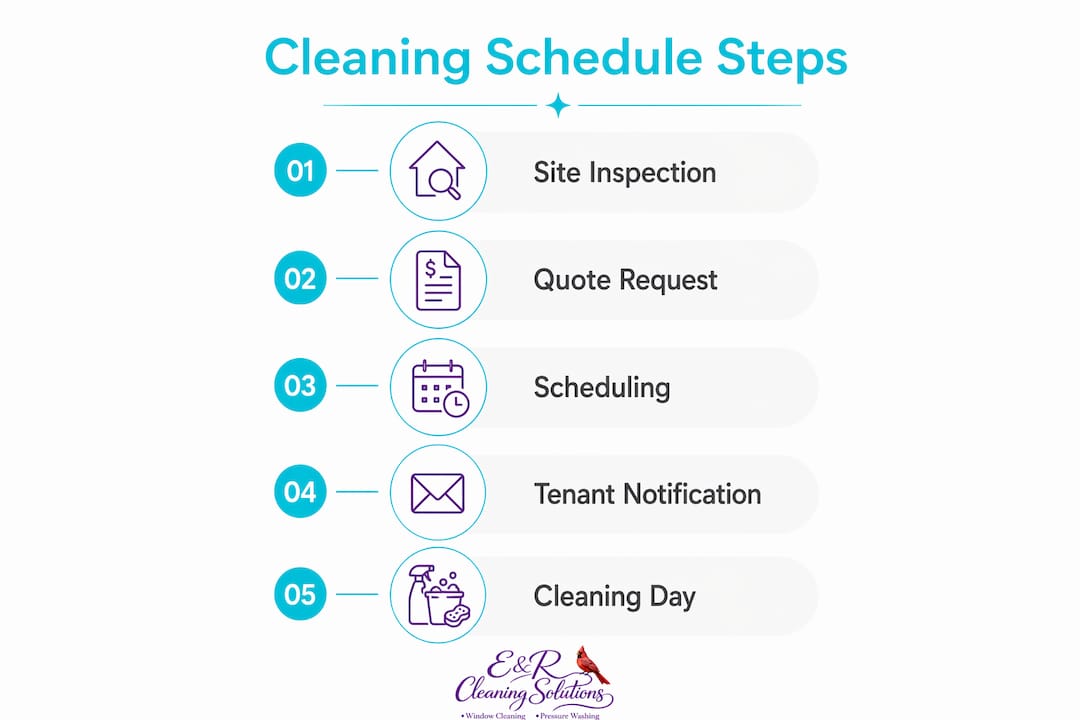
How does the scheduling process work from first call to booked service?
A well-run provider moves through five stages. Knowing what happens at each one lets you push the process forward instead of waiting on the vendor.
-
Request a free consultation and site walkthrough. The crew measures total glass square footage, identifies frame types, maps anchor points, and notes obstructions like HVAC units, signage, or setbacks. This visit is the foundation of an accurate quote — any provider who skips it and quotes remotely is guessing.
-
Safety verification during the inspection. The inspector should check rooftop anchor points for OSHA compliance and review fall-protection documentation. Outdated anchor certifications are one of the most common causes of scheduling delays — crews legally cannot begin rope-access work without valid proof. If recertification is due, build that window into your timeline before booking.
-
Site-specific scope and written quote. A credible provider converts measurements and access constraints into a method selection, price, and staging plan. Request an itemized quote that separates labor, mobilization, equipment, and any restoration line items. Bundled lump-sum quotes make it impossible to compare bids fairly.
-
Scheduling options. For most large buildings, phased section-by-section cleaning is the smarter call. It reduces staging needs, avoids full-building closures, and lets crews work predictable, repeatable sections. Single-day full-building cleans work for smaller mid-rises with good perimeter access. Preferred work windows — early mornings, evenings, or weekends — reduce tenant disruption significantly.
-
Pre-job coordination and confirmation. Lock in tenant notices, security and ID protocols, elevator reservations for equipment, and staging areas for lifts or water-fed pole rigs. Confirm a start date only after all of these are in place.
Pro Tip: Book large commercial window cleaning 2–4 weeks ahead, especially during spring and fall peak seasons. That lead time gives the provider room to schedule equipment and crew, and gives you time to handle anchor recertification if it comes up during the site visit.

How often should you schedule cleaning by building type?
Frequency is not one-size-fits-all. A downtown retail tower and a suburban office park have very different exposure profiles, and cleaning too infrequently on a high-exposure building means paying for restoration instead of maintenance.
Factors that push frequency higher:
- Coastal or lakefront locations (salt air accelerates mineral buildup)
- Heavy vehicle traffic or proximity to highways (exhaust and particulate)
- Seasonal pollen surges (spring and fall in most U.S. markets)
- Active nearby construction (concrete dust and overspray bond quickly to glass)
Routine maintenance prevents buildup of hard-water stains, airborne grime, and pollen that can eventually require expensive restoration — a cost that almost always exceeds what consistent cleaning would have run.
| Building Type | Recommended Frequency | Rationale |
|---|---|---|
| High-traffic retail / storefront | Monthly | Customer-facing glass; grime is visible immediately |
| Downtown high-rise office | Quarterly (minimum) | Pollution and pollen accumulate fast; tenant expectations are high |
| Suburban office tower | Semi-annual to quarterly | Moderate exposure; balance appearance with budget |
| Multi-family residential high-rise | Quarterly to semi-annual | Tenant satisfaction and lease renewal expectations |
| Sheltered / low-exposure building | Semi-annual to annual | Minimal environmental load; appearance standards are lower |
The right exterior cleaning frequency for your property depends on both exposure and the appearance standards your tenants or customers expect. When in doubt, start with quarterly and adjust after the first year.
What drives the cost of cleaning a large building’s windows?
Pricing for large-building glass cleaning is not linear. Two buildings with the same square footage of glass can quote very differently based on how that glass is accessed.
Primary cost drivers:
- Total glass area — the baseline for any quote; measured in square feet or by pane count
- Building height and access method — rope access and aerial lifts carry higher mobilization costs than water-fed poles
- Degree of restoration needed — hard-water mineral removal or construction-debris cleaning adds significant labor and chemical costs
- Architectural complexity — recessed windows, angled glass, skylights, and atriums each add time
Additional budget factors:
- Mobilization (truck, lift rental, fuel)
- Traffic control or street permits for boom lifts
- Staging and parking at the building
- After-hours or weekend surcharges
- Recurring-contract discounts (typically reduce per-visit cost)
Industry pricing signals for high-rise commercial work run roughly $0.07–$0.15 per square foot, $50–$100 per hour, or $2–$5 per windowpane depending on complexity. Treat these as budgeting frames only — actual quotes vary significantly by market, access method, and restoration scope.
One accounting note worth flagging before you submit a budget request: routine window cleaning is generally treated as an operating expense, while major restoration or structural repairs may be capitalized. Confirm the billing classification with your finance team before the scope is finalized, since it affects which budget line the invoice hits.
Always request an itemized quote. A bundled number makes it impossible to compare bids or identify where one provider is cutting corners.
What safety and compliance documents should you require before scheduling?
Safety documentation is not a formality — it is the legal foundation for the work. A provider who cannot produce these items before the job starts creates liability for the property owner, not just for themselves.
Essential documents to request:
- Proof of general liability insurance and workers’ compensation coverage
- Written fall-protection plan specific to your building
- OSHA fall-protection compliance evidence (29 CFR 1926 Subpart M for construction-adjacent work; 29 CFR 1910 for general industry)
- IWCA (International Window Cleaning Association) membership or I-1 standard references where applicable
- Anchor-point certification dates and the recertification schedule
- Crew licensing, background check documentation, and daily safety check records
Anchor-point certification is the detail most managers overlook. Many buildings have rooftop anchors that were installed years ago and have never been recertified. If a rope-access crew arrives and finds expired certifications, work stops — and the recertification process can take days to weeks depending on the certifying engineer’s availability. Verify anchor status before you finalize the schedule, not after.
Request a photo log or completion checklist at the end of the job. It documents the work performed, confirms quality, and gives you a record if any glass damage is disputed later.
What questions should you ask, and what red flags should stop the hire?
Questions to include in your RFP or vendor email:
- What does your site inspection cover, and will you provide a written report?
- Which access method do you propose for this building, and why?
- What is your staging plan and timeline by building section?
- What are your insurance limits for general liability and workers’ comp?
- Can you provide anchor-point certification documentation for rope-access work?
- Do you have references from similar large-scale projects in the past 12 months?
- What is your cleanup and quality-control process after each phase?
A documented maintenance plan that assigns responsibilities and defines communication with tenants and site teams is a strong signal of an experienced provider.
Red flags that should stop the hire:
- Refusal to conduct a rooftop or anchor-point inspection before quoting
- Quote delivered without a written scope of work or staging plan
- Price dramatically lower than other bids with no explanation
- No insurance documentation provided on request
- No references from comparable large-scale projects
- Vague or verbal-only answers to safety questions
Pro Tip: Before finalizing a vendor, confirm with your finance team whether the cleaning scope will be billed as an operating expense or capitalized. That classification affects budget approval and invoice routing — sorting it out after the work is done creates unnecessary friction.
How do you prepare the building, tenants, and operations for cleaning day?
Preparation on your end is what separates a smooth job from a chaotic one. Providers can only work as efficiently as the access and coordination you give them.
Operational checklist for facilities staff:
- Identify and clear staging areas for lifts, water-fed pole rigs, and supply vehicles
- Reserve freight elevators for equipment transport on cleaning days
- Secure access points and brief security staff on crew IDs and entry protocols
- Remove exterior obstructions (planters, signage, furniture) from work zones
- Arrange parking permits or reserved spaces for service vehicles
- Confirm that anchor points are accessible and recertification is current
Tenant coordination:
- Notify tenants at least 48–72 hours before work begins in their section
- Specify the work window (e.g., 7:00 AM–12:00 PM, north façade only)
- Clarify whether interior access is needed and how to prepare window areas
- Set expectations for noise from lifts or water-fed pole equipment
- Provide a contact number for questions or concerns during the job
Sample tenant notice (adapt as needed):
For a full pre-job checklist your facilities team can use during the site inspection and vendor vetting stages, the large building window cleaning checklist covers every step in detail.

How E and R Cleaning Solutions schedules and runs large-building window cleans
E and R Cleaning Solutions follows a structured process designed specifically for commercial property managers who need accurate quotes, clear timelines, and zero surprises on cleaning day.
The process:
- Free site inspection — a crew visits your property, measures glass area, maps anchor points, identifies access constraints, and documents the current condition of the glass.
- Written scope and binding quote — you receive an itemized proposal with method selection, staging plan, timeline by building section, and a contingency policy for unexpected restoration or weather delays.
- Phased scheduling options — for large buildings, E and R Cleaning Solutions stages work section by section to keep the building operational and minimize tenant disruption throughout.
- Quality check and photo documentation — on completion of each phase, the crew conducts a walkthrough and provides a photo log confirming the work performed.
Trust signals:
- Licensed, bonded, and insured for commercial properties
- OSHA-trained crews with documented fall-protection plans
- Anchor-point verification completed before any rope-access work begins
- Transparent, itemized pricing with no hidden mobilization fees
- References available from comparable large-scale commercial projects
To request a site inspection or set up a recurring maintenance plan, visit eandrcleaningsolutions.com.
Key Takeaways
Scheduling professional window cleaning for a large or high-rise building requires a site inspection, verified safety compliance, a written phased scope, and confirmed tenant coordination before any work begins.
| Point | Details |
|---|---|
| Start with a site inspection | No accurate quote exists without a rooftop walkthrough that maps glass area and anchor points. |
| Verify anchor certification first | Expired rooftop anchors stop rope-access crews legally; confirm recertification before finalizing the schedule. |
| Request itemized quotes | Bundled pricing hides cost drivers and makes fair bid comparison impossible. |
| Match frequency to building type | High-traffic retail needs monthly cleaning; suburban offices typically run quarterly to semi-annual. |
| E and R Cleaning Solutions | Offers free site inspections, phased scheduling, and written binding quotes for large commercial buildings. |
What property managers consistently get wrong when scheduling large-building cleans
The mistake I see most often is not a bad vendor choice — it is a rushed timeline. A property manager calls in March, wants the building cleaned before a major tenant move-in in April, and skips the site inspection to save a week. Then the crew arrives, finds expired anchor certifications on the roof, and the job is delayed anyway. Only now there is no buffer.
The second most common oversight is treating all bids as equivalent. A quote that is 30% lower than the others is not a deal — it is a signal that something is missing from the scope. Usually it is the restoration line, the mobilization cost, or the insurance. When you ask for itemization and the provider pushes back, that tells you everything.
Phased scheduling also gets underused. Managers default to “clean the whole building in one day” because it feels simpler. In practice, a phased approach by façade section is easier to coordinate with tenants, requires less staging space, and gives the crew predictable, repeatable conditions. The total job time is often the same; the disruption is a fraction.
One small change that consistently saves projects: send the tenant notice three days before the crew arrives, not the morning of. That single shift eliminates most of the friction on cleaning day — tenants move furniture, clear window areas, and know who to call with questions. It costs nothing and saves hours.
Ready to book a site inspection with E and R Cleaning Solutions?
Property managers who need to schedule exterior window cleaning for a large or high-rise building get the most accurate quote by starting with a free site inspection — not a phone estimate. E and R Cleaning Solutions provides written, itemized proposals with phased scheduling options, OSHA-compliant crew documentation, and a clear contingency policy, so you know exactly what you are approving before any work begins.
Visit the large building window cleaning checklist to prepare for your site visit, or go directly to the commercial windows specialist page to understand what a correctly scoped large-building clean includes. When you are ready to book, contact E and R Cleaning Solutions to request your free inspection and get a binding quote with a phased schedule built around your building’s needs.
Useful sources and references
| Resource | What it covers |
|---|---|
| OSHA Fall Protection Standards | Federal fall-protection requirements applicable to window cleaning crews working at height |
| IWCA — International Window Cleaning Association | Industry standards, I-1 safety standard references, and high-rise cleaner certification resources |
| Commercial Window Cleaning Frequency Guide | Practical guidance on setting the right cleaning schedule by building type and exposure |
| Large Building Window Cleaning Checklist | E and R Cleaning Solutions’ downloadable checklist for site inspections and vendor vetting |
| Why Commercial Windows Need Specialized Cleaning | Background on glass types, restoration vs. maintenance, and why large buildings need specialist crews |
| Exterior Cleaning Frequency for Businesses | How frequency choices reduce long-term costs for commercial properties |
| Coordinating exterior work with painting projects | Useful when window cleaning is scheduled alongside exterior painting or restoration work |