How Cleaning Services Are Evaluated Professionally

Professional cleaning service evaluation is defined as a weighted scoring process that measures compliance, operational capacity, scope clarity, and quality systems before price. Property owners and managers who skip this structure routinely end up with vendors who underperform, forcing costly re-procurement within the first year. A structured assessment method protects your property, your tenants, and your budget. Understanding how cleaning services are evaluated professionally gives you the leverage to choose a vendor who delivers consistent results, not just a low bid.
What are the primary criteria for evaluating cleaning services?
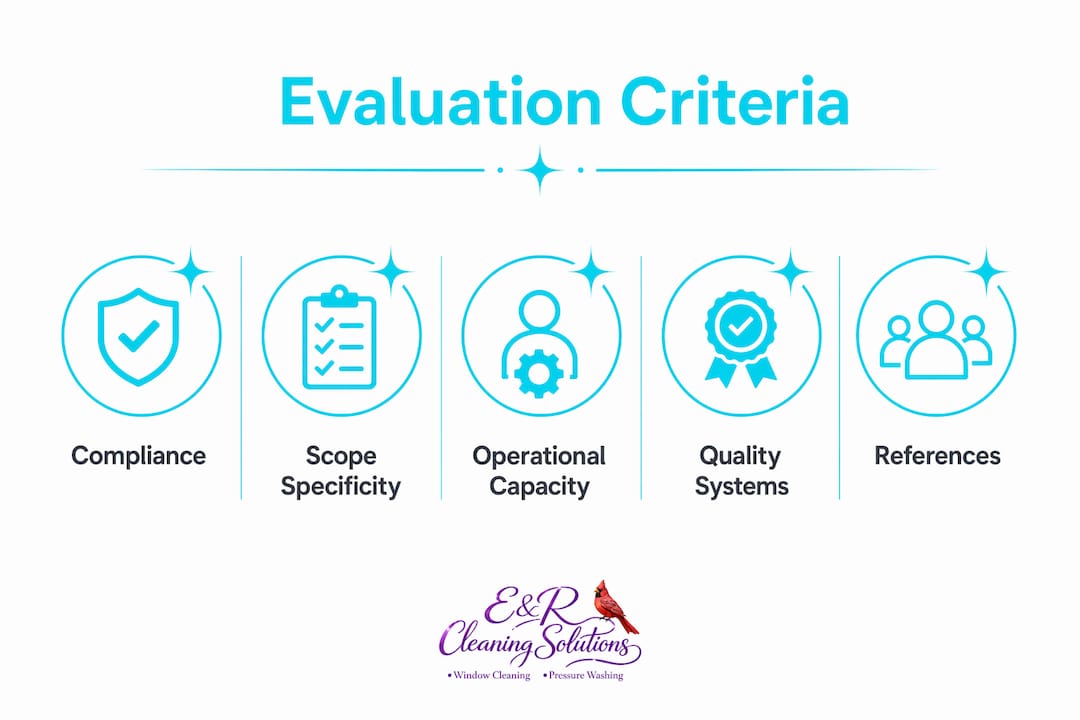
Cleaning service evaluation criteria fall into two stages: compliance pre-qualification and competitive scorecard scoring. Stage 1 acts as a pass/fail filter. Stage 2 scores only the vendors who cleared Stage 1. This two-stage evaluation approach prevents non-compliant vendors from winning contracts on price alone.
Compliance pre-qualification covers the following non-negotiable requirements:
- Insurance certificates: General liability and workers’ compensation must be current and verifiable.
- Bonding: Protects your property against theft or damage caused by cleaning staff.
- Licensing: State and local business licenses confirm the vendor operates legally.
- Background checks: Workforce screening is a baseline requirement, not an optional add-on.
- ISO certification or equivalent quality standard: Signals that the vendor operates under a documented quality management system.
Any vendor missing one of these items is disqualified before price is ever discussed. Background checks, bonding, and insurance must be verified first because non-compliant vendors often submit misleadingly low bids. A low number from an uninsured vendor is not a bargain. It is a liability.
Scope specificity is the second major criterion. A vendor’s proposal must include a task-frequency matrix: a table listing every cleaning task, the area it covers, and how often it occurs. Scope defined only by broad terms like “general cleaning” scores zero in a professional evaluation because it creates no accountability. If the contract does not specify that restrooms are sanitized daily and lobby floors are mopped three times per week, you cannot enforce either standard.
Operational capacity covers supervisor structure, backup coverage plans, and response times for complaints or emergencies. A vendor with one supervisor managing 40 properties cannot respond to a problem at your building within a reasonable window. Ask directly: how many sites does each supervisor manage, and what is the backup plan when a crew member calls out?

Quality systems include inspection cycles, written audit reports, and corrective action protocols. A vendor who cannot describe their internal inspection process has no mechanism for catching problems before you do.
References complete the picture. Ask references specific questions about how the vendor handled a service failure and whether quality held up over the last six months. Superficial reference checks reveal nothing useful.
How do weighting and scoring models work in evaluating cleaning vendors?
A 100-point weighted scoring system is the industry standard for comparing cleaning vendors. Price should represent only 25–30% of the total score. The remaining 70–75% covers quality systems, operational capacity, compliance documentation, and scope clarity. This distribution exists because a vendor who scores 90 on price but 40 on quality is a high-risk hire.
A typical scorecard distributes points across these categories:
| Category | Weight |
|---|---|
| Compliance and insurance | 20% |
| Scope specificity and task matrix | 20% |
| Operational capacity and supervision | 15% |
| Quality systems and audit protocols | 15% |
| References and contract history | 10% |
| Price (normalized) | 20–30% |
Vendors scoring below 70–80 points on this scale indicate a high risk of service failure and future re-procurement costs. Rejecting a low-priced vendor who scores 65 is not being overly cautious. It is avoiding a predictable problem.
Normalized pricing makes the price column meaningful. If Vendor A quotes $3,200 per month but excludes floor stripping, and Vendor B quotes $3,800 and includes it, the raw numbers are not comparable. Add the estimated cost of missing tasks to the narrower bid before scoring. This “apples-to-apples” adjustment often reverses which vendor appears cheaper.
Pro Tip: Score price last. Evaluate compliance, scope, and operational capacity first. Vendors who know price is your primary filter will submit stripped-down bids that look cheap but deliver less.
Turnover rate and average contract length belong on the scorecard too. Stable cleaning companies average contract lengths of 36–40+ months, while the industry average employee turnover runs around 200%. A vendor with turnover well below that benchmark delivers more consistent service because the same trained staff show up each week.
What practical steps verify vendor capabilities beyond proposals?
A proposal tells you what a vendor promises. An on-site walkthrough and a structured audit process tell you what they can actually deliver.
-
Require a physical walkthrough before any quote. Vendors submitting bids without on-site inspections lack the facility knowledge to scope accurately. A vendor who quotes remotely is guessing. Disqualify them. The walkthrough also reveals whether the vendor asks intelligent questions about your facility’s specific needs or simply takes notes and leaves.
-
Evaluate how vendors conduct their own audits. Ask to see a sample audit report. A professional audit includes five components: consistent checklists, weighted zone-based scoring, photo documentation of issues, corrective action protocols, and an auditor who is independent from the cleaning crew. A vendor who cannot produce a sample report does not run audits.
-
Check average contract lengths and employee turnover directly. Ask the vendor: “What is your average client tenure?” and “What is your annual staff turnover rate?” These two numbers reveal operational stability faster than any sales pitch. A vendor averaging 18-month contracts in an industry where stable companies hold clients for 36–40+ months is losing clients at an above-average rate.
-
Run targeted reference checks. Contact at least two references and ask: “Describe a time the vendor failed to meet your expectations and how they resolved it.” Also ask: “Has service quality changed in the last six months?” References checked with specific, problem-focused questions reveal reliability far better than open-ended praise.
-
Audit after contract award, not just before. Schedule independent quality audits at 30, 60, and 90 days after service begins. Shifting from impression-based walkthroughs to data-driven audits is the single most effective way to enforce contract standards over time.
Pro Tip: Ask the vendor to walk your facility with you during the site visit. Watch whether they identify problem areas proactively or wait for you to point them out. Proactive vendors manage properties. Reactive vendors manage complaints.
Common pitfalls when assessing cleaning services
Most evaluation failures trace back to the same avoidable mistakes. Recognizing them before you start the process saves time and money.
-
Prioritizing price too early. Property managers who focus on price first incentivize vendors to submit narrow, stripped-down scopes. You end up comparing bids that do not cover the same work, which makes every number meaningless.
-
Skipping scope normalization. Two bids with a $600 monthly difference may actually be within $50 of each other once missing tasks are priced in. Failing to normalize bids before scoring creates a false impression of savings.
-
Accepting vague scope language. Any proposal using phrases like “clean as needed” or “general maintenance” gives the vendor an exit from accountability. Specific task-frequency matrices are the only language that holds up in a contract dispute.
-
Relying on vendor presentations instead of structured questions. Sales walkthroughs are designed to impress. A structured scorecard with numeric ratings forces vendors to compete on measurable criteria, not personality.
-
Ignoring turnover and compliance documentation. A vendor with high staff turnover cannot deliver consistent service regardless of their proposal quality. Compliance gaps expose your property to liability the moment an incident occurs.
-
Failing to write quality standards into the contract. Verbal commitments disappear. Inspection frequency, response time requirements, and corrective action timelines must appear in the signed agreement. Without contractual language, you have no enforcement mechanism.
Key Takeaways
Professional cleaning service evaluation requires a weighted scoring system that places compliance, scope clarity, and operational capacity above price.
| Point | Details |
|---|---|
| Compliance comes first | Verify insurance, bonding, background checks, and licensing before reviewing any price. |
| Weight price at 25–30% | Score quality, scope, and operational factors across the remaining 70–75% of your evaluation. |
| Normalize bids before comparing | Add missing task costs to narrower bids so price comparisons reflect equal scopes. |
| Require on-site walkthroughs | Disqualify any vendor who submits a bid without physically inspecting your facility. |
| Audit after contract award | Run independent, data-backed audits at 30, 60, and 90 days to enforce contract standards. |
What I’ve learned from watching property managers evaluate cleaning vendors
The most common mistake I see is treating the evaluation as a one-time event. Property managers invest real effort in selecting a vendor, then assume the contract runs itself. It does not. Quality drifts within weeks if there is no structured audit process holding the vendor accountable.
The second thing I have noticed is how much the walkthrough reveals about a vendor’s character. A vendor who shows up with a clipboard and asks detailed questions about your facility’s traffic patterns, surface types, and problem zones is thinking about your property. A vendor who nods along and hands you a brochure is thinking about closing the deal. That difference shows up in the work within the first month.
Scope normalization is the insight most property managers resist because it takes extra time. But I have seen evaluations where the “cheapest” bid was actually the most expensive once missing tasks were priced in. Skipping normalization does not save time. It creates a problem you pay for later.
Responsiveness during the evaluation process also predicts service quality. If a vendor takes four days to return a call during the bidding phase, when they are trying to win your business, response times will not improve after they have the contract. Communication speed is a leading indicator, not a lagging one.
— Richard
E and R Cleaning Solutions: transparent service, clear scope
Property owners who apply a structured evaluation process quickly realize how rare genuine transparency is among cleaning vendors. E and R Cleaning Solutions operates with honest pricing, detailed scope delivery, and a customer-first approach that holds up under scrutiny.

Whether you manage a residential property or a commercial building, E and R Cleaning Solutions provides window cleaning and pressure washing services with clear task definitions and no hidden variables. Their team conducts thorough on-site assessments before quoting, so every proposal reflects your actual facility. For property managers who want to understand what professional cleaning looks like in practice, the residential window cleaning guide covers the full process from assessment to completion. Commercial property owners can also review why commercial windows require specialized cleaning to understand the scope and standards involved.
FAQ
What does a professional cleaning service evaluation include?
A professional evaluation covers compliance pre-qualification, scope specificity, operational capacity, quality systems, references, and normalized pricing. Compliance is assessed first as a pass/fail filter before any scoring begins.
How much weight should price carry in a cleaning vendor evaluation?
Price should represent 25–30% of the total evaluation score. The remaining 70–75% covers quality, compliance, scope clarity, and operational factors to reduce the risk of selecting a low-cost, low-quality vendor.
Why is scope normalization important when comparing cleaning bids?
Scope normalization adds the estimated cost of missing tasks to narrower bids so all proposals reflect equal work. Without it, price comparisons are misleading because vendors are quoting different scopes.
What questions should I ask cleaning service references?
Ask references how the vendor handled a specific service failure and whether quality has remained consistent over the last six months. Problem-focused questions reveal reliability far better than general satisfaction inquiries.
How do I verify a cleaning vendor’s stability before hiring?
Ask for their average client contract length and annual employee turnover rate. Stable vendors average contract lengths of 36–40+ months and maintain turnover well below the industry average of around 200%.