Why Property Cleaning Affects Insurance Costs: Owner’s Guide

Regular, professionally documented cleaning lowers your property’s risk profile and can reduce premiums or improve coverage terms at renewal. That’s the short answer. The Insurance Information Institute (Triple-I) notes that insurers have shifted from a repair-and-replace mindset to a predict-and-prevent model, where documented maintenance is treated as evidence of mature risk management. The ISSA frames cleaning as measurable risk mitigation rather than just hygiene. Exterius Facilities Management adds that professional cleaning records can serve as legal and insurance evidence, showing a hazard was not the result of negligence. E and R Cleaning Solutions sees this play out in the field: clients who arrive at renewal with dated logs and vendor certificates are in a fundamentally different conversation with their broker than those who show up empty-handed.
Table of Contents
- How cleaning changes an insurer’s risk calculus
- Which insurance policies are affected and how
- What insurers and underwriters actually want to see
- How cleaning affects premiums: timelines and what to expect
- A practical checklist you can start using today
- When cleaning can hurt your insurance position
- E and R Cleaning Solutions templates and field examples
- Key Takeaways
- The part most property owners get backwards
- What E and R Cleaning Solutions offers property owners
- Useful sources and further reading
How cleaning changes an insurer’s risk calculus
Cleaning removes or reduces the specific exposures that generate claims. Each mechanism below maps directly to a loss category underwriters price:
- Slip and fall prevention: Wet, dirty, or debris-covered floors are the leading source of general liability claims in commercial properties. Regular floor maintenance and pressure washing between tenancies cuts that exposure at the source.
- Mold and water damage: Routine cleaning of drains, gutters, and HVAC condensate lines prevents moisture buildup. Mold remediation claims are expensive and often contested; prevention is cheaper than the deductible.
- Pest control: Sanitation removes the food sources and harborage that attract pests. Pest damage can void warranties and trigger property claims that insurers scrutinize for deferred maintenance.
- Kitchen fire risk: Grease buildup in hoods and ducts is a primary cause of commercial kitchen fires. Kitchen hood cleaning is a common underwriting requirement, typically every 90–180 days depending on the carrier.
- HVAC performance: Dirty filters and coils force systems to run harder, increasing fire and mechanical-failure risk. Clean HVAC systems also reduce the airborne particulates that drive employee illness and workers’ comp claims.
- Roof and gutter clearing: Debris-clogged gutters cause water intrusion and ice damming. Preventive tree trimming combined with regular gutter cleaning addresses two of the most common residential property claims simultaneously.
Which insurance policies are affected and how
| Policy type | Primary cleaning link | Typical underwriting effect |
|---|---|---|
| Property insurance | Water/fire prevention (gutters, hoods, HVAC) | Premium credits; fewer deferred-maintenance denials |
| General liability | Slip/trip hazard removal (floors, entries, walkways) | Lower claim frequency; better renewal terms |
| Business interruption | Proactive hygiene reduces downtime from mold, pests, or fire | Fewer triggering events; shorter interruption periods |
| Workers’ compensation | HVAC/air quality and floor safety reduce employee injuries | Lower experience modifier (mod rate) over time |
| Health-related costs | ISSA links clean environments to reduced absenteeism | Lower group health utilization; productivity gains |
The ISSA white paper specifically connects professional cleaning to reduced absenteeism and downstream health insurance costs. For property managers running multi-tenant buildings, that workers’ comp mod rate is often the most direct lever cleaning can move.
What insurers and underwriters actually want to see
Insurers reward documented, repeatable maintenance programs. A verbal assurance that you clean regularly carries no weight in an underwriting review or a claim dispute. Here is what they actually ask for:
- Cleaning schedules (daily, weekly, monthly, quarterly) with assigned areas
- Daily logs with timestamps, staff initials, and supervisor signatures
- Vendor certificates of insurance (COI) and professional liability coverage
- Kitchen hood cleaning certificates (with date, technician, and frequency)
- HVAC filter replacement records and inspection reports
- Pest-control service reports from licensed contractors
- Restroom inspection logs (especially for commercial and multi-family properties)
- Gutter and roof-clearing records, ideally with before/after photos
Insurers increasingly use drone and satellite imagery to audit for deferred maintenance during underwriting and renewals. A credible, timestamped maintenance record is often the best defense against an adverse finding. The Fix It Homestead analysis confirms that carriers are asking about inspection frequency for core systems, including water, roof, and HVAC, more often than they did even two years ago.
Pro Tip: Bring your cleaning documentation to your broker 60–90 days before renewal, not at the meeting itself. Underwriters need time to review records, and presenting them proactively signals a mature risk-management program rather than a reactive one.
How cleaning affects premiums: timelines and what to expect
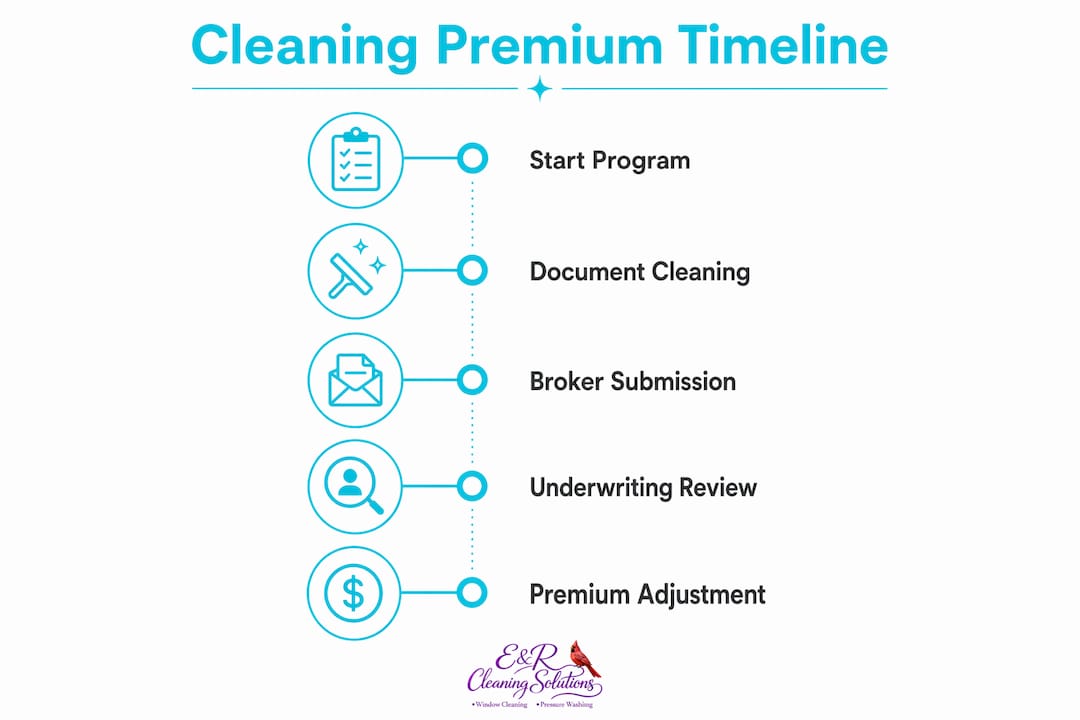
Properties with documented, professional cleaning programs typically see 5–15% lower insurance premiums and 20–30% fewer liability and property claims. Those figures reflect industry observations across commercial portfolios, not a guaranteed outcome for every property.
What shapes your actual savings: property class and use type, prior claims history, geography and local weather risk, the depth and consistency of your documentation, third-party certifications (ISSA CIMS), and current market conditions.
Timeline matters. Premium changes almost always happen at renewal, not mid-term. If you start a documented cleaning program today, the first realistic window to present that evidence is your next renewal cycle, typically 12 months out. Mid-term audits and claim investigations are secondary opportunities where records can influence outcomes. Cleaning certifications such as ISSA CIMS can accelerate the conversation because they provide independent verification that a program meets a recognized standard.
One important boundary: routine deep cleaning is generally not a covered expense under standard property policies. Post-event cleanup after a covered loss (fire, water, vandalism) may be claimable, but deductibles and coverage limits determine whether filing is worth it. The value of regular cleaning is in preventing those events, not in recovering their cost.

A practical checklist you can start using today
Daily/Weekly
- Inspect and mop entry floors, stairwells, and high-traffic corridors
- Check restroom fixtures for leaks and clean surfaces; log with timestamp
- Clear exterior walkways and entries of debris, standing water, or ice
Monthly
4. Inspect and clean HVAC filters; document filter condition and replacement date
5. Check gutters for debris buildup; clear downspouts
6. Inspect kitchen hood filters; schedule professional hood cleaning per carrier requirements
Quarterly/Annual
7. Professional kitchen hood and duct cleaning (every 90–180 days for commercial kitchens)
8. Full gutter cleaning and roof inspection; photograph results
9. Pest-control service visit; retain written report
10. HVAC coil cleaning and system inspection by a licensed contractor
Vendor vetting mini-checklist
- Verify current COI (general liability and workers’ comp at minimum)
- Confirm professional liability (E&O) for sensitive sites
- Check certifications (ISSA CIMS or equivalent)
- Request references from similar property types
- Confirm reporting format: do they provide signed logs and photos?
Pro Tip: Use a free timestamping app (Google Photos location/time metadata works) to capture before-and-after photos of each cleaning task. Store them in a shared folder organized by date and area. A remote underwriter reviewing your file can verify the work without a site visit.
When cleaning can hurt your insurance position
Bad cleaning practices or missing documentation can produce “deferred maintenance” findings and outright claim denials. Insurers commonly deny claims when they can show damage developed from neglect, and a dated, verifiable maintenance record is the primary way to contest such findings.
Common pitfalls include DIY cleaning that voids manufacturer warranties on HVAC or roofing systems, hiring unverified vendors without COIs (which shifts liability back to the property owner), missing timestamps on logs, and using improper techniques in sensitive areas. For data centers and server rooms, specialized ESD-safe cleaning and a Certificate of Cleanliness are often required to protect OEM warranties and prevent insurers from pursuing subrogation after equipment damage.
Two brief examples illustrate the risk. A homeowner filed a water-damage claim after a bathroom leak caused subfloor rot. The insurer’s adjuster found no maintenance records and dated the moisture intrusion to at least 18 months prior. The claim was denied as deferred maintenance. In a commercial case, a restaurant owner filed a kitchen fire claim after a hood fire. The carrier asked for hood-cleaning certificates. The owner had cleaned the hood internally but had no professional certificate and no dated log. The claim was disputed and settled at a fraction of the loss.
E and R Cleaning Solutions templates and field examples
E and R Cleaning Solutions provides clients with a structured cleaning-log template designed to satisfy insurer documentation requirements. The core columns are: date and time, area or system cleaned, tasks performed, photo reference number, staff initials, and vendor COI reference. That last column is the one most owners miss. Linking each service visit to a current COI creates an auditable chain of evidence.
Vendor contract checklist (what to require in writing):
- Current COI with your property named as additional insured
- Professional liability (E&O) coverage for high-value or sensitive areas
- Service frequency and scope defined per area
- Reporting format: signed log, timestamped photos, and digital delivery
- Remediation escalation path: what happens if a hazard is found during cleaning
Anonymized case example: A mid-size commercial property manager adopted a documented cleaning program with E and R Cleaning Solutions, including monthly exterior pressure washing, quarterly gutter clearing, and weekly interior logs with photo records. At the next renewal, the broker presented the 12-month log package to the underwriter. The property qualified for a liability premium credit and the carrier removed a prior deferred-maintenance notation from the file. No specific premium figure was disclosed, but the manager confirmed the renewal terms improved and a prior coverage restriction was lifted.
For cleaning and building code compliance questions, the documentation approach is the same: dated, signed, and photo-backed records protect you in both regulatory and insurance contexts.
Key Takeaways
Regular, documented cleaning reduces claim frequency and severity, and properties with verified maintenance programs typically see 5–15% lower premiums and 20–30% fewer liability and property claims.
| Point | Details |
|---|---|
| Start documenting today | A 30-day verified log is enough to begin a credible maintenance record for your broker. |
| Prioritize high-risk systems | Kitchen hoods, gutters, HVAC filters, and entry floors drive the most insurer-relevant claims. |
| Present evidence at renewal | Bring cleaning logs and vendor COIs to your broker 60–90 days before renewal, not at the meeting. |
| Vet vendors carefully | Require a current COI and signed logs from every cleaning contractor you hire. |
| E and R Cleaning Solutions | Provides dated logs, photo records, and COIs that map directly to insurer documentation requirements. |
The part most property owners get backwards
Most owners think about insurance and cleaning as separate budgets. Insurance is the annual bill; cleaning is the recurring operational cost. That framing is exactly why so many claims get denied.
The predict-and-prevent shift Triple-I describes is not a trend. It is a structural change in how underwriters price risk. Carriers are using satellite imagery and drone audits to identify deferred maintenance before you file a claim. By the time you need the insurance, the underwriter has already formed a view of your property. A cleaning log does not just help you at renewal. It changes what an adjuster sees when they open your file after a loss.
The other thing owners underestimate: the documentation gap. Most properties that get cleaned regularly still have no paper trail. The cleaning happened; nobody wrote it down. That is the gap E and R Cleaning Solutions closes. The service itself matters, but the signed log with a photo reference is what moves the needle with an underwriter.
What E and R Cleaning Solutions offers property owners

E and R Cleaning Solutions delivers the two things insurers actually want: the physical work and the paper trail. Services include professional window cleaning, exterior pressure washing, and pre-inspection exterior cleaning, with every visit documented in a signed, timestamped log with photo references. Clients receive vendor COIs naming their property as additional insured, making the records immediately usable for underwriting submissions.
For property managers preparing for renewal, the commercial property cleaning best practices page outlines the full documentation workflow. For homeowners, the residential window cleaning process page covers deliverables and COI handling. Request a quote or ask for a sample cleaning-log template at eandrcleaningsolutions.com and arrive at your next renewal with something concrete to show your broker.
Useful sources and further reading
- Insurance Information Institute (Triple-I) — underwriting trends and the predict-and-prevent shift in insurer risk framing
- ISSA Value of Clean white paper — health, productivity, and cleaning as operational risk mitigation
- Exterius Facilities Management — how cleaning records function as legal and insurance evidence
- RBM Building Services — industry observations on premium effects and kitchen hood requirements
- Critical Facilities Solutions — specialized cleaning, warranties, and subrogation risk in sensitive environments
- Oply blog — drone/satellite audits and the role of maintenance records in claims outcomes
Practitioner cleaning-log templates and vendor contract checklists are proprietary to E and R Cleaning Solutions and available on request via the contact page at eandrcleaningsolutions.com.