Clean Awnings Business Exterior: A Storefront Care Guide
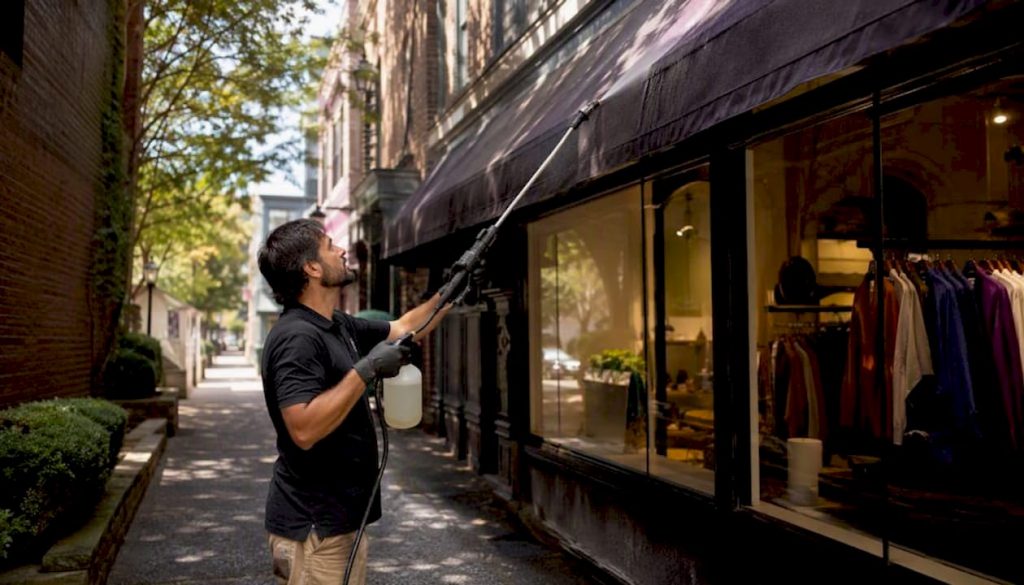
For a commercial storefront awning, the right move is a professional soft-wash cleaning twice a year, spring and fall, with light touch-ups between visits to stop grime before it sets. Do not reach for the pressure washer, and do not wait until the fabric looks gray to make a call.
Before you book anything, there are three things you can safely do today. First, walk outside and actually look at the awning, not through your car window on the way to the register. Check for sagging fabric, torn seams, rust streaks on the frame, or dark patches that could be mildew. Second, knock off loose debris, leaves, pollen clumps, bird droppings, with a soft brush or a garden hose on a gentle setting. Third, if the awning is retractable and it got rained on recently, extend it fully and let it dry before rolling it back up. Damp fabric rolled tight is one of the most common causes of mildew, because mildew feeds on the organic film that builds up on the fabric, not the fabric itself.
- Inspect visually for tears, sagging, rust, or dark staining.
- Clear loose debris with a soft brush or low-pressure hose rinse.
- Fully extend and air-dry a rolled awning before retracting it again.
Quick industry benchmark: two deep cleanings per year, spring and fall, is the maintenance cadence most awning specialists recommend for commercial fabric, with light wipe-downs in between during high-pollen or high-traffic seasons.
When you are ready to bring in a pro, have three details on hand before you call: the awning’s approximate size (width and depth), the material if you know it (canvas, acrylic, vinyl, or metal-framed), and how accessible it is (ground level, second story, or requiring a lift). E and R Cleaning Solutions can usually give you a realistic quote range from that alone.
Key Takeaways
Commercial awnings last longest with a professional soft-wash cleaning twice a year, matched chemistry to fabric type, and full drying before every retraction.
| Point | Details |
|---|---|
| Standard cleaning cadence | Schedule two professional deep cleanings per year, spring and fall, with light touch-ups between. |
| Match chemistry to material | Bleach solutions work only on acrylic fabric with a 15-minute contact limit; never use on untreated canvas. |
| Skip the pressure washer | Soft-wash, low-pressure methods protect fabric, seams, and printed logos that pressure washing can damage. |
| Dry before retracting | Fully air-dry any awning before rolling it up to prevent the mildew growth that damp fabric causes. |
| Work with E and R Cleaning Solutions | E and R Cleaning Solutions offers inspection, soft-wash cleaning, stain treatment, and recurring maintenance programs with custom pricing for commercial storefronts. |
Table of Contents
- Why Professional Awning Cleaning Matters for Business Exteriors
- Our Proven Awning Cleaning Process
- Which Cleaning Methods Work Best for Different Awning Materials?
- How Do You Safely Remove Mold and Mildew From Awning Fabric?
- How Often Should You Clean Commercial Awnings?
- What Should You Expect When You Hire a Professional Awning Cleaner?
- Can You Clean Your Business Awning Yourself, or Should You Call a Pro?
- A Field Note on What Actually Wears Awnings Out
- Get Your Storefront Awning Professionally Cleaned
- Sources
Why Professional Awning Cleaning Matters for Business Exteriors
A dirty awning does more damage to your business than most owners realize. It is not just an aesthetic problem, it is a slow-motion financial one, quietly shortening the life of an expensive piece of equipment while telling every passerby that nobody is paying attention inside.
Curb appeal is the obvious piece. A faded, streaked awning above your entrance undercuts everything else you have done to make the storefront look inviting, clean windows, swept sidewalks, fresh signage. But the less obvious cost is fabric degradation. Organic buildup, pollen, tree sap, exhaust residue, bird droppings, does not just look bad. It holds moisture against the fabric and accelerates the exact staining and mildew growth that shortens an awning’s useful life. Manufacturers of solution-dyed acrylic and vinyl fabrics generally specify cleaning methods in their warranty terms, and using the wrong chemistry or pressure level can void that coverage entirely.
There is a safety dimension too. Many commercial awnings sit above head height, over doorways, walkways, or loading zones, which means cleaning them involves ladder work, extension poles, or lift equipment. A crew that follows OSHA-aligned safe work practices and carries proper insurance protects you from liability if something goes wrong on your property, not just them.
- Curb appeal directly affects first impressions and foot traffic near your entrance.
- Routine cleaning prevents the organic film that leads to permanent staining.
- Manufacturer warranty terms often specify approved cleaning methods.
- Elevated or hard-to-reach installs carry real fall-risk that trained crews are equipped to manage.
Pro Tip: Small, regular cleans are cheaper than big remediation jobs. Wiping down or rinsing an awning every few weeks in pollen-heavy or high-traffic seasons prevents the buildup that eventually requires aggressive stain treatment or, worse, fabric replacement.
Our Proven Awning Cleaning Process
A professional soft-wash job follows a specific sequence, and knowing it helps you evaluate whether a vendor actually knows what they are doing. The short version: inspect, identify the material, soft-wash, treat stains, rinse at low pressure, dry fully, and document everything with photos.
- Inspection. A technician walks the awning structure, checking fabric condition, frame integrity, seams, and any existing damage before touching a hose.
- Material identification. Solution-dyed acrylic, vinyl, canvas, and polyester each react differently to cleaning agents, so this step determines everything that follows.
- Soft-wash application. A low-pressure sprayer applies a manufacturer-approved detergent solution, letting it dwell briefly to loosen dirt and organic film without forcing water into seams or backing.
- Targeted stain treatment. Set-in mildew, bird droppings, or tree sap get spot-treated with appropriate chemistry rather than blasted with more pressure.
- Low-pressure rinse. Water pressure stays low enough to protect fabric coatings and printed logos while fully clearing residue.
- Full air drying. The awning stays extended until completely dry, since retracting damp fabric is what causes mildew in the first place.
- Before-and-after photo documentation. A reputable crew photographs the awning before starting and after finishing, giving you a record for your own files and for any warranty conversation down the line.
For a medium storefront awning, a full job, from initial inspection through final drying and photos, typically runs a couple of hours, longer if there is significant mildew or if a lift is required for access.
Soft-wash and high-pressure washing are not interchangeable, even though people use the terms loosely. Pressure washing fabric at close range is repeatedly flagged by industry experts as damaging, because it can drive water into stitching, delaminate coated fabrics, and strip printed logos right off the surface. Soft-washing relies on the right chemistry and dwell time to do the work that pressure would otherwise attempt to force.
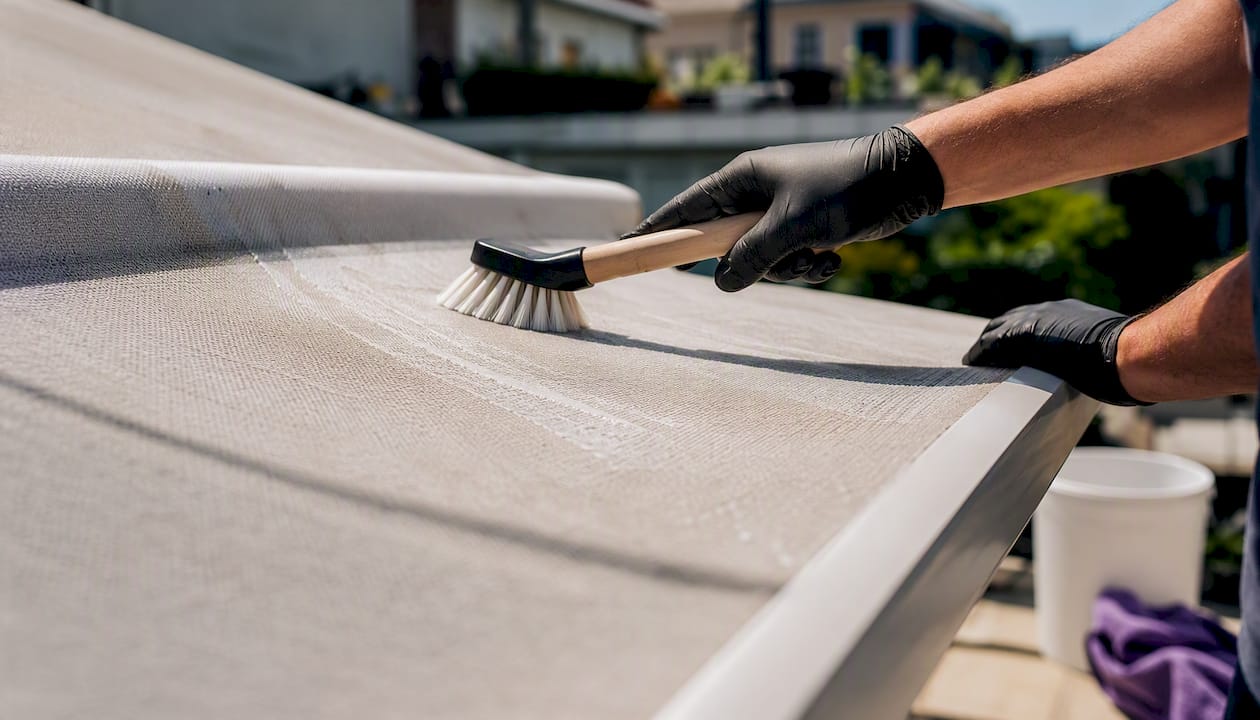
Pro Tip: Ask any vendor to show you sample before-and-after photos from a job similar to yours, not stock images. Good technicians document material type, cleaning method used, and any manufacturer notes alongside the photos, which becomes useful if you ever need to make a warranty claim.
Which Cleaning Methods Work Best for Different Awning Materials?
Matching method to material is the single biggest factor in whether an awning cleaning job succeeds or backfires. Get this wrong and you can permanently discolor fabric, void a warranty, or strip a logo you paid good money to print.
| Material | Recommended Approach | What to Avoid |
|---|---|---|
| Solution-dyed acrylic | Mild detergent, soft-wash, manufacturer-approved mildew treatment when needed | Bleach on untreated sections; high-pressure rinsing |
| Vinyl | Mild soap and lukewarm water, soft brush for grime | Solvent-based cleaners that can crack or dull the coating |
| Untreated canvas | Gentle detergent only, thorough air drying | Bleach of any concentration; power washers |
| Polyester blends | Manufacturer-recommended cleaner, low-pressure rinse | Abrasive brushes that can fray the weave |
| Metal frames (aluminum/steel) | Mild household cleaner, soft cloth or brush, dry to prevent rust | Harsh solvents on painted or powder-coated finishes |
Manufacturer guidance for most outdoor fabrics recommends mild detergent and lukewarm water, and specifically advises against using a pressure washer on canvas and similar fabrics. That single point covers more support-desk calls than anything else in this business.
A few specific warnings worth repeating to any staff who might touch the awning between professional visits:
- Never use bleach on untreated canvas. It weakens the fibers over time even at diluted concentrations.
- Never pressure-wash at close range, especially near seams, logos, or printed graphics.
- Skip stiff or abrasive brushes on coated fabrics. A soft-bristle brush does the job without scuffing the finish.
- Treat printed logos and valances as the most fragile part of the awning. Spot-clean gently rather than scrubbing directly over graphics.
How Do You Safely Remove Mold and Mildew From Awning Fabric?
For mildew on acrylic fabric specifically, use one cup of household bleach per gallon of water, with contact time limited to no more than 15 minutes before a thorough rinse. That 15 minute cap matters. Bleach breaks down the organic material mildew feeds on, but leave it sitting too long and it starts attacking the fabric fibers themselves, which is how a mildew problem turns into a fading or weakening problem.
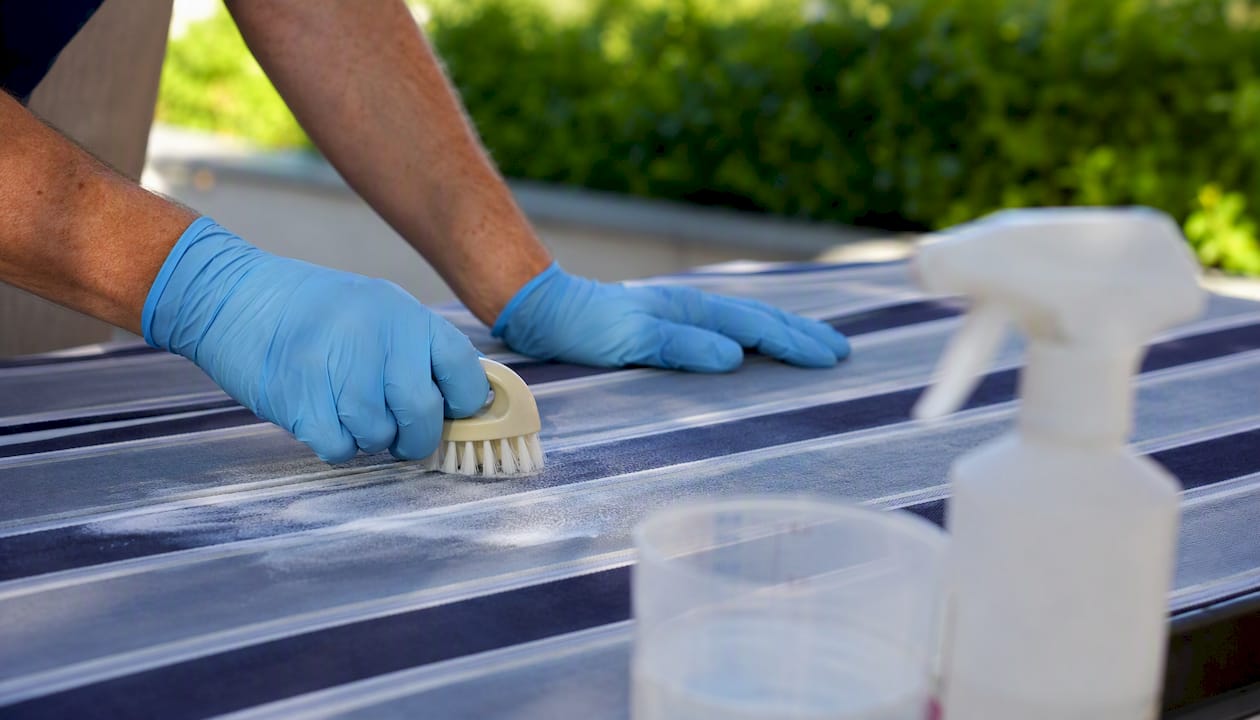
That same guidance carries a hard exception: this bleach ratio is for acrylic fabric only. Untreated canvas cannot handle bleach at any dilution without fiber damage, which is why material identification comes before any chemical treatment, not after.
On a commercial job, runoff containment matters as much as the chemistry itself. Diluted bleach solution and rinse water need to be directed away from storm drains and landscaping, and technicians working with cleaning solutions should wear gloves and eye protection as standard practice, the same safety baseline as any other chemical handling task on a commercial property.
Pro Tip: Always test any cleaning solution on a small, inconspicuous section of fabric first, even one you have used before, since fabric can fade or react differently after months of sun exposure. On a commercial job, photograph that test patch. It gives you a record if a client or property owner ever questions the method used.
How Often Should You Clean Commercial Awnings?
Two deep cleanings a year, spring and fall, is the standard most awning specialists point to for commercial fabric, with light wipe-downs or hose rinses every few weeks during dusty or pollen-heavy stretches. That rhythm keeps organic film from ever building up enough to cause staining or mildew, which is the whole point.
- Spring: Full soft-wash after winter grime, pollen, and any salt residue from winter weather in colder climates.
- Summer: Light rinse or wipe-down every few weeks, more often near high pollen sources or heavy foot traffic.
- Fall: Second deep clean before leaves and organic debris accumulate for winter.
- Winter: Visual checks only in most climates, with spot cleaning if debris collects.
Local conditions shift that calendar. Storefronts in urban corridors with heavy vehicle exhaust or coastal locations with high humidity tend to need more frequent attention than a suburban strip mall awning, simply because particulate accumulates faster in high-traffic environments.
Recurring service programs make more financial sense than one-off calls for most businesses running an awning year-round. A tiered program, two scheduled deep cleans plus periodic inspections, tends to cost less overall than emergency remediation after mildew sets in, and it gives you predictable line-item budgeting instead of a surprise invoice when the awning finally looks bad enough to act on. There is also a branding benefit that is easy to underweight: a business that always looks maintained reads as more trustworthy than one that occasionally looks neglected between big cleanings.
What Should You Expect When You Hire a Professional Awning Cleaner?
Before you sign off on any quote, ask the vendor these questions:
- What material is my awning, and how does that change your cleaning method?
- Are you insured, and can you provide proof of coverage?
- Will this cleaning method affect my manufacturer warranty?
- How do you contain and dispose of rinse water and chemical runoff?
- Can you provide references or before-and-after photos from similar jobs?
- What’s included if mildew or stains don’t fully lift on the first pass?
Cost on a commercial awning job depends on a handful of factors that vendors should be transparent about upfront:
- Access and height. A ground-level awning over a shop door costs far less to service than a second-story installation requiring a lift.
- Total fabric area. Larger storefront canopies naturally take more time and solution than a single window awning.
- Severity of staining or mildew. Set-in organic staining requires extra treatment time compared to routine dust and pollen removal.
- Fabric guard re-treatment. Some jobs include reapplying a protective coating after cleaning, which adds to material cost but extends time between deep cleans.
- Equipment needs. Jobs requiring scaffolding or a lift carry higher labor cost than one a technician can reach from a ladder.
A few red flags should end the conversation immediately. Any vendor who recommends pressure washing fabric awnings, who cannot produce proof of insurance on request, or who has no before-and-after documentation from past jobs is not someone you want on your roof or over your storefront entrance. Those gaps usually mean cut corners elsewhere too.
Pro Tip: Ask specifically whether the quote includes containment for rinse water runoff. It’s a small detail that separates a vendor who understands commercial-site requirements from one used to residential-only work.
Can You Clean Your Business Awning Yourself, or Should You Call a Pro?
Small, low-height jobs are reasonable to handle in-house. Anything large, elevated, heavily mildewed, or involving a mechanically complex retractable frame is a job for professionals, both for the sake of the fabric and for the sake of whoever is standing on the ladder.
For safe DIY maintenance on ground-level, accessible awnings, a mild dish soap solution, about 1/4 cup of dish soap per 5-gallon bucket of water, applied with a soft-bristle brush, works well for routine grime.
- Mix roughly 1/4 cup of dish soap per 5 gallons of water.
- Apply with a soft brush, working gently rather than scrubbing hard.
- Let the solution briefly dwell on stubborn spots without soaking the fabric.
- Rinse thoroughly with a garden hose on a gentle setting.
- Fully air-dry the awning before retracting it, even if that means leaving it extended overnight.
Run through this checklist before deciding whether a job stays in-house:
- Is the awning reachable from ground level or a short stepladder, without needing a lift or scaffold?
- Is there any visible structural damage, sagging fabric, rust, or loose hardware?
- Have set-in stains survived a gentle cleaning attempt already?
- Does the fabric smell musty or show dark spotting when extended, a sign of active mildew?
- Is the fabric under a manufacturer warranty that specifies approved cleaning methods?
Any “yes” past the first question is a reasonable trigger to call a professional instead of sending staff up a ladder. Elevated work carries real liability exposure for a business, and untrained staff attempting to clean a high awning is exactly the kind of incident that turns into a workers’ comp claim. If your team already handles other exterior upkeep, it’s worth reading how commercial windows require specialized cleaning approaches compared to routine residential work, the same logic that applies here.
A Field Note on What Actually Wears Awnings Out
The awnings that age fastest are almost never the ones cleaned too little. They’re the ones cleaned incorrectly, or left damp after a storm because nobody wanted to deal with a wet, heavy fabric extension overnight. That single habit, rolling up a rain-soaked awning to get it out of the way, does more cumulative damage than a year of skipped dustings.
The other pattern worth flagging: business owners tend to treat awning cleaning as a cosmetic decision rather than a maintenance one, something to schedule when a customer finally comments on it. By the time staining is visible from the sidewalk, the organic film has usually been building for months, and what would have been a routine soft-wash six weeks earlier has turned into a stain-treatment job with a real chance the discoloration doesn’t fully lift.
A recurring maintenance schedule changes that dynamic entirely. It’s not about the awning looking pristine every single day, it’s about never letting the buildup get far enough ahead that a deep clean stops being enough. That shift, from reactive to scheduled, tends to be the difference between an awning that lasts a full decade and one that needs fabric replacement in half that time.
Get Your Storefront Awning Professionally Cleaned
E and R Cleaning Solutions brings the same soft-wash discipline to awnings that it applies to window cleaning and pressure washing work across residential and commercial properties: inspection first, material-appropriate chemistry, low-pressure rinsing, and full documentation before and after. That last part matters more than owners expect. Having dated before-and-after photos on file protects you if a warranty question ever comes up, and it gives you a record of exactly what condition your storefront was in going into busy season.
When you request a quote, have the awning’s approximate dimensions, material type if known, and accessibility on hand, that alone lets the team give you a realistic estimate before a technician ever sets foot on site. Inspection and estimate turnaround is typically quick, and recurring programs get custom pricing based on your specific schedule and awning count rather than a flat rate that ignores your actual setup. If you’re weighing whether your fabric needs a soft-wash instead of a pressure wash, the difference between the two methods is worth understanding before you book anything. Reach out to E and R Cleaning Solutions to schedule an inspection and get a custom quote for your storefront awning.
Sources
- Remove stains from mildew & mold | University of Georgia Extension
- How to clean your RV awning the easy way | Lippert
- How to clean an awning | The Home Depot
- How to clean & maintain your awning | AwningTown