
What Does Surface GPM Mean in Pressure Washing?
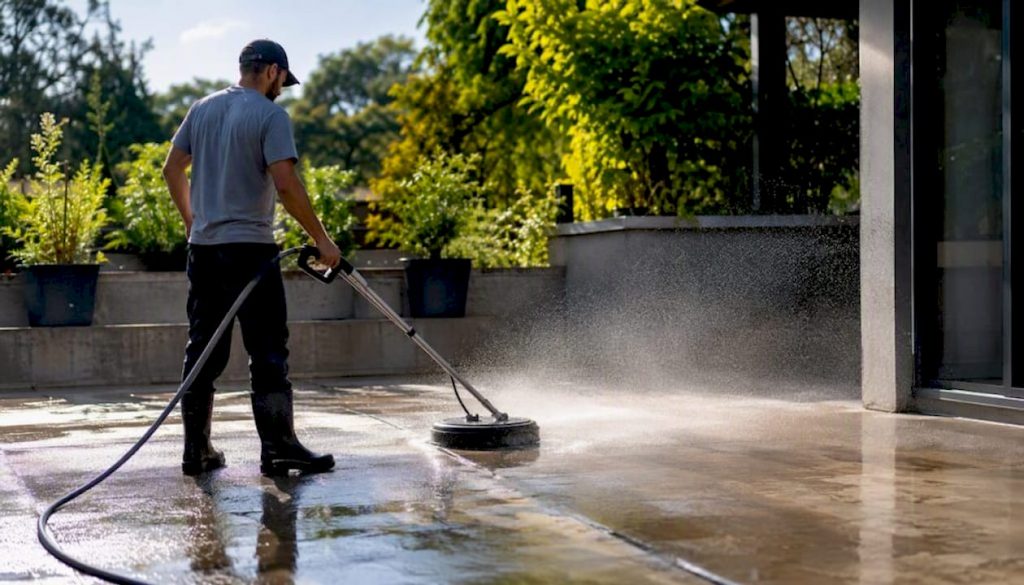
Surface GPM, or gallons per minute, is the volume of water your pressure washer delivers through a surface cleaner every minute. It controls rinsing speed, not force. Think of it this way: PSI is what breaks grime loose, and GPM is what sweeps it away. Without enough flow, loosened dirt just sits there.
For most surface cleaners, the practical range runs from a moderate flow on a compact residential deck up to a much higher flow on wide commercial units. Entry-level residential pressure washers typically deliver a moderate flow suitable for light home tasks, while industrial machines push 3 GPM and beyond.
One quick way to compare machines is the cleaning units formula:
- Cleaning units = PSI × GPM. A 3,000 PSI machine with moderate flow produces substantial cleaning units. Another machine with lower pressure but higher flow may produce comparable or superior cleaning power. The second machine cleans faster despite lower pressure.
- Surface GPM specifically refers to the flow rate matched to your surface cleaner’s deck width and nozzle count, not just the pump’s rated output.
- Typical deck-to-GPM pairings run roughly 4–5 inches of cleaner width per 1 GPM of output, so a 20-inch deck needs about 4–5 GPM to perform correctly.
Table of Contents
- Common GPM ranges and which jobs they suit
- How to match your equipment: a step-by-step checklist
- What contractors actually see in the field
- Key Takeaways
- The GPM detail most homeowners overlook
- Matched equipment, no guesswork: E and R Cleaning Solutions
- Useful sources
Common GPM ranges and which jobs they suit
The right GPM depends on your deck width and the job at hand. Forcing a wide surface cleaner onto a low-GPM machine leaves you with slow, streaky results. Undersizing the deck on a high-GPM machine wastes flow and stresses nozzles.
Manufacturer guidance pairs cleaner widths to GPM ranges this way:
| GPM Range | Deck Width | Typical Use Cases |
|---|---|---|
| 1–3 GPM | 10 inches | Small patios, walkways, residential steps |
| 4–5 GPM | 20 inches | Residential driveways, decks, sidewalks |
| 5–8 GPM | 30 inches | Commercial sidewalks, parking aprons, mid-size lots |
| 9+ GPM | — | Large commercial lots, warehouse floors, industrial pads |
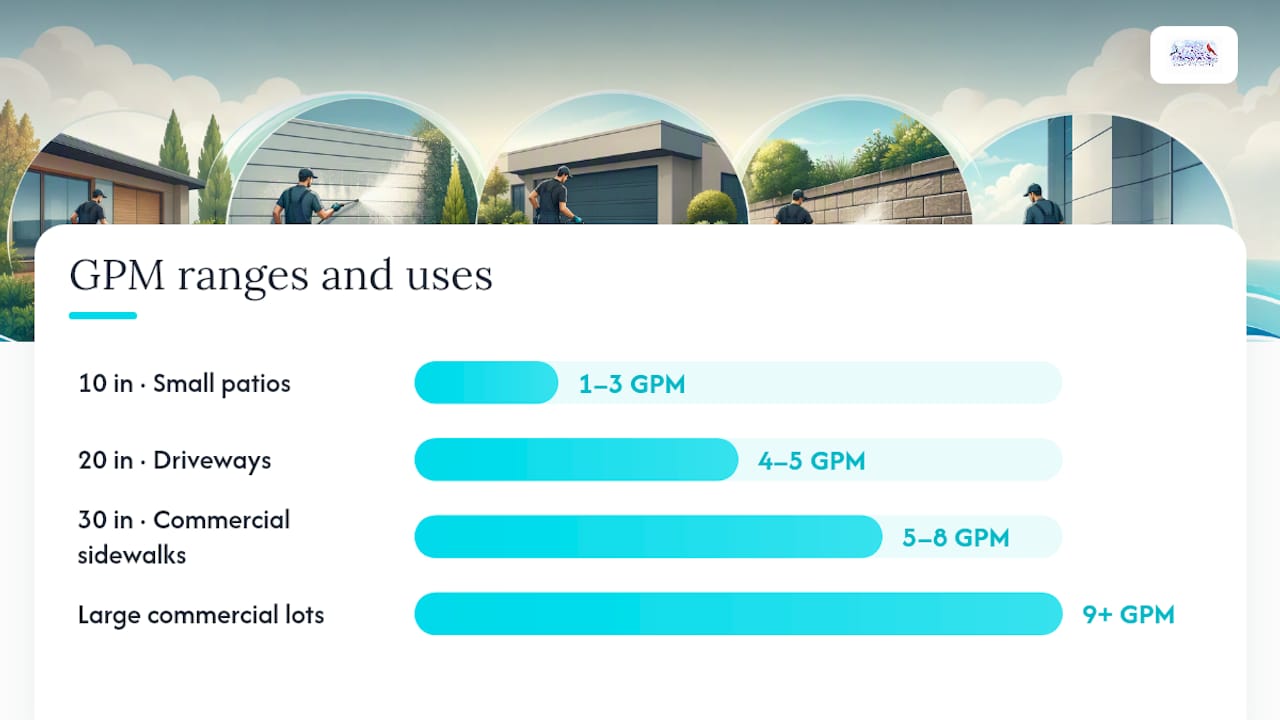
A homeowner with a standard moderate-flow pressure washer is well-matched to a medium-sized surface cleaner for driveway work. A contractor cleaning large commercial lots needs a higher-flow machine with a larger deck to stay productive. Mismatching in either direction creates either inefficiency or premature wear on the spray bar and nozzles.
How to match your equipment: a step-by-step checklist
Getting the right GPM to the surface requires every component in the chain to agree with each other. One weak link drops your real-world performance below what the spec sheet promises.
- Confirm your pump’s rated GPM. Check the pump label or owner’s manual, not just the machine’s marketing spec. Advertised figures can be optimistic; the pump plate is the honest number.
- Verify the engine or motor can sustain that flow at your target PSI. A pump rated for 4 GPM at 3,000 PSI needs an engine with enough horsepower to hold both simultaneously under load.
- Select a surface cleaner deck matched to your GPM. Use the 4–5 inches of deck width per 1 GPM rule as your starting point, then cross-check against manufacturer pairings.
- Choose nozzle orifices sized for your working pressure and flow. Undersized tips restrict flow and overload the pump; oversized tips drop pressure below effective cleaning range.
- Check hose diameter and length. On runs over 50 feet, step up to 1/2-inch hose. Long runs of 3/8-inch hose produce significant pressure drops that reduce delivered GPM at the surface cleaner.
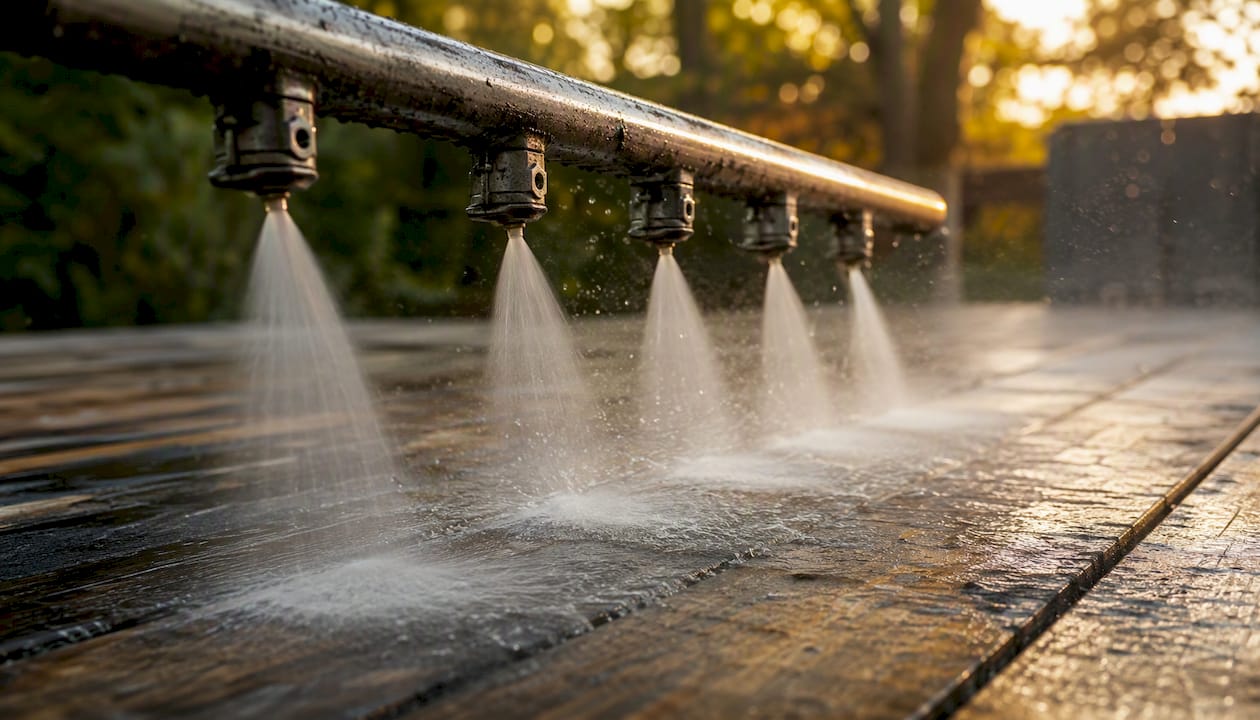
- Inspect the spray bar openings. Forcing high GPM through a spray bar designed for lower flow accelerates wear and reduces cleaning consistency across the deck.
Hot-water systems add one more variable: heated water softens grease and biofilm faster, which can let you drop PSI without sacrificing results. Nozzle selection still follows the same GPM logic, but material compatibility matters more since heat can damage certain coatings and sealers.
What contractors actually see in the field
Operators who run surface cleaners daily are clear about one thing: higher GPM is the biggest single driver of productivity on flat work, but only when the rest of the equipment is sized to match. Pushing 8 GPM through a spray bar built for 4 GPM doesn’t double your speed. It wears out nozzles faster and can actually reduce cleaning quality as pressure distribution across the deck becomes uneven.
Real-world example: a contractor cleaning a commercial parking lot with a 30-inch, 8 GPM surface cleaner covers ground roughly three times faster than a homeowner-grade 4 GPM unit with a 20-inch deck. For a homeowner driveway, that same commercial rig is overkill and harder to control in tight spaces near landscaping or vehicles.
One maintenance note technicians repeat: check nozzles and hose connections every 40–50 hours of use. Worn nozzle orifices enlarge over time, which drops working pressure even when the pump is healthy. A simple nozzle test kit catches this before it costs you a pump rebuild.
- Match deck width to GPM before buying or renting a surface cleaner.
- Inspect nozzles regularly. Worn tips are the most common cause of unexplained pressure loss.
- Use 1/2-inch hose on long runs to preserve delivered flow and pressure.
- For commercial exterior cleaning, hire a pro when the job requires 6+ GPM equipment you don’t own or maintain.
Key Takeaways
Surface GPM determines rinsing volume and cleaning speed; pairing it correctly with PSI, deck width, and hose size is what separates a fast, clean result from a slow, streaky one.
| Point | Details |
|---|---|
| GPM controls rinsing speed | Higher GPM moves debris off the surface faster; PSI breaks it loose first. |
| Use cleaning units to compare machines | Multiply PSI × GPM; a higher product means more cleaning power per pass. |
| Match deck width to GPM | Allow roughly 4–5 inches of cleaner width per 1 GPM of pump output. |
| Hose diameter affects delivered flow | Use 1/2-inch hose on runs over 50 feet to avoid pressure and flow losses. |
| E and R Cleaning Solutions | Brings matched GPM equipment and five-plus years of experience to driveways, lots, and commercial surfaces. |
The GPM detail most homeowners overlook
Most people shopping for a pressure washer fixate on PSI because it’s the bigger number on the box. GPM barely gets a glance. That’s backwards for surface cleaning work.
On flat surfaces, GPM is what determines whether you’re done in 20 minutes or an hour. A 4,000 PSI machine at 2 GPM will blast concrete aggressively but rinse slowly, leaving you making extra passes. A 3,000 PSI machine at 5 GPM covers the same driveway faster and leaves it cleaner because the volume of water is actually flushing the debris away rather than just displacing it.
The other thing worth saying plainly: the cleaning units formula is useful for quick comparisons, but it doesn’t account for nozzle condition, hose losses, or operator technique. A well-maintained 4 GPM setup in the hands of someone who knows how to work a surface cleaner will outperform a neglected 6 GPM rig every time. The spec sheet is a starting point, not a guarantee.
Matched equipment, no guesswork: E and R Cleaning Solutions
Knowing your GPM range is one thing. Showing up with the right equipment, sized correctly for the surface, is another. E and R Cleaning Solutions brings over five years of pressure washing experience to residential driveways, commercial lots, sidewalks, and building exteriors, matching GPM and deck width to each job rather than running one setup on everything.

For surfaces that need careful flow management, like older pavers, painted concrete, or post-tenancy pressure washing between tenancies, getting the GPM wrong causes damage that costs more to fix than the cleaning itself. E and R Cleaning Solutions custom-quotes every job and brings the matched equipment to do it right the first time. Get a quote for your driveway, lot, or commercial property today.
Useful sources
- GPM (Gallons Per Minute) measures the flow rate of water through a pressure washer — FergusonHome
- Choosing a Surface Cleaner — Cleaner Times
- Surface cleaners: insights for power washing — PowerWash.com
- What is GPM in a Pressure Washer? — Active Products Inc.
- Pressure washer surface cleaners — American Pressure Systems
- GPM vs. PSI in Pressure Washers — Alkota
- What Is GPM On A Pressure Washer? — ToolsAdvisers
- Pressure washer buying guide — The Home Depot